Saturday, September 26, 2015

A Dark Mystery.

The Carlton House was a cheap hotel on the corner of Franklin and William Streets in New York City. The basement of the building housed shops and a laundry, and below them was a sub-cellar that served as a repository for ashes and refuse from the hotel and businesses above. In the fall of 1884, the Board of Health received several complaints about the unclean condition of the cellar. After inspecting the premises, the board ordered the owner of the property to remove the heaps of dirt and ashes that had accumulated there. 

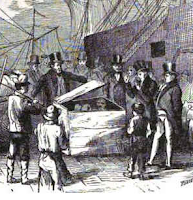
After about a week of hoisting barrels of rubbish up to the street, one of the workmen found what he thought was a slender piece of wood. When he grabbed it and tried to pull it out, he dropped it quickly, with a cry of terror. It was not a piece of wood, but the leg of a woman, dried and shriveled. The workmen removed about six inches of dirt, uncovering the corpse of a young woman who had been dead for more than a year. She was wearing a black cloth sacque, with lace trimmings on the sleeves, a brown cloth dress and muslin underskirt. On her legs were blue and white striped stockings, partially worn away or eaten by mice. The flesh of the body had wasted from the frame which was now little more than a skeleton. 

Saturday, September 19, 2015

Murderous New Jersey.

The state of New Jersey has been the scene of quite a few sensational murders, and it was famous in the nineteenth century for swift prosecution and harsh punishment. All but one of the following murder cases are prime examples of “Jersey Justice.”

A Crime of Passion.

Joel Clough fell madly in love with his landlady’s daughter, Mary Hamilton. She did not return his love, and in 1833 his passion drove him to stab her eleven times in the chest.


Antoine Le Blanc.

Hatred of Antoine Le Blanc, murderer of the Sayre family, was so strong in New Jersey that after a speedy trial and execution his body was used for bizarre experiments and his skin tanned and made into wallets.

Saturday, September 12, 2015

The Charcoal Pit Tragedy.

Little Murders
North Madison, Connecticut, was rural and sparsely populated in the 1880s. The land was rough and rocky and the soil hard to cultivate; charcoal manufacturing was the chief occupation of people living there. Among those eking out a living, farming and making charcoal in North Madison, was the Johnson family. The parents long dead, two brothers and two sisters lived together in a long low white house about a mile from the turnpike.  Though all were verging on, or well past, forty years of age none had ever married. The sisters kept house, while the older brother, Edgar worked the farm, and the younger brother Eldridge tended a charcoal pit, down the hill about 40 rods from the house. 

Charcoal pits require frequent monitoring, and Eldridge Johnson would often spend the night in a small shack built next to the pit. The night of December 2, Eldridge left the house at 10:00 bound for the pit, but when he did not return for breakfast the next morning the family became concerned. Edgar went down to the pit and found his brother stretched out on the smoldering, sod-covered heap of charcoal. His skull had been fractured, his body was bruised and his lower limbs badly burned. The ground around the pit showed signs of a struggle. Eldridge’s axe and lantern were missing along with $41 he was known to have had in his pocket.

Saturday, September 5, 2015

The Hamilton Murder.

Little Murders
(From Cincinnati Daily Gazette , Cincinnati, Ohio, December 27, 1870)


The Hamilton Murder.
 A Most Mysterious Tragedy.
Special Dispatch to the Cincinnati Gazette.
 Hamilton, O. December 26.
The murder of Thomas Meyers, in George Johnson’s saloon, in this city last Saturday night, is almost the only topic of conversation here now. The circumstances of the tragedy are so very peculiar that no one knows exactly what to make of it. The murder occurred in a room over the saloon used as a faro bank, but in which were also several card tables, employed at times by those who wished to enjoy a quiet game of cards for amusement.

In this room, where the affair occurred, were gathered several of our prominent citizens among whom were Co. A. C. Sands, Job E. Owens, Dr. Huber, Peter Schwab, David E. Brown, John McKinney, E. Bannister, J. C. Lindley, Samuel Davidson, Solomon Schurz. Colonel Sands says, however, that hi had left the room before the shooting occurred, although he was there but a short time before. Of all those who were present, no one but Peter Schwab can give an intelligent account of what happened, and his statement is singularly deficient in some important particulars.

He says that he and Dr. Huber were playing casino at one of the tables. Colonel Sands and three others were playing seven-up at another, while Meyers and a number of others were engaged at the faro bank, George Johnson, the proprietor, dealing the same.

Of a sudden he heard the cry, “Oh, murder,” and looking up saw Meyers fall against the wall and sink toward the floor. As he slipped from his seat he discharged a revolver, the bullet lodging in the wall over the faro table. As he reached the floor he fired again, the ball being imbedded in the wash board just above the floor. At the cry of “murder” the room was cleared in a jiffy, only Schwab and Bannister remaining. Seeing that Meyers was badly hurt, Schwab ran out upon the street, captured Dr. Huber and brought him back, who examined Meyers’ condition. He found that Meyers had received a pistol shot in the abdomen which had severed an important artery, and death ensued in a few minute. In addition to this wound he had received three blows upon the head, evidently made by a slung-shot, either of which would have proved fatal.

Now, what is particularly curious about the affair is that no one saw the man enter and deliver the blows upon Meyers’ head and no one heard the report of the pistol when he was shot. The first circumstance which attracted attention was the cry or “Oh, murder.” Of course, under these circumstances, it is very difficult to fix upon any one as the perpetrator of the deed. Suspicion rests, however upon Tom McGehen, a man who has had a deadly quarrel with Meyers for some time past. A boy stated that, shortly before the occurrence, he saw Tom McGehen, his nephew, James McGehen, Jack Gavin, Daniel McGlynn and Ich Sheely pass through the saloon below, and go to the card room. Upon this statement a warrant was sworn out or the arrest of these parties. This morning, however before the warrant was served, they learned that it had been issued, and voluntarily surrendered themselves to esquire Wilkins. Upon representations made by the defenders that the presence of witnesses from abroad was necessary to their defense, they were placed in charge of a constable and sent to the Hamilton House to be kept until Wednesday morning when the preliminary examination will take place.


"The Hamilton Murder." Cincinnati Daily Gazette 27 Dec 1870.


Saturday, August 29, 2015

The Guttenberg Murder.


On May 3, 1881, Mena Muller and Louis Kettler took the ferry from New York City to Hoboken, New Jersey. They were going to be married in Hoboken, although they each had a spouse already. The legality of the marriage did not concern them; they were returning to Germany and would start a new life there. But somehow their plans went awry; that night Louis Kettler returned to New York alone and ten days later Mena Muller’s body was found in New Jersey with a fractured skull.

Saturday, August 22, 2015

Katie Hood's Fate.

Little Murders
Sixteen-year-old Katie Hood left the house the evening of Saturday, September 21, 1889 and never returned. She worked at Mike Schoenig’s saloon in Connersville, Indiana, and resided with her employer’s family. Katie was known to be somewhat wild, and at one point, Schoenig fired her and sent her from his home for staying out until two or three in the morning. On her promise to do better, Schoenig rehired Katie, and up until the night of her disappearance she appeared to have reformed.

Katie Hood’s reputation as a fast girl fueled speculation in Connersville that she had met with foul play. Some believed she had simply skipped town, but all she had with her were the clothes on her back, and most thought she was being held somewhere against her will. A rumor circulated that Katie had become an inmate of a brothel in the South End of Connersville, and on the night of September 27, a posse of men raided the house, sending the customers running in all directions. Reportedly, one respectable citizen jumped out of a window to avoid exposure. But when the dust settled, Katie Hood was not in the house.

Saturday, August 15, 2015

Trunks, Crates, and Barrels.

Disposing of the body without being captured has always been a post-mortem problem for a murderer, but in the nineteenth century there always seemed to be a large receptacle handy—steamer trunks, shipping crates, and wooden barrels have all been used to a killer’s advantage. With a little body modification, a barrel can be used as a makeshift coffin or to float a body downriver. A large trunk can conceal a body while transporting it to a dumping spot or hide it long enough for a killer’s escape. The most creative method was to crate the body and ship it to a city far away. It is not known how many times this mode succeeded, but it failed enough times to demonstrate its popularity.

The Corpse in the Shipping Crate
John C. Colt put the body of Samuel Adams in shipping crate and sent it to New Orleans c/o General Delivery. If the ship had left on schedule, his plan may have worked.
The Great Trunk Mystery
A trunk bound for Chicago by train was found to contain the body of Alice Bowlsby, put there by abortionist Jacob Rosenzweig.
The Boston Barrel Tragedy
The dismembered body of Abijah Ellis was found stuffed inside two barrels floating down the Charles River. The killer’s identity was never known for certain.

Saturday, August 8, 2015

The Mystery of Zora Burns.


Zora Burns
Missouri Burns, better known as Zora, was nineteen years old when she left her father's home in St. Elmo, Illinois, to work as a domestic for the family of Orrin A. Carpenter, the richest man in Lincoln, Illinois. Carpenter was a grain dealer who owned a huge grain elevator as well as a farm and other real estate in Logan County. He was fifty years old with a wife and two daughters.

In newspaper reports, Zora Burns was described as a beautiful and captivating young woman: “Abundant hair of yellow-golden tint clustered about features as perfectly regular as those which Phidias chiseled from the marble of Greece. Her form was grace and symmetry personified, and despite her lack of educational advantages, her natural tact and quickness of intellect atoned in great measure for her deficiencies.” It is not surprising that Mr. Carpenter soon became infatuated with his young servant.
 

Monday, August 3, 2015

IAN Book of the Year Finalist.

I am proud to announce that my book, The Bloody Century, has been selected as a finalist in the

2015 Independent Author Network Book of the Year Awards.

Winners to be announced later this month.


Saturday, August 1, 2015

The New Hampshire Horror.


After his wife left him in November, 1883, Thomas Samon began a weekend of drunken debauchery in Laconia, New Hampshire, with Jane Ford, the wife of his landlord. But when the beer ran out Saturday morning, events turned unexpectedly violent, ending in a horrible triple murder

Saturday, July 25, 2015

Concerning Popular Sympathy.

In January 1892, Carlyle W. Harris was convicted of murdering his wife, nineteen-year-old, Helen Potts Harris. It was a particularly ugly story—Harris had bragged about his amorous conquests, saying he had gone so far as to marry a girl to get her into bed, then dump her later. This appeared to be the case with his marriage to Helen Potts; they eloped, kept the marriage a secret, and at his insistence they used assumed names at the ceremony. When Helen’s mother found out and demanded they make the marriage public, Harris decided to murder Helen instead. In spite of an elaborate plot to make the death appear to be accidental poisoning, Harris was convicted and sentenced to the electric chair. The whole story can be found here: The Six Capsules.

Saturday, July 18, 2015

The Briggs House Murder.

Little Murders

On December 7, 1883, Sadie Reigh went into the dining room of the Briggs House, one of Chicago’s finest hotels, and fired four shots from a revolver, in rapid succession, at Head Waiter Patrick Kinsley. Sadie fled the hotel but was apprehended quickly. Two of her shots had hit their mark; Kinsley died the following day and Sadie Reigh was charged with murder. 

Saturday, July 11, 2015

Recent Homicides—The Murder Mania.

(From New York Herald, January 28, 1872)


Recent Homicides—
The Murder Mania.
The community is at present in the midst of a series of shocking murders which seem at undefined intervals to sweep over the face of our civilization, darkening it with a tinge of blood. Homicide appears for a while to be epidemic, and men talk gallows philosophy with a tinge of ferocity in sentiment which indicates all the more how the blood-spilling mania seizes mankind in some form or other, whether under the form of murder or killing for murder. Two days ago a wretch named Botts expiated the shooting of “Pet” Halsted, in Newark—moving cause jealousy. In California, Mrs. Fair, is under sentence for killing a man who was about to return to a long-neglected, much-injured wife; jealousy the cause here, too. Stokes killed Fisk—cause, jealousy indirectly; not Stokes’ but Fisk’s jealousy. Two days ago within the very hour that the murderer Botts was hurried out of the world, a girl of eighteen—a Mrs. Hyde—shot her seducer dead. Yesterday in front of St. Mary’s Roman Catholic Church, a German, named Henry Hepner, deliberately shot and killed his own son, and afterwards attempted suicide. And so the cases move out into ghastly prominence, with some hellish distortion of the divine passion, love, at their root. If gallows medicine is the only specific for this epidemic of murder, why is it so rarely administered? At the time that the crimes surge in upon society each murderer and murderess is hanged in imagination, and there only. When homicide fever passes away for a while the murder virus seems to leave the public mind too, and the criminal is forgotten with the crime. The jealous murders, or those founded on sentiment, no matter how morbid, flabby or maudlin, always find their apologists among decent people, who never saw the gashed, riddled or jellied corpse of the victim. These people illustrate the mania by applause of the murder.

The theory of a murder mania is true also of the more brutal classes of crime, such as the car-hook murder, or those that arise out of vulgar brawls in the dens of vice. Awakening unanimous condemnation at the time, they pass into oblivion, and the example idea of the law is frustrated. While in most of the murders which come to light the slayer is found at once or clearly traceable on account of the incidents of passion which were part of the murdered being’s lie, there is the class of murder which is the accompaniment of robbery. The failure to trace this class of criminal is a notorious and deplorable commentary on the efficiency of the police, whose sensibilities alone appear to be in no way quickened by the sudden increase of crime. The Rogers and Nathan murders are as much wrapped in mystery now as at the time of their committal, and the murder of the unfortunate Professor Panormo, a couple of nights ago, seems as if about to be sent to keep company with the other two mockeries of our system of detection of crime, as they all three shake our belief in the police as a protective or preventive force. There must be no effort spared to bring the assassins of Panormo to justice; but the ignorance; sloth and blundering of the Brooklyn police give us little hope of the result. As in the Rosenzweig case, some of the most important links in the chain of evidence have already been worked up by the press writers, and if so-called detectives will only follow the trail public vengeance may yet be satisfied.


"Recent Homicides-the Murder Mania." New York Herald 28 Jan 1872.


Saturday, July 4, 2015

The Silver Lake Mystery.


The discovery of a woman’s body in a barrel, buried in a ravine near Silver Lake, on Staten Island, New York in 1875 began a frantic investigation to determine who she was and how she had died. With three false identifications and at least a dozen other missing girls as candidates for the body in the barrel, it seemed as if the Silver Lake mystery would never be solved. She turned out to be Mrs. Mary Ann Reinhardt, married to a Staten Island candy store owner who decided to take a new wife and dispose of the old one. 

Saturday, June 20, 2015

Portraits of the Nicely Brothers.

After a recent post about the Nicely Brothers, who were hanged for the coldblooded murder of Herman Umberger in Jennerstown, Pennsylvania in 1889, I was contacted by Rick Carbone who told me he had some old photographs of the Nicelys. Rick was kind enough to share these portraits of Josiah G. “Joseph” Nicely and David C. Nicely:
Josiah G. “Joseph” Nicely
David C. Nicely
It was common at the time, to sell photographs, mounted on card stock, as souvenirs of sensational murders. These portraits were produced in Indiana, Pennsylvania, near the site of the Umberger murder. They were obviously the models for the drawings below, published in the Somerset Herald at the time of the hangings - it is interesting to note that the artist did not exaggerate Joe’s mustache.


More on the Nicelys here: The Nicely Brothers.
More on murder portraits here: Souvenirs of Murder.

Saturday, June 13, 2015

Lottie Volner and Jack Tinker.

Little Murders

The Murder of Lottie Volner
George and Lottie Volner ran a bakery and restaurant together in Rockville, Indiana, until one day in 1883, a customer named Charles Rutledge got a little too familiar with Lottie and George took him to the back room for a beating, Rutledge drew a revolver and shot him dead. After that, Lottie Volner ran the place alone.

Mrs. Volner hired a man named John C. Henning, also known as “Jack Tinker” to help tend to the place, allowing him to sleep in the barn. Soon he was sleeping in the house, and in October 1885, he asked her to marry him. The newspapers variously described Henning as “a trifling worthless fellow,” “a drunkard, considered insane,” and “among the lowest grade of deadbeats.” In spite of all that, Lottie Volner agreed to marry him and Henning obtained a marriage license.

But Lottie had another, unnamed, suitor who persuaded not to marry Henning. On October 24, Henning went to see Lottie and found her sewing with her friend, Miss Oliver. What happened next is unclear, either Henning asked Lottie again to marry him and she laughed in his face, or he told her to go upstairs and get him a bucket of beer and she told him to get it himself. In either case, an incensed Henning pulled out his revolver and started firing wildly. One shot hit Miss Oliver in the foot, another three went into Lottie. Henning fled the restaurant and Lottie Volner died a few minutes later.

The news spread quickly through Rockville and soon an angry mob was searching for Henning. When they found him hiding in a clump of weeds behind the restaurant, there were calls to hang him on the spot, but cooler heads prevailed and Henning was taken to jail. John Henning was tried and found guilty, and the mob got their hanging, under color of law, on May 27, 1886.

Sources:

"A Tough Choice." The National Police Gazette 14 Nov 1885.
"An Indiana Hanging." Dallas Morning News 28 May 1886.
"Cold-Blooded Murder by a Disappointed Lover." Cincinnati Commercial Tribune 26 Oct 1885.
"Shocking Crime at Rockville." Saginaw News 28 Oct 1885.
"Shot By Her Paramour." Plain Dealer 27 Oct 1885.
"Will Hang." Cincinnati Commercial Tribune 6 Feb 1886.

Saturday, June 6, 2015

The Murder of Pet Halsted.


Oliver "Pet" Halsted
Oliver Spencer Halsted Jr., better known as Pet, was a political gadfly in the Lincoln administration. Coming from a prominent family of New Jersey politicians, Pet Halsted was a political insider, both in Washington and back home in Newark. Like so many in his profession, Pet Halsted was also a man of unbridled lust and in 1871 he became romantically involved with one of his legal clients. His rival for her affections, a charcoal peddler, was not impressed by Pet’s credentials and was ready to fight to the death for his lady.

Saturday, May 30, 2015

Murderous Massachusetts.


Massachusetts, settled by Puritans, has long considered itself a model of morality and civilized behavior. But in spite of its lofty posturing, the Commonwealth of Massachusetts was the scene of a surprising number of gruesome and sensational murders in the nineteenth century. Here is a chronological list:


Captain Joseph White-A Most Extraordinary Case

In 1830, John and Joseph Knapp hired Richard Crowninshield to murder their great uncle Capt. Joseph White. They very nearly got away with their scheme, but the great Daniel Webster secured their convictions.

The Sleepwalking Defense

In 1845, Maria Bickford was found in murdered in her room, her throat cut from ear to ear. Albert Tirrell, charged with the crime pled not-guilty because he had been sleepwalking at the time.

Dr. George Parkman - "The Pedestrian"

Harvard professor, John Webster, murdered and dismembered his creditor, George Parkman, in 1849, shocking the residents of Boston and fascinating newspaper readers across Ameri

Saturday, May 23, 2015

Avenging Her Honor.


Stephen L. Pettus stepped off the Fulton ferry boat from Brooklyn, the morning of November 22, 1889, and was walking up Fulton Street when he was accosted by a nervously distraught woman. The two had angry words, then he brushed her aside and continued walking. Without hesitation, the woman raised a revolver and fired five shots into Pettus’s back, killing him instantly. She was standing near the body when a police officer arrived.

“Did you do that?” he asked her.

“Yes,” she replied, “he had ruined me and dishonored my family."

Saturday, May 16, 2015

The Northwood Murderer.


Franklin B. Evans
When senseless a murder occurred with no obvious suspects, a community’s worst fear was that some transient had drifted into town, done his dirty work and left without a trace. The roads of rural America, in the ninetieth century, were filled with tramps; some were honest men looking for work in hard economic times, others were aimless ne’er-do-wells, running from or heading toward trouble. When these men turned to murder they were likely to get away without capture and were prone to kill again. But every now and then a wandering killer was caught and his whole bloody itinerary made public. Such was the case of Franklin B. Evans, known as the Northwood Murderer.