This week we have a guest post from Donna Wells, a former employee of the Boston Police Department who made a rare discovery—a previously unknown photograph of “The Boston Boy Fiend,” Jesse Pomeroy.
Discovery of Previously Unknown Photograph of America’s Youngest Serial Killer, Jesse Pomeroy
I have a very strange story to tell you. I call it my strange little serial killer story… My name is Donna Wells. I graduated in 1997 from Simmons College in Boston with a master’s degree in library and information science. Several months later, I accepted a position with the Boston Police Department as their first records manager and archivist. I was tasked with establishing and managing the Department’s records management program and also with the day-to-day running of the Department’s records center and archives. I served in this position until 2007 when I took early retirement due to health and personal reasons.
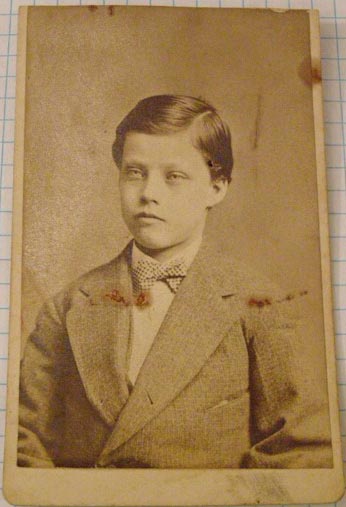 |
| Jesse Pomeroy Carte de Visite |
During the time that I was with the Department, I read everything I could get my hands on regarding the history of the Department and Boston crimes.
I now live in Central Maine with my husband. I am disabled, but I buy jewelry, buttons, and other items at auctions, flea markets, and thrift stores and sell them on eBay.
One day, some time ago, I grabbed a tin of buttons from the shelf and took it downstairs to sort. I opened the tin and, lying on top of the buttons, was an old envelope, all folded up. There was nothing written on the envelope, so I opened it and inside there was an old photograph (a carte de visite) of a young boy. He was kind of creepy looking because the irises of his eyes appeared to be without color – they were a dead white. I put the photograph aside and continued with the buttons. Over the next several days, I was drawn back to the photograph over and over again. It just seemed like I should know who this was – that I had seen a similar image somewhere. And there was something tickling my brain, something about a white eye.
As I was looking at the picture one day, it just came to me about a book that told the story of a young Boston serial killer that I had read when I was with the Department about a young man who had committed some truly horrifying acts—about a young man who had at least one white eye— I couldn’t remember the name of the book or his name, but I googled “Boston serial killer 1800s,” and Jesse Pomeroy came at the top of the list.
When fourteen-year-old Jesse Pomeroy was arrested in 1874 for the murder of Horace Millen, he was thought to have tortured at least six children and tortured and murdered two more. The two murder victims, ten-year-old Katie Curran and four-year-old Horace Millen had both been stabbed and nearly decapitated. Katie also had a fractured skull and several broken bones. Horace had also been nearly castrated, had one eyeball deeply pierced, and been set on fire. The victims that had managed to survive his attacks had suffered whippings, stabbings, beatings, which included broken noses and split lips, vicious bites to the face and buttocks, attempted castration, and attempted scalping. At the time of his arrest for Horace Millen’s murder, Jesse’s reputation in Boston as the “Boy Torturer” was firmly established.
In the course of my research, I found out that the title and author of the book I had read was Fiend: The Shocking True Story of America’s Youngest Serial Killer by Harold Schechter. I no longer possessed a copy of the Schechter book because I had donated it to the BPD Records Center & Archives. I know my successor at the archives, Margaret Sullivan, so I called her and told her my story. I sent her a scan of the image that I had found and asked her to compare it with the drawing in the book. Margaret thought that the image could be Jesse. She pointed me to some resources, and I dove back into the internet.
On the back of my photograph, there is a partial photographer’s name. The last name is Dunshee, and there is an address given as 323 Washington Street, Boston. There is also what I assume is the date of the print – 1875 in the lower left corner. There is a very useful database online that lists Boston’s photographers and provides the dates that they would have been at a particular address. The approximate dates that this database gives for when E.S. Dunshee was at the address on the back of my photo are 1873-1874.
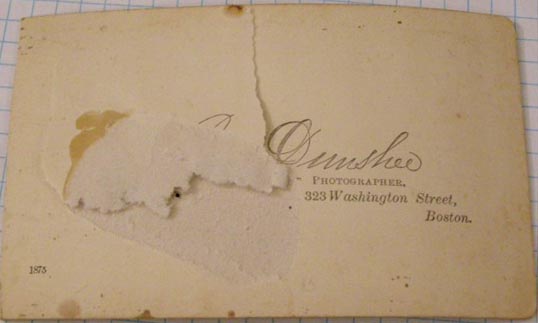 |
| Back |
I had ordered another copy of the Schechter book and had read it again to see if I could find anything that would help me to authenticate the photograph. On page 92, I found a quote from a journalist from the Boston Herald:
“He does not look like a youth actuated by the spirit of a fiend, and, with the exception of a peculiarity about the eyes, he has no marked expression in his face from which one might read the spirit within. The idea that he is insane is not supported, except by the extraordinary character of his conduct.”
Contrary to what many reporters of the time of the murders claimed, the image in my photograph does not show a wild-eyed lunatic, neither is there any indication of the monster that he could become, but shows a seemingly normal, although sad and confused, boy with, admittedly, very strange eyes. Looking at my photograph, I am forced to speculate that Jesse’s very normality made it possible for him to succeed in deceiving and assaulting his victims. I mean, if he truly looked like a monster, he would not have been able to get close to his victims.
In my photograph, there does not seem to be any great differences in the visible portions of his actual eyeballs, however, because the photograph is black and white, any differences of color between his irises would not be obvious. I have examined the image under magnification, and the only difference that I can detect is a slightly more “flattish” look to the iris of his right eye. There are, however, several much more obvious external differences – his right eye is more slanted and smaller than his left. Also, there is a dark area around his right eye. It appears to be a bruise of some kind, but whatever it was, it was permanent because it remains in all of the future photographs of Jesse. In later photographs, he does appear to have developed some kind of clouding of his right eye, but in my early photograph, that is not evident.
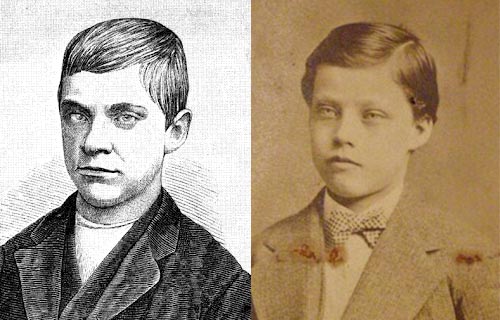 |
| 1870s Drawing -- Found Photograph |
There are some pretty striking similarities between my photograph and the drawing of Jesse that is reproduced in the Schechter book. The pose is the same. The hairstyles are identical. The costume is similar. I speculate that the artist who created the drawing might have depicted Jesse in a collar-less shirt without the bowtie of my image because he didn’t want Jesse to look too “normal.” The features, especially the shape of the ears, jaw, and nose, are alike. The eyes are very similar, except the artist had drawn Jesse’s right eye as clouded. Perhaps Jesse’s right eye had become clouded by the time that the artist drew his portrait. However, I believe that it is an inescapable conclusion that the drawing was based on another copy of my photograph. The photograph of Jesse in 1920 that is in the Schechter book is probably the best to compare with the earlier photograph. Following is the text of an email from Harold Schechter in response to my email to him:
Dear Donna--
My agent forwarded your email to me.
After closely studying your photograph, I think you may, in fact, have found an early portrait of Jesse Pomeroy. I base that conclusion by comparing it not only to the newspaper engraving of the adolescent Pomeroy reproduced in my book but on the photograph of the elder Jesse that served as the frontispiece of his 1920 book of poems, which I've attached. Take a close look at the right eye in both your photo and the later one: they are virtually identical--weirdly shaped, slightly slanted, distinctly different from the left, and surrounded by a strange dark shadow as if he had a permanent shiner.
It's an exciting find, and I would certainly consider writing it up and trying to get it published somewhere. Thanks for sharing it with me, and let me know if I can be of further help. Best, Harold S.
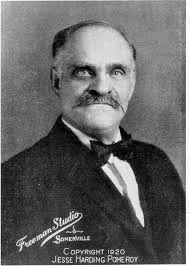 |
| Jesse Pomeroy, 1920 |
I hired Maureen Taylor, a nationally-known historical photograph expert, to assess the photograph. I told her my story and emailed her high-resolution images of the photograph. She replied, saying that it was “an 1870s image of a man in a pretty typical suit for the period [and that] the card stock used agrees with that time period.“ She added that it was “an incredible random find [and] an astonishing discovery!”
I am still, even now, pretty freaked out about the fact that this photograph, a previously unknown photograph and the only known photograph of Jesse during the period in which he was active, ended up in my buttons, given the fact that I am probably one of the few people who might be able to recognize the subject.
Donna Wells can be reached at TonyMay2021@gmail.com for questions and comments.


.jpg)


