Saturday, November 28, 2015

Murdered in Court.

Little Murders


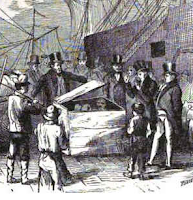
A bitter rivalry between two Ashland, Ohio newspapers turned bloody in a Cleveland courtroom on October 30, 1887. The details of the lawsuit have been overshadowed by subsequent events in the courtroom, but C. D. Mason, the editor of the Ashland Gazette, was the plaintiff in a suit to recover $52.50 from Elias Lutz on a note transferred to him from his brother James Mason. Representing Mr. Lutz was attorney W. H. Reynolds, who was also the editor of the Ashland Times. In a separate case, the Mason brothers were suing Reynolds for libel over an article in his paper characterizing the note transaction as a swindle.

The tension in the room was palpable when James Mason took the witness stand. As he spoke, W. H. Reynolds made irritating remarks regarding his testimony. D. C. Mason soon had enough of Reynolds’s comments; he stood up and struck Reynolds with a chair. Reynolds, who was lame, stood up as well, and supporting himself on a chair, began to strike D. C. Mason with his cane. James Mason came to his brother’s defense from the witness stand, by pulling out his .38 caliber revolver and firing two fatal shots into W. H. Reynolds. Spectators who were supporting Reynolds called for the lynching of James Mason, but cooler heads prevailed and with some difficulty, both Mason brothers were protected.

Saturday, November 21, 2015

Recent Acquisitions.

Here are some murder related cartes de visite I recently acquired. They were produced at the time of the murders and sold as souvenirs.


Jennie Cramer
Poisoned in Connecticut, 1881.
Jim Fisk
Shot in New York City, 1872
Josie Mansfield
Jim Fisk's mistress
& cause of his downfall.


Josie Langmaid
Beaten and Decapitated in
New Hampshire, 1875
Moses Sargent
Private Detective
active in the Langmaid Case
& Other N. H. murders.

Saturday, November 7, 2015

Little Mary Mohrman.


In 1868, Mrs. Mohrman, a widowed mother, lived with her five daughters, on Orkney Street in Philadelphia. The youngest girl, Mary, was a favorite of everyone in the neighborhood. “Little Mary Mohrman,” as she was known by all, was described as “one of those sunny-haired, bright-eyed, sylvan-like children, whose innocence, one would think, could soften the hardest soul.” This sentiment would be tested and proven horribly false.

Saturday, October 31, 2015

The Devil in Essex County.

In honor of Halloween, I am switching, this week, from nineteenth century murder to seventeenth century witchcraft. Everyone knows of the mass hysteria surrounding the Salem witch trials in 1692, but as this excerpt from my book, Murder and Mayhem in Essex County, points out, fear of witchcraft, in Massachusetts, did not begin or end with the witch trials, and accusations of demonic possession spread far beyond the borders of Salem.


The Devil in Essex County.

    Without a doubt the most nefarious events ever to take place in Essex County, Massachusetts, were the trials and executions of twenty women and men, and the imprisonment of dozens more, between 1692 and 1693, for practicing witchcraft. The witch trials in Salem have become synonymous with mass hysteria and injustice, and have left an indelible stain on the reputation of Salem, Massachusetts. The notion of accusing and punishing witches has become so tightly bound to Salem as to leave the impression that it was an isolated incident, a brief moment of insanity limited to that place and time, ending as suddenly as it began.  In fact, accusations of witchcraft had a long history in Essex County, which neither began nor ended in Salem.

Saturday, October 24, 2015

Murder in McDowell.

Little Murders


Stephen Effler
On January 6, 1881, a traveler named Sowers stopped at the home of Stephen Effler and his wife and was invited to stay for supper. The Efflers lived near McDowell, North Carolina, in a wild gorge in the Blue Ridge Mountains, so remote that no wheeled vehicle could pass within a mile. During the meal, Effler and his wife, got into a terrible argument and she told him she planned to leave him and return to her mother the following day. By the time Sowers left, the fighting had ceased, and Mrs. Effler seemed to be in good health.

Some time later Effler went to his grandfather’s house and told him that his wife was very ill. His grandfather alerted the neighbors, and they went to see how Mrs. Effler was doing. “Very ill” was an understatement, they found Mrs. Effler lying dead with her three-month-old baby sleeping on her breast. Her neck had been broken, her right shoulder dislocated, and she had wounds and bruises all over her body. Effler was arrested, and a coroner’s jury summoned. Their conclusion was “that the deceased came to her from wounds inflicted by some weapon in the hands of her husband.”

Saturday, October 17, 2015

An Ancient Mystery Solved.

Little Murders
(From New York Tribune, November 29, 1883)


An Ancient Mystery Solved.
 The Perpetrator of One Murder, Which Led to Four Others, Discovered.

Seymour, Ind., Nov. 28. – An old murder mystery, resulting in four other tragedies, has just been cleared up. Moore Woodmansee, a wealthy merchant of Medora, nineteen miles from here, came to Seymour, January 3, 1866, on his way to Cincinnati. He had $2,000 with which to purchase goods. He was missed from his room at the Roder House, and the cause of his disappearance was a mystery until October, when his body was found in White River, with the head cut off. Gordon Kinney, an employee of the hotel, was suspected of the crime. When the excitement caused by the finding of the body was at its highest, an unknown man called Kinney from his door one night; as the latter opened the door he was shot and instantly killed.

In 1872 Reuben Wheeler was mortally wounded. When told he had to die, Wheeler made a confession, saying that on the night of Woodmansee’s murder two men had taken from the Roder stable the horse and spring-wagon. In the morning they returned. The bottom of the wagon was covered with blood. It was afterward taken out and new boards substituted. Roder was arrested for the murder, but acquitted; and again the affair was a dark mystery.

Saturday, October 10, 2015

Unrequited Love.

Little Murders

Andrew J. Gillen
When he was a young law student, Andrew J. Gillen was mentored by Michael Sigerson, Assistant Corporation Lawyer for New York City. Gillen was a troubled youth whose family had disowned him over his “habits of dissipation,” and appreciated Sigerson’s help and hospitality. He would often visit Sigerson’s home on Lewis Street, where he lived with his widowed mother, his brother John and his sister Mary.

The mentoring continued for several years and over that time Gillen fell in love with Mary Sigerson. She was thirty-years-old, brunette, short and somewhat stout, quiet and reserved, educated as a teacher, but did not feel robust enough to follow that occupation. Though she was described as “not particularly handsome,” Gillen was infatuated with Mary and, after passing the bar, he continued to visit the Sigerson home to see her.

Andrew Gillen was a fine looking young man with light hair and blue eyes, but he was only twenty-three and Mary did not take his advances seriously. Undeterred, Gillen persisted until his conduct became too annoying to tolerate. Mary and her mother requested that he cease his visits.

Devastated, Gillen sent Mary a note, appealing for an opportunity to win her affections. Mary sent a note back, agreeing to see him once more. She told her mother that she would dismiss Gillen after a few minutes. When he arrived, he was allowed into the family sitting-room on the second floor, and Mrs. Sigerson went in and out of the room several times, to make her presence known.

Saturday, October 3, 2015

The North Carolina Tragedy.


The Reverend George Washington Carawan, prominent and powerful North Carolina Baptist minister was a man of violent temper and strong animal passions, more apt to inspire terror than piety in those around him. The sorrows he begat in his relationships would follow him to the courtroom for the last savage act in Carawan’s tragedy.

Saturday, September 26, 2015

A Dark Mystery.

The Carlton House was a cheap hotel on the corner of Franklin and William Streets in New York City. The basement of the building housed shops and a laundry, and below them was a sub-cellar that served as a repository for ashes and refuse from the hotel and businesses above. In the fall of 1884, the Board of Health received several complaints about the unclean condition of the cellar. After inspecting the premises, the board ordered the owner of the property to remove the heaps of dirt and ashes that had accumulated there. 

After about a week of hoisting barrels of rubbish up to the street, one of the workmen found what he thought was a slender piece of wood. When he grabbed it and tried to pull it out, he dropped it quickly, with a cry of terror. It was not a piece of wood, but the leg of a woman, dried and shriveled. The workmen removed about six inches of dirt, uncovering the corpse of a young woman who had been dead for more than a year. She was wearing a black cloth sacque, with lace trimmings on the sleeves, a brown cloth dress and muslin underskirt. On her legs were blue and white striped stockings, partially worn away or eaten by mice. The flesh of the body had wasted from the frame which was now little more than a skeleton. 

Saturday, September 19, 2015

Murderous New Jersey.

The state of New Jersey has been the scene of quite a few sensational murders, and it was famous in the nineteenth century for swift prosecution and harsh punishment. All but one of the following murder cases are prime examples of “Jersey Justice.”

A Crime of Passion.

Joel Clough fell madly in love with his landlady’s daughter, Mary Hamilton. She did not return his love, and in 1833 his passion drove him to stab her eleven times in the chest.


Antoine Le Blanc.

Hatred of Antoine Le Blanc, murderer of the Sayre family, was so strong in New Jersey that after a speedy trial and execution his body was used for bizarre experiments and his skin tanned and made into wallets.

Saturday, September 12, 2015

The Charcoal Pit Tragedy.

Little Murders
North Madison, Connecticut, was rural and sparsely populated in the 1880s. The land was rough and rocky and the soil hard to cultivate; charcoal manufacturing was the chief occupation of people living there. Among those eking out a living, farming and making charcoal in North Madison, was the Johnson family. The parents long dead, two brothers and two sisters lived together in a long low white house about a mile from the turnpike.  Though all were verging on, or well past, forty years of age none had ever married. The sisters kept house, while the older brother, Edgar worked the farm, and the younger brother Eldridge tended a charcoal pit, down the hill about 40 rods from the house. 

Charcoal pits require frequent monitoring, and Eldridge Johnson would often spend the night in a small shack built next to the pit. The night of December 2, Eldridge left the house at 10:00 bound for the pit, but when he did not return for breakfast the next morning the family became concerned. Edgar went down to the pit and found his brother stretched out on the smoldering, sod-covered heap of charcoal. His skull had been fractured, his body was bruised and his lower limbs badly burned. The ground around the pit showed signs of a struggle. Eldridge’s axe and lantern were missing along with $41 he was known to have had in his pocket.

Saturday, September 5, 2015

The Hamilton Murder.

Little Murders
(From Cincinnati Daily Gazette , Cincinnati, Ohio, December 27, 1870)


The Hamilton Murder.
 A Most Mysterious Tragedy.
Special Dispatch to the Cincinnati Gazette.
 Hamilton, O. December 26.
The murder of Thomas Meyers, in George Johnson’s saloon, in this city last Saturday night, is almost the only topic of conversation here now. The circumstances of the tragedy are so very peculiar that no one knows exactly what to make of it. The murder occurred in a room over the saloon used as a faro bank, but in which were also several card tables, employed at times by those who wished to enjoy a quiet game of cards for amusement.

In this room, where the affair occurred, were gathered several of our prominent citizens among whom were Co. A. C. Sands, Job E. Owens, Dr. Huber, Peter Schwab, David E. Brown, John McKinney, E. Bannister, J. C. Lindley, Samuel Davidson, Solomon Schurz. Colonel Sands says, however, that hi had left the room before the shooting occurred, although he was there but a short time before. Of all those who were present, no one but Peter Schwab can give an intelligent account of what happened, and his statement is singularly deficient in some important particulars.

He says that he and Dr. Huber were playing casino at one of the tables. Colonel Sands and three others were playing seven-up at another, while Meyers and a number of others were engaged at the faro bank, George Johnson, the proprietor, dealing the same.

Of a sudden he heard the cry, “Oh, murder,” and looking up saw Meyers fall against the wall and sink toward the floor. As he slipped from his seat he discharged a revolver, the bullet lodging in the wall over the faro table. As he reached the floor he fired again, the ball being imbedded in the wash board just above the floor. At the cry of “murder” the room was cleared in a jiffy, only Schwab and Bannister remaining. Seeing that Meyers was badly hurt, Schwab ran out upon the street, captured Dr. Huber and brought him back, who examined Meyers’ condition. He found that Meyers had received a pistol shot in the abdomen which had severed an important artery, and death ensued in a few minute. In addition to this wound he had received three blows upon the head, evidently made by a slung-shot, either of which would have proved fatal.

Now, what is particularly curious about the affair is that no one saw the man enter and deliver the blows upon Meyers’ head and no one heard the report of the pistol when he was shot. The first circumstance which attracted attention was the cry or “Oh, murder.” Of course, under these circumstances, it is very difficult to fix upon any one as the perpetrator of the deed. Suspicion rests, however upon Tom McGehen, a man who has had a deadly quarrel with Meyers for some time past. A boy stated that, shortly before the occurrence, he saw Tom McGehen, his nephew, James McGehen, Jack Gavin, Daniel McGlynn and Ich Sheely pass through the saloon below, and go to the card room. Upon this statement a warrant was sworn out or the arrest of these parties. This morning, however before the warrant was served, they learned that it had been issued, and voluntarily surrendered themselves to esquire Wilkins. Upon representations made by the defenders that the presence of witnesses from abroad was necessary to their defense, they were placed in charge of a constable and sent to the Hamilton House to be kept until Wednesday morning when the preliminary examination will take place.


"The Hamilton Murder." Cincinnati Daily Gazette 27 Dec 1870.


Saturday, August 29, 2015

The Guttenberg Murder.


On May 3, 1881, Mena Muller and Louis Kettler took the ferry from New York City to Hoboken, New Jersey. They were going to be married in Hoboken, although they each had a spouse already. The legality of the marriage did not concern them; they were returning to Germany and would start a new life there. But somehow their plans went awry; that night Louis Kettler returned to New York alone and ten days later Mena Muller’s body was found in New Jersey with a fractured skull.

Saturday, August 22, 2015

Katie Hood's Fate.

Little Murders
Sixteen-year-old Katie Hood left the house the evening of Saturday, September 21, 1889 and never returned. She worked at Mike Schoenig’s saloon in Connersville, Indiana, and resided with her employer’s family. Katie was known to be somewhat wild, and at one point, Schoenig fired her and sent her from his home for staying out until two or three in the morning. On her promise to do better, Schoenig rehired Katie, and up until the night of her disappearance she appeared to have reformed.

Katie Hood’s reputation as a fast girl fueled speculation in Connersville that she had met with foul play. Some believed she had simply skipped town, but all she had with her were the clothes on her back, and most thought she was being held somewhere against her will. A rumor circulated that Katie had become an inmate of a brothel in the South End of Connersville, and on the night of September 27, a posse of men raided the house, sending the customers running in all directions. Reportedly, one respectable citizen jumped out of a window to avoid exposure. But when the dust settled, Katie Hood was not in the house.

Saturday, August 15, 2015

Trunks, Crates, and Barrels.

Disposing of the body without being captured has always been a post-mortem problem for a murderer, but in the nineteenth century there always seemed to be a large receptacle handy—steamer trunks, shipping crates, and wooden barrels have all been used to a killer’s advantage. With a little body modification, a barrel can be used as a makeshift coffin or to float a body downriver. A large trunk can conceal a body while transporting it to a dumping spot or hide it long enough for a killer’s escape. The most creative method was to crate the body and ship it to a city far away. It is not known how many times this mode succeeded, but it failed enough times to demonstrate its popularity.

The Corpse in the Shipping Crate
John C. Colt put the body of Samuel Adams in shipping crate and sent it to New Orleans c/o General Delivery. If the ship had left on schedule, his plan may have worked.
The Great Trunk Mystery
A trunk bound for Chicago by train was found to contain the body of Alice Bowlsby, put there by abortionist Jacob Rosenzweig.
The Boston Barrel Tragedy
The dismembered body of Abijah Ellis was found stuffed inside two barrels floating down the Charles River. The killer’s identity was never known for certain.

Saturday, August 8, 2015

The Mystery of Zora Burns.


Zora Burns
Missouri Burns, better known as Zora, was nineteen years old when she left her father's home in St. Elmo, Illinois, to work as a domestic for the family of Orrin A. Carpenter, the richest man in Lincoln, Illinois. Carpenter was a grain dealer who owned a huge grain elevator as well as a farm and other real estate in Logan County. He was fifty years old with a wife and two daughters.

In newspaper reports, Zora Burns was described as a beautiful and captivating young woman: “Abundant hair of yellow-golden tint clustered about features as perfectly regular as those which Phidias chiseled from the marble of Greece. Her form was grace and symmetry personified, and despite her lack of educational advantages, her natural tact and quickness of intellect atoned in great measure for her deficiencies.” It is not surprising that Mr. Carpenter soon became infatuated with his young servant.
 

Monday, August 3, 2015

IAN Book of the Year Finalist.

I am proud to announce that my book, The Bloody Century, has been selected as a finalist in the

2015 Independent Author Network Book of the Year Awards.

Winners to be announced later this month.


Saturday, August 1, 2015

The New Hampshire Horror.


After his wife left him in November, 1883, Thomas Samon began a weekend of drunken debauchery in Laconia, New Hampshire, with Jane Ford, the wife of his landlord. But when the beer ran out Saturday morning, events turned unexpectedly violent, ending in a horrible triple murder

Saturday, July 25, 2015

Concerning Popular Sympathy.

In January 1892, Carlyle W. Harris was convicted of murdering his wife, nineteen-year-old, Helen Potts Harris. It was a particularly ugly story—Harris had bragged about his amorous conquests, saying he had gone so far as to marry a girl to get her into bed, then dump her later. This appeared to be the case with his marriage to Helen Potts; they eloped, kept the marriage a secret, and at his insistence they used assumed names at the ceremony. When Helen’s mother found out and demanded they make the marriage public, Harris decided to murder Helen instead. In spite of an elaborate plot to make the death appear to be accidental poisoning, Harris was convicted and sentenced to the electric chair. The whole story can be found here: The Six Capsules.

Saturday, July 18, 2015

The Briggs House Murder.

Little Murders

On December 7, 1883, Sadie Reigh went into the dining room of the Briggs House, one of Chicago’s finest hotels, and fired four shots from a revolver, in rapid succession, at Head Waiter Patrick Kinsley. Sadie fled the hotel but was apprehended quickly. Two of her shots had hit their mark; Kinsley died the following day and Sadie Reigh was charged with murder.