Saturday, April 25, 2026

Annie Bock.

(New York Journal, August 5, 1896)

Annie Bock and her husband, Jacob, were spending the summer at Rockaway Beach in Queens, New York. On Sunday, August 1, 1896, Annie went back to their flat at 207 E. 21st Street in Manhattan’s East Side to pay their monthly rent. She had $300 in the Dry Dock Savings Bank, and on Monday morning, she withdrew $50 and paid $20 rent. Her plan was to return to Rockaway that afternoon, but instead, she went to Coney Island, possibly accompanied by a man. “At 9:00 she was on 14th Street,” said the New York Journal, “the pavements of which she knew well.”  

Her movements were observed by others who knew the pavements well. Rosa Schwartz saw Annie stop and converse with a man, 5’ 6”, slender, graying hair, wearing a black frock coat and a straw hat. They walked to 3rd Avenue and took a cable car uptown. Hattie Stein and Lillie Field saw them alight from the car on 21st Street and enter No. 207 together. Mamie Freidman saw them leave the house about 20 minutes later. At about 12:30, Mrs. Feltner, who had a view of the entrance to 207 from her window, saw Annie return to the house with another man, of medium build, with a swarthy complexion and a black mustache. This was the last time Annie Bock was seen alive by anyone but her killer.

Saturday, April 18, 2026

Mamie Cunningham.

(New York Journal, May 31, 1896.)
On the morning of Memorial Day, May 30, 1896, Mrs. Annie Cunningham had to go to work, while her 13-year-old daughter, Mary (known as Mamie), was home from school for the holiday. Mrs. Cunningham asked Mamie if she planned to go to the parade. Mamie said no, she wasn’t interested, and she planned to do housework and study. At 8:30, Mrs. Cunningham said goodbye to her daughter; it was the last time she saw Mamie alive.

Saturday, April 11, 2026

Minnie Weldt.

(New York Evening Journal, March 18, 1898.)
Helen Kahlert, a washerwoman, came home from work at 8:00 on the evening of Wednesday, May 30, 1894. After working all day at a home on Park Avenue in New York City, she climbed the stairs to the humble, second-floor apartment on East 61st Street that she shared with Minnie Weldt. To her surprise, the door was unlocked, and the apartment was dark. Minnie should have been home, but there was no response when Helen called out to her. Helen went into the bedroom and struck a match. She saw Minnie lying on the bed with a handkerchief tied tightly around her throat. Her face was badly discolored, and her eyes were bulging from their sockets. Helen screamed in horror, then rushed from the room down to the street, crying for help.

Saturday, April 4, 2026

Jack the Strangler.

(New York Journal, March 18, 1898.)
When the news of London’s 1888 Whitechapel Murders, attributed to “Jack the Ripper,” crossed the Atlantic, Americans were instantly fascinated. The vision of a dark, elusive killer, mutilating women without motive, was morbidly titillating, and the name Jack the Ripper fired the popular imagination. In the nascent age of yellow journalism, no one was more fascinated by Jack the Ripper than newspaper reporters who began seeing Ripper-like murders everywhere they looked.


Sensational murder reporting had been a staple of American newspapers since the 1830s, and multiple murderers (serial killers) were active in America throughout the 19th-century. But the fear of deranged killers roaming the streets and killing at random was something new. Journalists instinctively saw the value of linking murders to a single killer, and they invariably attributed groups of unsolved murders to some local version of Jack. 

Saturday, March 28, 2026

Butchered and Burned.

National Police Gazette, January 28, 1882

Mrs. J.W. Gibbons was away from her home in Ashland, Kentucky, on December 23, 1881. She left behind her 18-year-old son Robert, her 14-year-old daughter Fannie, and 17-year-old Emma Thomas (aka Carico), who was staying with them. Mrs. Gibbons returned the following day to find her home burned to the ground and all three inhabitants dead.

Read the full story here: The Ashland Outrage.

Saturday, March 14, 2026

Frederick F. Streeter.

About half past three, the morning of July 2, 1863, a young man on his way to work in Medina, Ohio, saw the home of Shubal Coy in flames. He alerted the neighbors, who came out to douse the flames with water. When the fire was under control, they went inside to look for the Coy family. They found Shubal lying in bed with nine stab wounds in his throat and breast, any one of them capable of producing death. His wife lay on the floor, with her throat cut. She had fought with her attacker and had twenty-four cuts on her head and body. Their seven-year-old son Ferdinand lay in bed with his throat cut. Mercifully, it appeared he was murdered in his sleep.

Saturday, March 7, 2026

Medford's Murder Mystery.

(Boston Post, March 29, 1897,)

Walter R. Debbins was shot twice in the back, in broad daylight, on Highland Street in Medford, Massachusetts, on the afternoon of Saturday, March 27, 1897. Though no one saw the murder or heard the gunshots, there was enough traffic on Highland Street that afternoon for the police to precisely pinpoint the time of the shooting to between 1:00 and 1:05. But that was all they could pinpoint; everything else about the crime was shrouded in mystery that grew more dense with each new revelation.
 

Read the full story here: The Medford Mystery.

Saturday, February 28, 2026

Sororcide.

The Murder of Lizzie Anderson
Josie Fay was standing at the corner of Bowker and Sudbury Streets in Boston’s West End, on the evening of January 19, 1880. Stella Vannell approached her and asked if she had seen Ida King. Josie pointed down Bowker Street, where Ida stood talking with a young man named Michael Tolan. Stella walked up to the couple, called out to Ida, and began making disparaging remarks about Tolan. The women exchanged angry words, and the argument escalated until, in a flash, Stella drew a large clasp-knife and plunged it into Ida’s breast. Both women were drunk at the time of the incident, and both were using assumed names. In fact, they were sisters, Maggie and Lizzie Anderson.

Saturday, February 21, 2026

Harry and Catherine.


Harry and Catherine.
(Harry Hayward: Life, crimes, dying confession and execution of the Celebrated Minneapolis Criminal.)

Harry Hayward was a handsome young conman from a wealthy Minneapolis family. He persuaded Catherine Ging to make him beneficiary on a life insurance policy, then, on December 3, 1894, he lured her to her death. 

Read the full story here: The Minneapolis Svengali.

Saturday, February 14, 2026

A Murder on Ice.


A group of young boys from Lambertville, New Jersey, went skating on Island Creek on December 15, 1880. They brought their lunches and, when they sat down to eat, they built a fire on the ice to keep warm. John Pierman, an older boy (age reported variously as 15, 16, or 18) with another group, came upon them and started kicking the burning wood around the ice. Theodore Parker, aged 13 or 14, told Pierman to stop. An argument ensued and words led to blows. When Parker struck Pierman in the face, breaking his pipe, Pierman pulled out a knife and plunged it into Parker’s left breast, piercing his heart.

Saturday, February 7, 2026

Clara and Daniel.


("On Trial for Murder," Daily Inter Ocean, November 27, 1895.)


During a time of conflict between the Shanks family and the Keller family in rural Indiana, the body of 18-year-old Clara Shanks was found floating in Wolf Creek. Circumstantial evidence pointed to Daniel Keller, who had a clandestine romance with Clara.

Read the full story here: The Wolf Creek Tragedy.

Wednesday, February 4, 2026

So far From Home: The Pearl Bryan Murder.


 So far From Home: The Pearl Bryan Murder - Amazon, Audible.

Saturday, January 31, 2026

Who Killed Carrie Farrel?


Mrs. Carrie Farrel left her home in Sibley, Iowa, at 7:00 a.m. on May 6, 1889. She went on horseback to visit her parents, who lived about two miles away. When she didn’t return that night, her husband thought nothing strange of her absence. It was not unusual for Carrie to spend the night with her parents. But when her horse returned home riderless the following morning, her husband became alarmed and began searching for her.

Saturday, January 24, 2026

James and Sarah Jane.


James E. Eldredge and Sarah Jane Gould.
(The Trial of James E Eldredge )

James E. Eldredge left his home in Canton, New York in the spring of 1856. He returned six months later with a new name and a duplicitous personality to match. All those around him soon learned to distrust anything the young man said—all except his fiancé, Sarah Jane Gould. She remained trusting to the end, when Eldredge poisoned Sarah Jane to pursue her younger sister.

Read the full story here: James E. Eldredge.

Saturday, January 17, 2026

Asked His Wife to Shoot Him.


Lourens Signourette and his wife lived near Foster’s Bar, a remote camp in the Yubas Foot Hills in California. Lourens had been ailing for quite a while, and on December 1, 1891, he decided to end his life by taking strychnine. The poison did not have the immediate effect that he wanted, so he asked his wife to get his shotgun and shoot him.

Saturday, January 10, 2026

The Late Mr. Benjamin Nathan.

Harper's Weekly, August 20, 1870.
Benjamin Nathan, a wealthy stockbroker and philanthropist, was found brutally beaten to death in his Manhattan home the morning of July 29, 1870. Some jewelry and a small amount of cash were stolen, and the police were quick to rule the incident a burglary gone bad. But if so, how and when did the burglars enter? And how could four others staying in the house sleep through the violent attack? In fact, the Nathan murder looked more like a classic locked-room mystery—a mystery that remains unsolved.

Read the full story here:

Saturday, January 3, 2026

The Crosby Street Murder.

At around 6:30, the morning of February 4, 1877, the residents of Crosby Street in New York City were alarmed by a woman’s shriek. Many were preparing for church that Sunday morning, and from their windows, they watched the woman, barefoot, wearing just a skirt and a thin chemise, run across the street, pursued by a man wielding what appeared to be a long iron spike. She ran to the house at 52 Crosby Street, screaming, “Open the door; for the blessed Virgin’s sake, open the door.”

Saturday, December 27, 2025

Frank and Christie.

Frank Almy and Christie Warden.
(Life, Trial, and Confession of Frank C. Almy, Laconia, N.H.: J.J. Lane, 1891.)

While working as a farmhand in Hanover, New Hampshire, career criminal Frank Almy (aka George Abbott) fell in love with the farmer’s daughter, Christie Warden. When Christie did not return his love Abbot went back to his old ways and took it at gunpoint in the shady hollow known as the Vale of Tempe.

Read the full story here: Murder in the Vale of Tempe.

Saturday, December 20, 2025

Murderous Christmas Celebrations.

Murder never pauses for Christmas; it is all too often an unwelcome guest at Yuletide parties.
Here are a few murderous nineteenth-century American Christmas "celebrations." 


Two Shots, a Shriek
.

“A dark, mean little bedroom, a woman, half-undressed, dirty and pale, and blear-eyed from long excesses, a male companion, leaning over her with a revolver at her head, two shots, a shriek, an ugly hole under the ear, and the vice and crime of Boston had added another murder to its long score.” 

- The Boston Herald’s vivid description of the murder of Josephine Brown on Christmas Eve, 1891.


It was Santa Claus' Fault.

On Christmas Eve, 1889, chaos ensued at a  Shawneetown, Illinois, Christmas party, when the tags fell off some of the presents and were replaced haphazardly.  The room erupted into a free fight with chairs, clubs, knives, and pistols. it looked as though several combatants would be killed, but none of the wounds proved fatal. A Christmas miracle. 


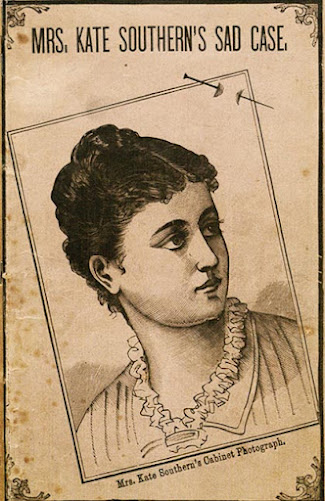
Mrs. Southern's Sad Case.

At a Pickens County, Georgia Christmas party in 1876, Kate Southern warned her husband not to dance with his mistress, Narcissa Cowan, and she warned Narcissa to stay away from her husband. When they danced together anyway Kate borrowed her father's pocketknife and plunged it into Narcissa's chest.

That Bad Man Stagolee.

Troubadours have sung the story of Stagolee for over a hundred years. Each singer seems to know a different version and tell a different story of its origin. But the story is true. The legend was born when Stack Lee Shelton shot Billy Lyons, in a fight over a Stetson hat, in Bill Curtis's Saloon, on Christmas night 1895.


Delia's Gone, One More Round.

On Christmas Eve 1900, Cooney Houston shot and killed Delia Green. If that isn’t tragic enough, they were both 14 years old. Their sad story would have been long forgotten, even in Yamacraw – the black neighborhood in the western end of Savannah, Georgia, where the killing took place – if it hadn’t been for a song. The ballad of Delia’s murder traveled from Georgia to the Bahamas, then back to the States during the folk boom of the 1950s. 


Saturday, December 13, 2025

The Just End of a Monster of Iniquity.


Dr. Thomas Neill Cream, “The Lambeth Poisoner” and possible Jack the Ripper suspect, was hanged at Newgate Prison in London on November 15, 1892. Dr. Cream had already been convicted of murder by strychnine in the United States. In fact, if he had not been released early from Chicago’s Joliet Prison, four young London women would have been spared excruciating death. 

Read the full story here:  The Lambeth Poisoner.