Saturday, June 27, 2026
Charles and Lizzie.
Saturday, January 17, 2026
Asked His Wife to Shoot Him.

Lourens Signourette and his wife lived near Foster’s Bar, a remote camp in the Yubas Foot Hills in California. Lourens had been ailing for quite a while, and on December 1, 1891, he decided to end his life by taking strychnine. The poison did not have the immediate effect that he wanted, so he asked his wife to get his shotgun and shoot him.
Saturday, January 3, 2026
The Crosby Street Murder.
Saturday, September 13, 2025
Lust and Lead.
The victims were Xavier and Aglae Wilhelm (no relation to the author), who were married in France sixteen years earlier, when she was 16 and he was 25. The age difference was a problem from the beginning; Aglae liked to flirt, and Xavier was profoundly jealous.
They emigrated to America and ended up in St. Louis. Aglae had some money, and they used it to open a coffee restaurant and ice cream parlor. They were raising two children, but business was bad, and Xavier and Aglae were constantly quarreling. Aglae couldn’t take it anymore, and in 1880, she took the children back to France.
Xavier followed soon after and persuaded her to return to St. Louis. They left the children in France and came back to the city with a new business plan. They purchased the two-story building on Poplar Street, opened a saloon on the first floor, and a brothel on the second floor.
Sometime later, Xavier returned to Paris to recruit new blood for their house of ill-fame. He secured three young girls by telling them they would work as domestics in a fine hotel, for fabulous wages. The authorities in France got wind of his scheme and managed to rescue two of the girls. He returned to St. Louis with one.
During his absence, Xavier put his bartender, Jean Morrel, in charge of the saloon. Upon his return, Xavier began to suspect that Morrel had taken charge of his wife as well. The old jealousies returned, and he swore out a warrant charging his wife and her paramour with adultery. On February 5, the case came before a judge who dismissed it for want of evidence. Racked with jealousy and devoid of hope, Xavier put an end to their problems with four gunshots.
The coroner’s inquest returned the only possible conclusion:
Verdict: Aglae Wilhelm came to her death from the effects of bullets fired from a revolver at the hand of her husband, Xavier Wilhelm, deceased at 109 Poplar Street.
Verdict: Xavier Wilhelm, suicide by gunshot wound.
Morbid fascination with the crime was so strong in St. Louis that people visited the scene of the crime all day to gaze upon the place where blood had been shed. Crowds gathered at the morgue, though the bodies were covered and kept behind closed doors.
Public fascination with the crime was matched by utter disdain in the press for both Xavier and Aglae. The Memphis Daily Appeal called it A “fitting end to a bad pair.” The St. Louis Post-Dispatch said:
Mr. Wilhelm is to be congratulated upon his success. As a rule, the blackguards who murder women are so exhausted by the manly exercise that they miserably fail when they attempt to do a good turn in the same line for themselves.
Sources:
“The Bloody End,” The Cincinnati Enquirer, February 6, 1881.
“Fitting End of a Bad Pair,” Memphis Daily Appeal, February 6, 1881.
“Lust and Lead,” St. Louis Globe-Democrat, February 6, 1881.
“News Article,” St. Louis Post-Dispatch, February 5, 1881.
“The Wilhelm Horror in St. Louis,” Illustrated Police News, February 26, 1881.
Saturday, August 10, 2024
The Norwich Poisoning.
Cobb’s friends and neighbors believed he was murdered, and they had a ready suspect. Wesley W. Bishop was having an affair with Cobb’s wife, Kate, and they were not very discreet. Bishop had purchased arsenic, which he said he had given to Cobb, and Bishop’s wife had died four months earlier under similar circumstances.
Saturday, April 20, 2024
Charles and Eva.
The marriage of Charles and Eva Herman had been on the rocks for several years. Their loud and violent fights were so common that neighbors took little notice of their shouting row on November 1, 1885. A few days later, they found Eva lying on the floor with her throat cut from ear to ear. After a night in jail, Charles confessed to the murder. I thought his wife was unfaithful, and he killed her out of jealousy.
Read the full story here: The Confession of a Wife Murderer.
Saturday, March 9, 2024
John and Maria.
Saturday, December 9, 2023
Mad with Jealousy.
Sunday, October 29, 2023
Jacob S. Harden.
Saturday, July 1, 2023
The Schoonmaker Tragedy.
“No more happy and loving couple could be found,” said Harry’s father, Col. John B. Schoonmaker, “So far as I knew, they never had a quarrel, and all was love and happiness.”
But in December 1888, Harry began acting strangely. His parents noticed he was irritable, and his talk was flighty. Others said he was “…alternately excited and depressed as if he was addicted to the use of opium or some other drug.”
Saturday, June 17, 2023
A Convenient Murder.
|
|
|
Amos J. Stillwell, a wealthy and prominent businessman in
Hannibal, Missouri, was 65 years old in 1889. His wife, Fannie, was 30 years younger.
On December 29, 1889, someone crept into their bedroom and murdered Amos with
an axe while Fannie lay sleeping in a separate bed with their children.
Dr. Joseph C. Hearne, who lived nearby, had been treating Fannie since before the murder. He and Fannie were married the following December. After
a long investigation, the police arrested both for Amos’s murder. Neither was
convicted.
Read the full story here: The Stillwell Murder.
Saturday, April 1, 2023
A Husband's Vengeance.
The couple appeared to live happily together until Paul Weber, a friend of John’s, came to board at their house. After a few months, Paul began paying undue attention to Lizzie. Then, one night in 1889, John came home to find that Paul and Lizzie had left together for parts unknown.
It took John Kolesko two years to track Paul and Lizzie to Cleveland, Ohio. On the morning of November 16, 1891, he went to their house and begged Lizzie to return with him to Denver. She refused, claiming John had beaten and otherwise ill-treated her. When his pleading failed, he went to the police department and tried to obtain a warrant to force his wife to return to him, but he was not able to prove that they were married.
That afternoon he went back to the house and commanded Lizzie to return with him. When she refused again, he shot her four times killing her instantly. Kolesko did not try to escape. He cooly walked to the police station and gave himself up.
Sources:
“A Husband's Vengeance,” National Police Gazette, December 5, 1891.
“Killed His Wife,” Bucyrus Evening Telegraph, November 17, 1891.
“Shot His Truant Wife,” Delaware gazette and state journal, November 19, 1891.
Saturday, October 22, 2022
Minerva Dutcher.
Saturday, September 3, 2022
Clemmer's Hypnotic Power.
Charles Kaiser, with two co-conspirators, staged a robbery on a road outside of Norristown, Pennsylvania in 1896, to cover up the murder of his wife Emma. The police quickly saw through the plot and Kaiser was convicted of first-degree murder.
Soon after, the police arrested his accomplices, James Clemmer and Lizzie DeKalb. DeKalb put all the blame on Clemmer, saying she had no knowledge of the conspiracy but was under Clemmer’s hypnotic spell and did whatever he said. Kaiser also changed his story, saying he too was under Clemmer’s hypnotic power. Their stories had little effect on the outcome.
Saturday, June 11, 2022
Murdered in Church.
Ferdinand Hoffman, a German immigrant, arrived in Canton, Ohio, in 1864. There he met Caroline Yost, and after a brief courtship, he proposed to her. Caroline’s parents opposed the marriage because they did not trust Hoffman and knew nothing of his background. Predictably, their opposition only drove Caroline closer to Ferdinand, and the couple eloped.
The Yosts' suspicions of Hoffman’s character proved justified. Before coming to Canton, Hoffman was an “unprincipled vagabond” who engaged in counterfeiting and horse stealing. Caroline learned firsthand of his bad character when he began to abuse her and engage in criminal activities. He was caught stealing from her father and sentenced to prison, but he was released early when he agreed to join an Ohio regiment fighting for the Union. He soon deserted and returned home with a head wound that he claimed resulted from a rebel guerilla gunshot. It was later revealed that he received the wound in a Cincinnati gambling hell.
Saturday, April 9, 2022
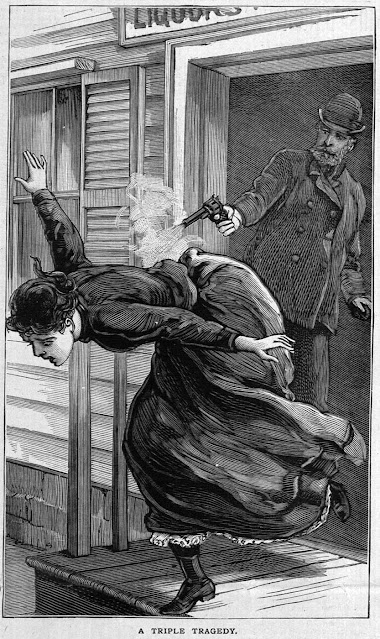
A Triple Tragedy.
The neighbors became alarmed and rushed to the saloon as two more shots were fired. They found Martin Curley lying in a pool of blood with a bullet wound over his left eye, a revolver lying on his breast. Mike Haddock (aka Anton Stanovitch), another Hungarian, lay three feet away with a wound behind his ear. Haddock was dead but both the Curleys were still alive. The neighbors brought them into an adjoining room and summoned physicians. Mary lived another hour and Martin lived for two hours but neither regained consciousness before dying.
It was first believed that Martin Curley had shot both his wife and Mike Haddock then shot himself. Haddock owed $70 in unpaid rent and Mary was rumored to have an intimate relationship with Haddock. Martin had a bad reputation and was known to be a fiend when drunk.
The theory changed when reporters learned that 5-year-old Mamie Curley witnessed the shootings. She said, “There was an awful noise when I was rocking the cradle. I rushed out into the barroom and saw papa and another man falling down. I cried ‘mama,’ but mama didn’t hear me. I saw another man in the backyard.” She did not recognize the other man, but he was believed to be John Thralle. The County Commissioners offered a $500 reward for his arrest and the search for Thralle began.
The police captured Thralle and on January 1, a coroner’s inquest was held. The story changed again when two new witnesses testified. Mathew Daley and Robbie Warner both saw Martin Curley shoot his wife. Thralle testified through an interpreter that he was in the saloon and invited Curley to have a drink of whiskey. Curley said he was not feeling well and did not care for it. The remark led to a dispute resulting in tragedy.
The jury determined that Curley murdered his wife and Haddock, then shot himself. Thralle was released.
Sources:
“The Broderick Tragedy,” Wilkes-Barre Times Leader, January 1, 1891.
“Four Victims of One Gun,” Chicago Daily News, December 29, 1890.
“Triple Tragedy,” Columbus Dispatch, December 29, 1890.
“A Triple Tragedy,” National Police Gazette, January 17, 1891.
“Wyoming Valley Tragedy,” Delaware Republican, December 30, 1890.
Saturday, February 12, 2022
A Double Tragedy.
Melinda Jones (nee Luce) married Samuel Jones, a farmer, around 1859. The two had grown up together in Washington, Maine, and they had a happy marriage raising three children. But Samuel grew tired of farming and decided to go west and seek his fortune. In California, he had no luck prospecting and ended up working as a farmhand. At first, he would send Melinda small sums of money, but soon his letters stopped completely. Melinda made some inquiries and concluded that Samuel was dead. Not long after, she married William Vannar, another of her childhood friends.
As the relatives predicted, the marriage was a stormy one. There were periods of calm when the couple seemed happy, but Vannar could not stay sober, and when drunk, he would beat and abuse his wife. Four times she left Vannar and went home to her parents, but Melinda remained infatuated with Vannar, and each time she went back to him.
In June 1871, Melinda had gone back to her parent’s home, and Vannar went to get her back. When she refused to go with him, he stabbed her in the breast. Her mother tried to intercede, and Vannar stabbed her as well. The wounds were not serious; Vannar was arrested for assault. He was released on $400 bond and fled the town.
While on the run, Vannar would write and tell Melinda where he was. Four months after the incident, Vannar returned, and Melinda took him back as if nothing had happened. This time she abandoned her children and traveled with him to Lynn, Massachusetts, where Vannar’s sister lived.
Their time in Lynn followed the familiar pattern—periods of marital bliss punctuated by drunken abuse. The night of December 16, 1871, the couple attended a ball at Wyoma Square in Lynn. Allegedly, Vannar took jealous offense at the attention paid to Melinda by another man. The matter appeared to be forgotten the next morning. Vannar arose at 5:00, built a fire, and went out to buy some liquor. When he returned, they sat down to breakfast and were observed laughing and joking together about the previous night.
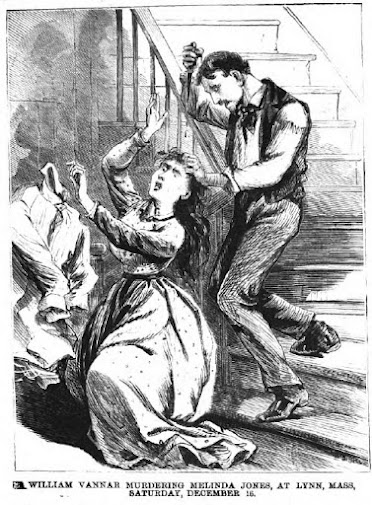
After breakfast, Vannar began drinking. His shirt had gotten dirty the night before, and Melinda said she would take it downstairs and wash it. He said he would hire someone to do it and save her the trouble. She took it downstairs anyway. Her disregard of his wishes infuriated Vannar, and he went down after her. A few minutes later, boarders in the house heard bloodcurdling screams coming from the basement. Mrs. Rodney, one of the boarders, saw Vannar come up the stair holding a knife, his clothing saturated with blood. He casually walked to the sink, washed his hands, cleaned his knife, and put it in his pocket.
“Give my coat and gloves to my sister,” he said to Mrs. Rodney, “for she (meaning his wife) is dead now, and I have got to die.”He went back downstairs, stepped over the corpse, and left through the back door.
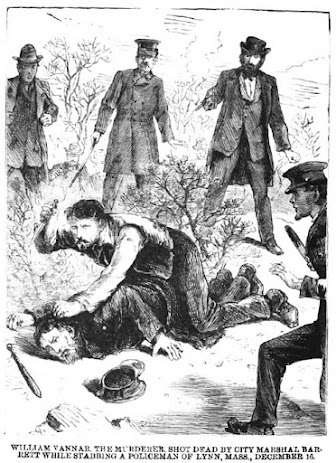
News of the murder traveled fast, and men turned out by hundreds to pursue Vannar. They had him cornered against a rock in the woods, but Vannar had his knife poised, ready to thrust, and no one would approach him. Officer John Thurston attempted to rush him with a club, but he slipped and fell. Vannar was on him instantly, dealing heavy blows with his knife. City Marshal, Daniel N. Barrett, drew his revolver and fired five shots, killing Vannar.
Officer Thurston suffered several stab wounds to the face and head and a bullet through his hand, but he survived the ordeal. A coroner’s inquest on December 21 ruled that Marshal Barrett’s action was justified.
Sources:
“The Lynn Tragedy,” National Aegis, December 23, 1871.
“News Article,” Gloucester Telegraph, December 20, 1871.
“News Article,” Evening Bulletin, December 26, 1871.
“The Recent Murder at Lynn Massachusetts,” Wheeling daily register, December 23, 1871.
“Tragedy in Lynn,” Republican journal, December 21, 1871.
Saturday, December 11, 2021
Michael M’Garvey.
The evening of November 21, 1828, Michael M’Garvey violently chastised his wife, Margaret, in the room, they occupied on the top floor of a house at the corner of Pine and Ball Alleys, between Third and Fourth Streets, and between South and Shippen Streets in Philadelphia. He tied her by the hair to a bedpost and began beating her, unmercifully with a whip, continuing at intervals for the next hour and a half. When she passed out, he attempted to throw her out the window but pulled her back in when someone outside saw him and cried out.
Saturday, October 16, 2021
Michigan Double Murder.
A very anxious and excited man arrived at the jail in Ann Arbor, Michigan, around midnight, October 22, 1871. He told the jailer he was unwell and wanted to sleep in the jail that night. The jailor decided it was in everyone’s best interest to give him what he wanted. As he locked the cell door, the man burst out crying but would not say why. The following morning the jailor released him.
The man, Henry Wagner, went to see his brother August and declared that he thought he had murdered his wife. “I don’t know what I have been doing,” he said, “I don’t know whether she will live or not.” They went to the police and gave Officer Leonard the key to Wagner’s house so he could check on the wife’s condition.
Wagner’s wife, Henrietta, ran a fancy store with her partner Mary Miley. Henry, Henrietta, and Henrietta’s 3-year-old son Oscar lived in the back room of the store. What Officer Leonard saw when he opened the door to their room nearly froze his blood. Mrs. Wagner lay on her side in her nightdress; her head was a mass of pounded flesh and bone. Around her, spatters of blood and clots of bloody gore covered the walls and nightclothes. Nearby laid a bloody hatchet—she had been beaten with the blunt end. After several minutes, the officer heard a slight rustling in the bed. He pulled back the covers to find little Oscar covered with blood; his head had been smashed, but he was still alive. Leonard notified the coroner and arrested Henry Wagner. Oscar died a few hours later.
The Wagners had come to Ann Arbor from Germany about three years earlier. At the time, they were unmarried; Henrietta was the ex-wife of Henry’s older brother, Oscar’s father, who was still living in Germany. Henry and Henrietta married the previous July, but at times it was an unhappy marriage—they would have serious arguments, sometimes ending in violence. Despite the fighting, Henry declared he had always loved his wife very dearly.
24-year-old Henry Wagner related what had occurred the night of the murder to a reporter who visited him in jail:
“For the past two or three days, we lived most happily; she never seemed to love me so much. Last night she went to bed, I don’t know what time. I said to her good night and went to the bed to kiss her when she spit in my face and kicked me, saying, go away, you are a crazy man, and I can’t live with a crazy man. I said to her, give me my money, and I will go. She said nothing to this. I then went and got the money and started to leave, when she jumped up and said, ‘I will cut you in pieces before you go with that money.’ That made me very angry, and I took the hatchet from the wood-box and went toward her, she jumped at me and called me a dog, and told me to leave the house. I kept brandishing the hatchet to frighten her. She and the child both cried fire and murder, and as she clutched me by the throat, I hit her accidentally. She fell right down and said, “Oh my,” and groaned. When I saw what I had done, that she was hurt so she could never get well, I thought I would put an end to her life and struck her several times. After this, I remember nothing. I seemed to see my wife before my eyes all the time. I don’t remember striking the boy at all. I remember putting out the light and locking the door. I went out in the street, but I could not go anywhere I did not see my wife just as I struck her, lying before my eyes. I came down to the jail, but I could not sleep or eat. I don’t know what I shall do.”
At the inquest the following day, August Wagner testified that the trouble between Henry and Henrietta was due to the child. Henrietta had been the prostitute of their older brother in Germany. They had several children together, and he called her his wife, but they were never married. He believed that Henry was Oscar’s father, but Henry did not acknowledge this.
Mary Miley testified that Henry was very jealous of Henrietta and the trouble between them began about two weeks after their wedding. Mary said he had willed Henrietta all his property, including money still in Germany. A written contract giving her all his money, some $3,000, was found in Henry’s pocket, torn in two.
The newspapers speculated correctly that Henry Wagner would try “the insanity dodge” at his trial the following March. Friends, coworkers, and clergymen testified that Henry always seemed excited and uneasy, speaking in a disconnected manner, frequently disparaging his wife’s character. August Wagner said that the family always considered him of unsound mind.
The defense had no professional witnesses to give medical testimony as to the state of Henry Wagner’s mind, but the prosecution did. Professor Palmer, a specialist in insanity, visited Wagner in jail several times and conversed with him. He testified that Wagner did not show any signs of insanity or anything to indicate homicidal impulse. Drs. Lewitt and Kapp also examined Wagner and agreed that he was perfectly sane.
The jury deliberated for two hours then found Henry Wagner guilty of first-degree murder. He was sentenced to life in prison in solitary confinement and hard labor.
Sources:
“Conclusion of the Wagner Murder Case,” Detroit Free Press, March 16, 1872.
“The Double Murder At Ann Arbor,” Jackson Citizen Patriot, October 24, 1871.
“A Startling Murder,” Vermont Union, November 3, 1871.
“The Trial of Henry Wagner,” Michigan Argus, March 22, 1872.
“The Trial of Wagner,” Michigan Argus, March 15, 1872.
“The Wagner Murder,” Detroit Free Press, March 13, 1872.
Saturday, September 18, 2021
Edward H. Rulloff.
Read the full story here: The Man of Two Lives.


.jpg)