Showing posts with label Georgia. Show all posts

Saturday, December 21, 2024

A Christmas Party Murder.


In 1876, Kate Hambrick married Bob Southern in Picken’s County, Georgia. That Christmas, Kate’s father held a party for the community, and against Kate’s wishes, he invited Bob’s former girlfriend, Narcissa Cowan. When the party started, Kate warned Narcissa not to accept or encourage any attention from Bob. Her warnings were disregarded, and as the evening progressed, Bob led Narcissa to the middle of the floor for a dance. 

 “You have danced enough.” Said Kate as she whipped out a pocketknife and plunged it into Narcissa’s breast. 

Narcissa staggered back as a stream of blood gushed from the wound. Kate sprang on her, caught her by the hair, then cut her throat almost from ear to ear. Narcissa fell dead.

Read the full story here: Mrs. Southern's Sad Case.

Saturday, January 27, 2024

Robert and Kate.

In 1876, Robert Southern was the most eligible bachelor in Pickens County, Georgia. Kate Hambrick and Narcissa Cowan were rivals for his affection. Kate was the winner; she and Robert married that autumn. But Kate’s victory was short-lived; Robert was still secretly seeing Narcissa. At a Christmas party that year, he danced with Narissa and paid her more attention than Kate thought proper. Kate Southern solved the problem by stabbing her rival in the chest with a penknife. 

Read the full story here: Mrs. Southern's Sad Case.

Saturday, August 6, 2022

Mrs. Southern's Sad Case.

In 1876, Bob Southern was the most eligible bachelor in Pickens County, Georgia. He was tall and handsome, from a prominent family, but somewhat wild and reckless. He was seriously courting two young women—Kate Hambrick, slender and beautiful with dark eyes and luxuriant auburn hair, and Narcissa Cowan (nee Fowler), pretty, plump, and blonde. Kate was popular but strong-willed and impetuous. Narcissa was more reserved but a divorcee with a somewhat shady reputation. The women were bitter rivals for Bob Southern’s affections.

That autumn, Southern proposed to Kate Hambrick, and the two were married. They lived happily for several months until Bob began staying out late without explanations. Kate began hearing rumors that Bob was still meeting with Narcissa. They had been seen walking together in the woods several times since the wedding. The news made Kate intensely jealous.

Saturday, January 8, 2022

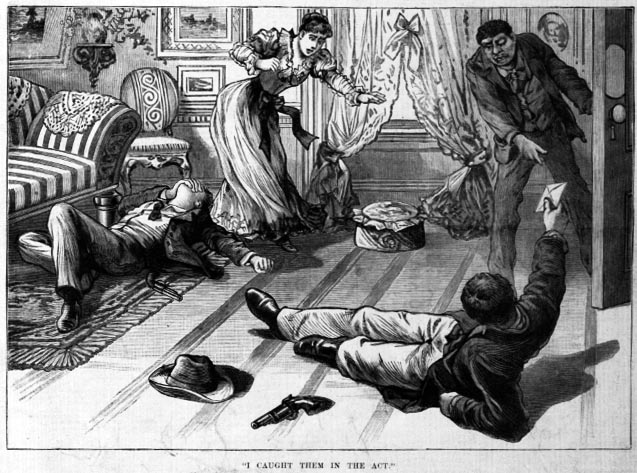
"I Caught Them in the Act."

C. F. Stephens owned a store in Livingston, Georgia about 12 miles from Rome. He employed Frank Wilkerson as a clerk in his store and provided him with room and board in his home.

Stephens was increasingly unhappy with this arrangement, and he sensed that things were not right in his house. He heard rumors that Wilkerson and his wife, Jessie, were intimate, and he found letters from Wilkinson to Jessie that appeared to confirm this.

Stephens wanted to find out for sure, so the morning of July 12, 1892, he told Jessie that he was going to Rome and would be back at 3:00 that afternoon. Instead, he returned home at 2:00. Stephens hitched his horse about half a mile from his house and walked home. He entered through the back door and took off his shoes so no one would hear his footsteps. 

The bedroom door was closed. When Stephens opened the door, he found Wilkerson and his wife in a compromising position. He drew his revolver and shot twice, wounding Wilkerson. Stephens had only two bullets in his pistol, so he grabbed Wilkerson and pulled him to the floor. Wilkerson drew his pistol and shot twice; one of the bullets hit Stephens between the eyes, and he died a few minutes later.

Before he died, Stephens took the incriminating letters from his pocket and wrote on one, “I caught them in the act. C. F. Stephens.” He gave the letters to his manservant, saying, “Take these to my father. They tell a tale.”

Mrs. Stephens tried to grab the letters, but the servant left with them. She and Wilkerson were both arrested.

The trial of Frank Wilkerson the following October in Troy, Georgia, caused a sensation due to the prominence of the Stephens family. The courtroom was packed every day. More than sixty witnesses testified, but there was very little hard evidence beyond the obvious facts of the case. The debate centered on the incidents that led to the murder and the motives of those involved.

Several prosecution witnesses testified to having caught Wilkinson and Jessie Stephen in “a questionable attitude.” One testified that Stephens had not meant to kill Wilkerson, just to scare him. He had told Wilkerson to leave several times, but Wilkerson said that would be over Stephen’s dead body. Others testified that Wilkerson had intended to murder Stephens at the first opportunity and that Mrs. Stephens knew of his plans.

When Frank Wilkerson testified, his voice was so soft he could not be heard from 10 feet away and had to pause and weep several times. He said no one regretted the killing more than he did, but when Stephens started firing, he had nowhere to go and had to shoot back. He denied ever having intimate relations with Mrs. Stephens. When Stephens caught them, they were standing and talking about his leaving the house. The letters were just thanking Mrs. Stephens for some advice she had given him. 

Jessie Stephens also denied any intimacy with Wilkerson, but she did say she loved him more than her husband. She said the handwriting on the letter was not her husband’s, but Deputy Sheriff McConnell, who had known Stephens from boyhood, said the signature was definitely his.

The jury convicted Frank Wilkerson of voluntary manslaughter. 

Following the conviction, a grand jury indicted Jessie Stephens for adultery and accessory to murder. She fled the city before the police could take her into custody.


Sources: 
“Summary of the News,” Sun, October 21, 1892.
“'I Caught Them in the Act',” Illustrated Police News, July 30, 1892.
“The Defendant Testifies,” Atlanta Journal, October 15, 1892.
“Didn't Desire His Blood,” Atlanta Journal, October 12, 1892.
“In the Southern States,” Dallas Morning News, July 19, 1892.
“Killed by His Wife's Lover,” Morning News, October 12, 1892.
“Killed by His Clerk,” Morning News, July 13, 1892.
“Mrs. Stephens Must Stand Trial,” Morning News, October 22, 1892.
“The Murderous Result,” Daily State Chronicle, July 14, 1892.
“She Loved Wilkinson,” Morning News, October 15, 1892.
“Wilkerson on Trial,” Atlanta Journal, October 11, 1892.

Saturday, April 25, 2020

The Unwritten Law.

Robert McBride was the wealthy operator of a cotton seed oil mill in Newnan, Georgia. He had come to Georgia from New Jersey, and quickly entered the vigorous business life of Newnan, with interests in several mills and factories. In 1893, he was a quiet and gentlemanly, 44 year-old bachelor, living in a boarding house run by Patrick Meehan and his wife.

Meehan was a successful traveling salesman for a Louisville, Kentucky, whisky distiller, whose job kept him in the road for long periods. In August 1893, Meehan was in New York City, and Robert McBride decided to use this opportunity to express his affection for Mrs. Meehan; his feelings for her had been steadily growing during the two years he spent under her roof. When they were alone on the front veranda, McBride told Mrs. Meehan that he wished to have a confidential conversation with her. Mrs. Meehan was taken aback and told Meehan that if he had anything confidential to say he should write it down and send it to Mr. Meehan, and she left the porch.

Saturday, May 5, 2018

A Wronged Husband's Revenge.

M. F. Boyd, the Tax Receiver of Floyd County, Georgia, suspected his wife of infidelity and had a plan to catch her in the act. On October 11, 1892 he told his wife he would be leaving town for the day, but he secretly returned home that afternoon.

Mrs. Boyd was from a good family but had been somewhat wild before the marriage; she was said to be “fond of wine and a lark.” That afternoon she lived up to her reputation, lying in bed with Walter Mitchell, owner of a steamboat line in Rome, Georgia.

Both were intoxicated with wine and sleeping soundly which was why they did not hear Boyd enter the room. Boyd was disabled and confined to a wheelchair. He had his assistant roll him into the bedroom then told him to leave the room and shut the door behind him. Boyd wheeled himself to the edge of the bed and without warning began to stab Mitchel with a sharp knife. He managed to inflict five wounds to Mitchell’s head and sever an artery in his left arm before waking Mrs. Boyd.

Mitchell was taken to his home where he died soon after. M. F. Boyd went into Rome surrendered himself to the sheriff and was released on bond. He also swore out a warrant against his wife for adultery and she was arrested and put in jail.

Source:
“A Cutting Affray,” News and Observer, October 12, 1892.
“A Cutting Affray in Georgia,” The Baltimore Sun, October 12, 1892.
“Wronged Husband,” National Police Gazette, October 29, 1892.

Saturday, March 10, 2018

A Duel in the Bedroom.

Will Shinall ran a small store and bar in Hackletown, Georgia, a suburb of Augusta. In the backrooms of the store, he resided with his wife and eight-year-old son. Shinall had business interests in Beaufort, South Carolina and would often travel there and stay overnight. When he was out of town, Shinall left his young clerk and bartender, Batty Buck to manage the store. Though not yet twenty years old, Buck was an honest and enthusiastic employee and Shinall had no qualms about leaving him in charge of the business.

Saturday, September 10, 2016

Betrayal and Mercy.

Little Murders

Two men walking through the woods near Dalton, Georgia, came across the body of a young woman lying in Milk Creek. Her feet were bare, she was clad in old wrapper tied with twine, her chestnut-brown hair hung over her shoulders in disheveled locks, and two deep wounds cracked her skull. No one in Dalton recognized the woman; there was no way to tell where she had come from and who had killed her. Then a liveryman, Robert Springfield, made a startling discovery while taking out one of his buggies. The seat was covered with fresh clots of blood and strands of hair. He had rented the buggy the previous night, to a man named Charles Patton.

Saturday, March 31, 2012

Confessing an Awful Crime.

Little Murders
(From Oshkosh Daily Northwestern, Oshkosh, Wisconsin, April 18, 1894)
CONFESSING AN AWFUL CRIME.
.
A Georgia Man describes How He Butchered His Five Children.
Waynesboro, Ga, April. 19.—Edward Dowse, who is held in jail charged with the murder of his five children, has confessed his guilt. He says his children kept accumulating upon him, while his ability to support them diminished, and on the morning of the murder he felt an uncontrollable desire to rid himself of the burden. Pretending to his wife that he wanted some necessary article in the cabin he went there, and having fastened the door behind him, he attacked the youngest child with an ax and killed it. The others held him by the legs, beseeching him to spare the child. Turning from his dead victim he grasped two others and beat their heads against each other until they became unconscious. With the ax he then killed them. The two remaining children sought refuge under the bed. Reaching for them he killed them also and left five dead bodies on the floor. Closing the door he returned to work, giving no sign of the bloody work in which he had been engaged. It is believed that his wife and sister, who have disappeared, are also guilty.


Oshkosh Daily Northwestern, Oshkosh, Wisconsin, April 18, 1894.

Sunday, March 21, 2010

Delia's Gone, One More Round


On Christmas Eve 1900, Cooney Houston shot and killed Delia Green. If that isn’t tragic enough, they were both 14 years old. Their sad story would have been long forgotten, even in Yamacraw – the black neighborhood in the western end of Savannah, Georgia, where the killing took place – if it hadn’t been for a song. The ballad of Delia’s murder traveled from Georgia to the Bahamas, then back to the States during the folk boom of the 1950s. Though the facts have been altered along the way, Delia’s story has been sung by generations of folk singers, and has been recorded by musical icons such as Bob Dylan and Johnny Cash.


Sunday, February 14, 2010

Bloody Woolfolk


In the early hours of August 6, 1887, nine members of the Woolfolk family of Bibb County, Georgia – ranging in age from 18 months to 84 years – were hacked to death in their home. The only surviving member of the household was 27-year-old Tom Woolfolk who quickly became the prime suspect. The press called him “Bloody Woolfolk” and it was all the sheriff could do to keep him out of the hands of a lynch mob. But when the trap sprung on Tom Woolfolk’s legal hanging, had the State of Georgia finished the work of the real killer?