Saturday, April 1, 2023

A Husband's Vengeance.

John Kolesko, a Slavonian laborer, met Lizzie Mattis in a small town in Hungary in 1884. Six weeks later, they married and sailed at once to America. They settled in Denver, Colorado, where John found work in a glass factory.

The couple appeared to live happily together until Paul Weber, a friend of John’s, came to board at their house. After a few months, Paul began paying undue attention to Lizzie. Then, one night in 1889, John came home to find that Paul and Lizzie had left together for parts unknown. 

It took John Kolesko two years to track Paul and Lizzie to Cleveland, Ohio. On the morning of November 16, 1891, he went to their house and begged Lizzie to return with him to Denver. She refused, claiming John had beaten and otherwise ill-treated her. When his pleading failed, he went to the police department and tried to obtain a warrant to force his wife to return to him, but he was not able to prove that they were married.

That afternoon he went back to the house and commanded Lizzie to return with him. When she refused again, he shot her four times killing her instantly. Kolesko did not try to escape. He cooly walked to the police station and gave himself up.


Sources: 
“A Deliberate Murder,” Jersey Journal, November 17, 1891.
“A Husband's Vengeance,” National Police Gazette, December 5, 1891.
“Killed His Wife,” Bucyrus Evening Telegraph, November 17, 1891.
“Shot His Truant Wife,” Delaware gazette and state journal, November 19, 1891.

Saturday, March 25, 2023

The Cruel Axe.


17-year-old James E. Nowlin murdered George Codman in a Massachusetts stable in January 1887. Then he took an axe and chopped Codman’s body into pieces. As he traveled home in a sleigh, he threw the pieces into the snow along the road.

Read the full story here: Massachusetts Butchery.


Saturday, March 18, 2023

Francis Colvin's Skull.

In December 1873, the body of Francis A. Colvin was found floating in the Seneca River, near Baldwinsville, New York. He had a severe wound to the left side of his skull. Owen Linsday and Bishop Vader were charged with his murder. Colvin’s skull was an exhibit in the trial of Owen Linsday and was examined by several witnesses. It served to illustrate the severity of the wound. It also helped determine which defendant had delivered the death blow. The location of the wound indicated a right-handed killer and Bishop Vader was left-handed.

Read the Full Story Here: The Baldwinsville Homicide.

Saturday, March 11, 2023

Most Atrocious Murder.

On February 2, 1846, Francis Adolphus Muir went to the home of his friend Captain William Dandridge Epes. Muir and Epes were two of Dinwiddie County, Virginia's most prominent and respected men.  They had business to discuss; Muir held bonds amounting to $3,200 against Epes, the balance owed by Epes for a tract of land he bought from Muir. Muir was invited to stay for dinner when their business was concluded.

According to Mrs. Epes, her husband told Muir about a deer he had seen in the woods and asked Muir to accompany him when he went to kill it. Muir agreed, and the two men left together on horseback. Epes returned alone and told his wife that Muir had found it necessary to go to Brunswick and would not be staying for dinner. Muir was not seen again in life.

Saturday, March 4, 2023

The Colt-Adams Murder.

The Murder of Samuel Adams by John C. Colt.

An argument over money between bookkeeper John C. Colt and printer Samuel Adams, on September 17, 1841, ended in the murder of Adams in Colt’s Manhattan office. Colt tried to dispose of the body by crating it up and shipping it to New Orleans.

Read the full story here: The Corpse in the Shipping Crate.


Illustrations from "Trial of John C. Colt", New York Sun, January 31,1842.

Saturday, February 25, 2023

Maria Bickford.

Maria Bickford, a beautiful young prostitute, was found murdered in her room in Boston’s Beacon Hill. Her throat was slashed from ear to ear and her bed had been set on fire. 

Read the full story here: The Sleepwalking Defense.

Saturday, February 18, 2023

An Affair of Blood and Mystery.

Mrs. Amelia Berry (or Berri) was a German widow living in Jefferson City, Missouri. In 1864, her husband died, leaving her a sizable estate, including a drug store with a residence on the upper floors. Her brother, Edward Hofius, lived in California until 1870, when Amelia invited him to return to Jefferson City and reside with her. Mary Clarenbach, a niece of Amelia and Edward, also lived in the large house.

Around 8:00, the night of Sunday, June 11, 1871, neighbors heard gunshots from the drug store. They went inside and found Amelia Berry lying on the floor, mortally wounded. On the floor above, they found Edward, insensible, with a bullet through his brain. The room was in disarray, and some of the furniture was broken. Edward died soon after, and Amelia died around 11:00 the following night. 

Saturday, February 11, 2023

Sarah Jane Gould.


Everyone in Canton, New York, learned to distrust James E. Eldredge, except his fiancé, Sarah Jane Gould.  Sarah Jane remained trusting till the end, when Eldredge poisoned her to pursue her younger sister, Helen.

Read the full story here: James E. Eldredge

Saturday, February 4, 2023

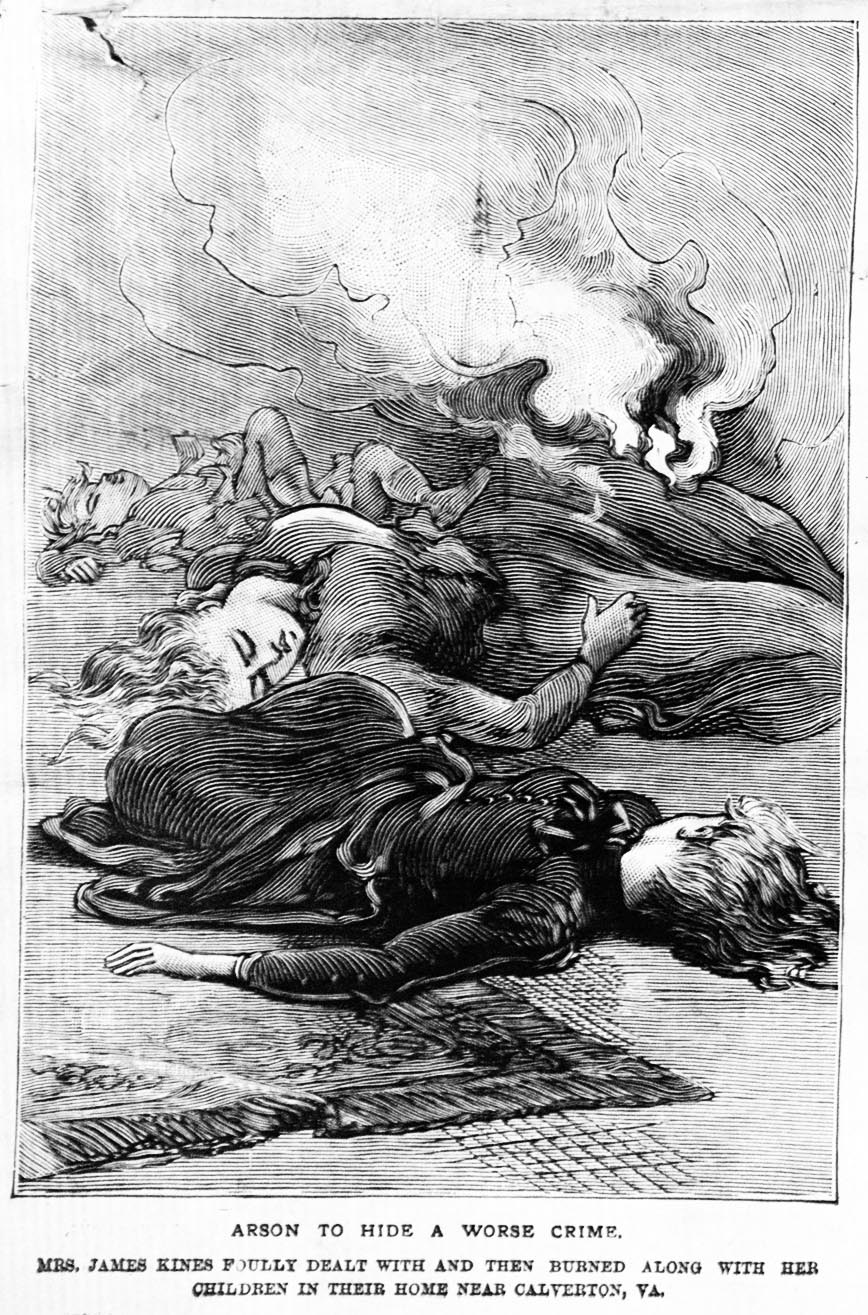
Arson to Hide a Worse Crime.

Lee Heflin ran to Thomas Robinson’s farm near Calverton, Virginia, on November 10, 1891, to raise an alarm that a house on a neighboring farm was on fire. Heflin led Robinson and his son George to the burning house. When they got there, other neighbors had gathered, and the house was engulfed in flames. 

The house belonged to Mrs. J. W. Kines, a widow who lived there with three of her children. It appeared that all four were still inside. The Robinsons ventured in and were able to pull out three bodies. 8-year-old Lizzie Kines lay near the door and was only slightly burned. Annie Kines, ten years old, was so badly burned as to be unrecognizable. Mrs. Kines’s body was severely charred but not as bad as her daughter's. There was no trace of 4-year-old Gilbert Kines. 

Saturday, January 28, 2023

The Murderous Barker Brothers.


The Baker Brothers of Bloomingdale, Michigan, suspected Harvey Keith of having adulterous relations with both of their wives. When they caught him in bed with Marshal Baker's wife, they brutally murdered Keith and dumped his body in Max Lake.

Read the full story: Murder at Bloomingdale.

Saturday, January 21, 2023

Henry G. Green.

Henry G. Green was infatuated with Mary Ann Wyatt, leading lady of a troupe of temperance players who performed in Berlin, New York in 1844. When the troupe left Berlin, Henry followed and was soon courting Mary Ann. On February 10, 1845, they were married. Eight days after that Mary Ann Wyatt Green was dead from arsenic poisoning.  

There is little doubt Henry Green murdered his wife but his motive in doing so is an enduring mystery.

Read the full story: The Murdered Wife.

Saturday, January 14, 2023

Erring Wives and Jealous Husbands.

One afternoon in the Autumn of 1855, two young men were drinking coffee at Vinton’s, a Boston confectionary saloon. Both were bright and respectable, with promising futures. William Sumner, age 19, was a cousin of Massachusetts Senator Charles Sumner and had recently completed a course of mercantile studies, preparing to enter his brother’s ship chandlery business. His friend, Josiah Porter, was a Harvard graduate and a lieutenant in the City Guards.

A pair of attractive young ladies sat down at the table next to them. Nelly Dalton and Fanny Coburn were sisters, the daughters of John Gove, who owned a clothing store in Boston. Fanny recognized Mr. Porter and reminded him they had been introduced at a ball for the City Guards the previous February. The four struck up a conversation, and although both ladies were married, they became quite flirtatious. Before they left, they told the men that they often came to Vinton’s and hoped they would see them there again.

Saturday, January 7, 2023

Murdered at Prayer.


A.E. Ambrose was working in his yard in South Byfield, Massachusetts, the morning of January 3, 1879, when he was surprised by two of his neighbors, Mrs. Caldwell and her sister Miss Brown, excitedly running toward him. Mrs. Lucy Caldwell was known for her erratic behavior and always seemed somewhat excited, but he had never seen Miss Brown looking so terrified.

Mrs. Caldwell exclaimed, “Go up and take care of him; he threatened to kill me, and I hit him with an axe, and I don’t know, but I have killed him.”

Saturday, December 31, 2022

The Murder of Ellen Lucas.


Ellen Lucas of Bridgeport, Connecticut, was to be married on October 3, 1874. The night before the wedding, Ellen went out to meet her fiancé. She never came home that night. Early the next morning, her family and friends began a search for her. The search ended when two workmen found her body, face down in a stream in a secluded spot called The Cedars, near Berkshire Pond in Northern Bridgeport.

Read the full story here: The Bridgeport Tragedy.

Friday, December 23, 2022

Baltimore Sorrow.


William James and Denwood Hinds of Baltimore were close friends who had served together in the Fifth Maryland Regiment. The friendship would have remained strong if William’s sister, Lizzie James, had not become hopelessly infatuated with Denwood Hinds. Lizzie’s love set off a chain of events that not only ended her brother’s friendship with Denwood but resulted in her own death and the murder of her father.

Read the full story here: The Baltimore Sorrow.

Thursday, December 22, 2022

The Best Books We Read this Year.

So Far from Home: The Pearl Bryan Murder

Included in

THE BEST BOOKS WE READ THIS YEAR (2022)

a collaborative book list by the reviewers at IBR in which they review the best books they read this year irrespective of their publication date. It consists solely of books by indie presses and indie authors.

Saturday, December 17, 2022

The Snyder-Harman Murder.

Christiana Harmon (better known as Annie, and sometimes spelled "Herman"), aged 32, lived with her father in Heidelberg Township, York County, Pennsylvania. On Saturday, December 9, 1878, she left home around noon to go shopping in Hanover. She returned to Heidelberg around 2:00 and stopped at the home of Reuben Snyder, about three-quarters of a mile from her home, where several young people had gathered for a singing party.

Reuben Snyder’s 26-year-old brother Ephriam was also at the party. Annie and Ephriam had been going together, off and on, for several years but lately had been arguing. Annie left the party around 8:00 that night. Ephriam left a few minutes later.

The next morning, Annie Harman’s body was found by the side of the road, about a quarter mile from her home. Her skull was crushed, her jaw broken, and her face badly cut and bruised. Next to the body lay a bloodstained chestnut club. A few feet away was another bloodstained piece of wood.

Ephriam Snyder became the prime suspect. Rebecca Snyder, Ephriam’s sister-in-law and Annie’s cousin, reported that Annie told her she thought she was pregnant and did not know what she would do if Ephriam did not marry her. Ephriam refused to marry her; he was engaged to someone else. Annie threatened to take him to court.

On Monday, Detective Rouse made a thorough examination of the crime scene. He found a bullet embedded in the ground where Annie’s head had been. Annie’s body was already buried, and the coroner had the body exhumed. Doctors performing a more thorough post-mortem examination found that she had been shot through the eye. They also determined that she was not pregnant.

Searching Snyder’s room, the police found a single-shot pistol and a box of cartridges. The bullet found at the scene fit the muzzle of the pistol. Detective Rouse arrested Ephriam Snyder for the murder of Christina Harman.

Snyder’s murder trial in York, Pennsylvania, began on April 26, 1879. Outside of the medical testimony, most of the witnesses were relatives of the defendant or the deceased and people who attended the party on December 9. The evidence against Snyder was mostly circumstantial, with only the pistol and cartridges exhibited in court, tying him directly to the murder.


The attorneys gave their closing arguments on May 2. W.H. Kain, for the defense, addressed the jury for an hour and twenty-five minutes. He was followed by E.D. Ziegler, for the defense, who spoke for an hour and fifteen minutes. After lunch H.L. Fischer, for the commonwealth, spoke for two hours. Before giving the case to the jury, the judge addressed them for an hour.

The jury deliberated from 4:30 to 6:00 before returning a verdict of not guilty. Ephriam Snyder heartily shook the hand of each juryman and each member of his defense team before leaving the courtroom.

It was not the legal oratory that swayed the jury, one of the jurymen noticed something that even the prosecution missed. The bullets in the cartridge box were a perfect plane, while the bullet found at the scene was concaved. This was enough to convince the jury that the cartridges were not the same as the bullet. Without that, there was not enough evidence to convict Ephriam Snyder of murder.

No one else was ever arrested for Annie Harman’s murder, but the scene of the crime became a center of local superstition. A large shirt was seen stretched at full length in the top limbs of a high hickory tree. The soiled garment was known throughout the region as the “Bloody Shirt.”


Sources:

“Ephraim Snyder's Trial for Murder,” The Philadelphia Times, April 28, 1879.
“The Herman Murder,” The York Dispatch, December 10, 1878.
“The Herman Murder,” York Democratic Press, January 3, 1879.
“Miss Annie Herman and Ephraim Snyder,” Illustrated Police News, January 11, 1879.
“News Article,” Juniata sentinel and Republican., December 18, 1878.
“Not Guilty,” The York Dispatch, May 2, 1879.
“A Queer Mark,” The York Dispatch, April 2, 1880.
“Snyder-Harman Murder,” The York Dispatch, April 29, 1879.
“Snyder-Harman Murder,” The York Dispatch, April 30, 1879.
“Snyder-Harman Murder Trial Ended,” The York Daily, May 3, 1879.
“The Snyder-Herman Murder,” The York Daily, December 13, 1878.
“The Snyder-Herman Murder,” The York Dispatch, December 17, 1878.
“Snyder-Herman Murder Trial,” The York Daily, April 28, 1879.
“York County Murder,” Philadelphia Inquirer, December 13, 1878.
“The York Tragedy,” Philadelphia Inquirer, December 17, 1878.

Wednesday, December 14, 2022

So Far from Home Audiobook.

Listen to a sample...
 

Available from Audible
and Amazon

Saturday, December 10, 2022

The Cold Spring Tragedy.


Jacob and Nancy Young were involved in what would later be called a Ponzi scheme with Nancy Clem in Indianapolis. In 1868 the Youngs decided it was time to pull out. They took between $7,000 and $9,000 and tried to leave town. The following day they were found dead from shotgun wounds by the river near Cold Spring. 

Nancy Clem was the prime suspect. She was tried four times but due to hung juries and legal technicalities, she remained unpunished.

Read the full story here The Notorious Mrs. Clem.

Saturday, December 3, 2022

The Trial, Life and Confessions of Charles Cook.


When tried for the 1840 murder of Catherine Merry, Charles Cook pled innocent by reason of insanity. Despite a history of medical treatment for extreme melancholy, and strange behavior such as running through the streets of Schenectady, wearing nothing but a blanket, proclaiming himself to be the Savior of the world, the jury rejected his plea and found him guilty.

Before his execution, Cook issued a formal written confession elaborating on his mental condition: “I labored upon the control of a single passion, it was that of sexual fondness; and whenever frustrated in my attempts to gratify it, the spirit of revenge came upon me.”

Read the full story here: Charley Cook.