Saturday, February 5, 2022
Obsession.
Saturday, January 29, 2022
Concealing his Bloody Work.
In April 1866, Antoine Probst murdered eight men, women, and children with an axe and a hammer, on the Deering farm outside of Philadelphia. He arranged the bodies in straight rows and covered them with hay.
Read the full story here: Horror!
Thursday, January 27, 2022
Her Struggle was Useless.
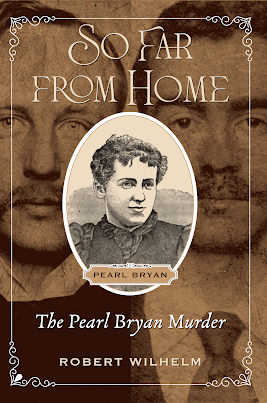
Read Pearl Bryan's story in the new book,
Now available at Amazon.
Saturday, January 22, 2022
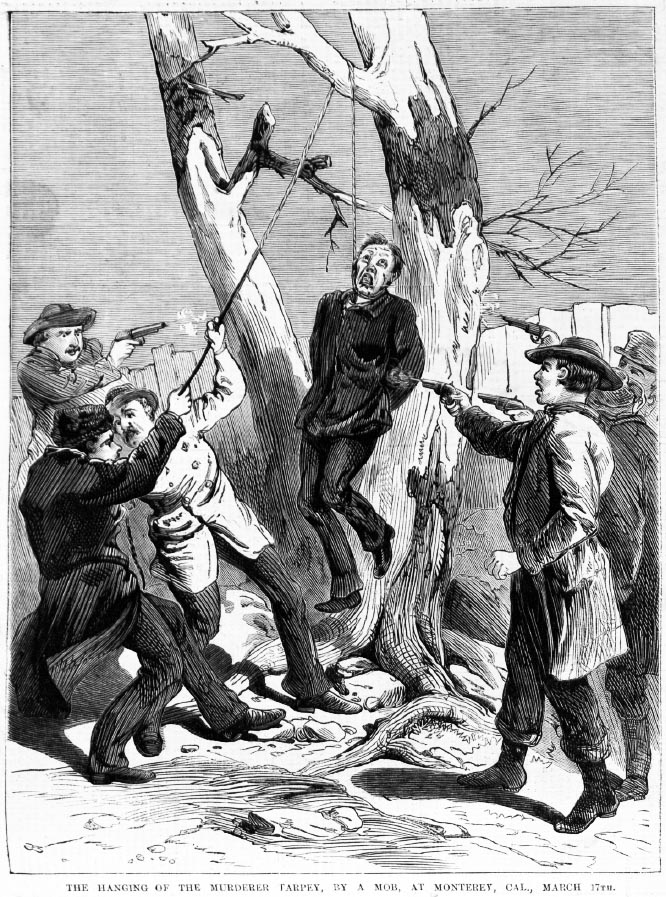
A Brutal and Cowardly Murder.
The Nicholsons of San Francisco owned some farmland near Watsonville in Monterey County, California. In 1873, Mrs. Sarah Nicholson spent all of her time there, working the farm while her husband traveled back and forth from San Francisco, where he had a carriage business.
Two years earlier, they bought the land from Matt Tarpey, a wealthy landowner and a big man in Monterey County politics. Tarpey was a well-known bully and desperado—“a brawling, profane, cowardly ruffian, with but few redeeming traits,” said the San Francisco Chronicle. He was caught trying to rig an election by forging nationalization papers of immigrants. Twice Tarpey was accused of murder. In one case, he used his political influence to have the charges dropped; in the other, he was acquitted after allegedly bribing jurors.
Tarpey claimed the Nicholsons were behind in their payments for the land, and he wanted it back. In March 1873, Tarpey moved an old frame house from an adjacent property he owned onto the Nicholsons’ land and situated it about a quarter-mile from their farmhouse. He built a fence around the house and rented it to a man named Peterson.
Her husband was away when Mrs. Nicholson learned of the new house on her property, so she rode into town to consult with her lawyer. He told her that since she held the deed, she could not be driven out without legal process. If Tarpey moved a house onto her land, she had a right to take possession of it. The next day, she went to the house, accompanied by a young man named O’Neill and a boy who worked on the farm.
When Peterson came by, he was surprised to find the house occupied. He demanded that they leave, but Mrs. Nicholson told him she was in possession of the house. If he had any grievance, he should talk to Tarpey.
That evening Tarpey buckled on a six-shooter, grabbed his Henry rifle, and started for the house. On the way, he stopped and borrowed a double-barreled shotgun. Behind a big oak tree on his property, he dug a hole where he could observe the house without being seen. After midnight that night, Tarpey fired six or seven shots in quick succession into the house. The occupants of the house were unarmed and, in a terrible fright, ran back to the Nicholson farmhouse.
The next morning they went back to see what damage had been done. As they approached the house, Tarpey stepped into the roadway holding the shotgun. Mrs. Nicholson was startled but recovered herself and said, “Good morning, Mr. Tarpey.”
“Now, you d----d w----, I’ve got you.” Said Tarpey as he raised the shotgun and pulled the trigger. The gun clicked but did not go off.
“For God’s sake, Mr. Tarpey, take the whole thing, but do not murder me.” Said Mrs. Nicholson.
Tarpey aimed the gun, and it clicked again. Terrified, she seized hold of O’Neill and said, “Come let us run; he’ll kill us both.”
As she turned to run, Tarpey fired again and this time the gun went off. Nine shots penetrated her back, and one went straight through her heart. Sarah Nicholson uttered a piercing scream and fell dead. O’Neill went to pick her up when the boy shouted, “Look out! He is going to shoot you.”
O’Neill ran; Tarpey fired again but missed. Tarpey turned to the boy and said, “Look out, I’m going to shoot you, too.”
The boy ran, and Tarpey did not fire.
As Tarpey walked toward Watsonville, he reflected on what he had done. He decided the best thing to do was turn himself in and claim the shot had been an accident. Constable Schade received Tarpey’s surrender but did not disarm him. Tarpey promised he would leave his weapons at his home in Watsonville, so they went there. When they got there, Tarpey changed his clothes and had breakfast, then buckling on his revolver, he went into the street, swaggering about and explaining the matter to friends he met. He stopped at the barbershop and had a shave, then told Schade he was ready to be taken to Salinas City.
As news of the shooting spread around the community, Schade was worried they might encounter some trouble on the road. They took a wagon back to Tarpey’s house to get his rifle before proceeding.
Someone telegraphed the news to Sheriff Wasson in Salinas, and he met the wagon a few miles outside of town. The sheriff took custody of Tarpey and disarmed him. He decided that the Salinas jail was not strong enough to prevent a mob from breaking in, so he planned to take the prisoner to Monterey.
As Schade had done, Sheriff Wasson first allowed Tarpey to march around town into barrooms telling his story. He even made a public speech describing the deed, trying to convince the crowd that the shooting had been accidental.
When Tarpey was safely in jail in Monterey, an inquest was held on the murder. Two witnesses, O’Neill and the boy told what had happened that morning. That night the whole population of Watsonville turned out for a public meeting to express sorrow for the victim and denounce the murderer. They decided that they could not trust the legal system and decided to seek justice themselves. One old gray-haired gentleman named Slankard, who had known Mrs. Nicholson for many years, got up and said, “Gentlemen, if you permit this murderer to go unhanged twenty-four hours longer, you are all cowards.”
The people agreed, and in small groups, set off for Monterey. The crowds increased, coming from two counties, and by the time they reached Monterey jail, they were four hundred strong. A dozen or so men apologized to the sheriff then bound him hand and foot. With sledgehammers, they broke into Tarpey’s cell. They carried him to a wagon that contained a pine box and a long hemp rope.
They took him about three miles outside of town and told him he had half an hour to arrange his worldly affairs and prepare himself for death. He dictated a brief will to a lawyer in the crowd then, on his knees, begged for his life. When the leader told him his time had come, Tarpey said, “Well, I’m ready, but you are committing murder.”
They threw the rope over the limb of a tree and tied a noose around Tarpey’s neck. They had him stand on his coffin as they drove the wagon forward. Tarpey fell, but the fall did not break his neck. The new rope stretched so much that his toes were touching the ground. Men from the mob grabbed the rope and pulled him up by force. Tarpey swung another ten minutes. Reportedly, some of the men shot at Tarpey as he slowly strangled to death.
In the days that followed, the authorities vowed to arrest those responsible for the lynching. Newspapers printed editorials half-heartedly denouncing vigilante justice, but the people of Monterey County were satisfied that Sarah Nicholson’s murder had been justly avenged.
Sources:
“By State Telegraph,” Sacramento Daily Union, March 18, 1873.
“Cowardly Murder,” San Francisco Bulletin, March 14, 1873.
“The Hanging of the Murderer Tarpey,” Illustrated Police News, April 3, 1873.
“The Lane with a Turn in It,” San Francisco Bulletin, March 17, 1873.
“News Article,” Carson daily appeal, March 20, 1873.
“News of the Morning,” Sacramento Daily Union, March 17, 1873.
“The Tarpey Brothers in the Field,” Sacramento Daily Union, March 26, 1873.
“Tarpey Hanged,” San Francisco Chronicle, March 18, 1873.
“Telegraphic Dispatches,” Ely record, March 15, 1873.
“The Watsonville Tragedy,” San Francisco Bulletin, March 15, 1873.
“The Woman-Murderer,” San Francisco Chronicle, March 17, 1873.
Wednesday, January 19, 2022
So Far from Home.
New Book!
The Pearl Bryan Murder
Saturday, January 15, 2022
The Ging Murder Case.
Thursday, January 13, 2022
Pearl Bryan.
So Far from Home:
The Pearl Bryan Murder
by Robert Wilhelm
Saturday, January 8, 2022
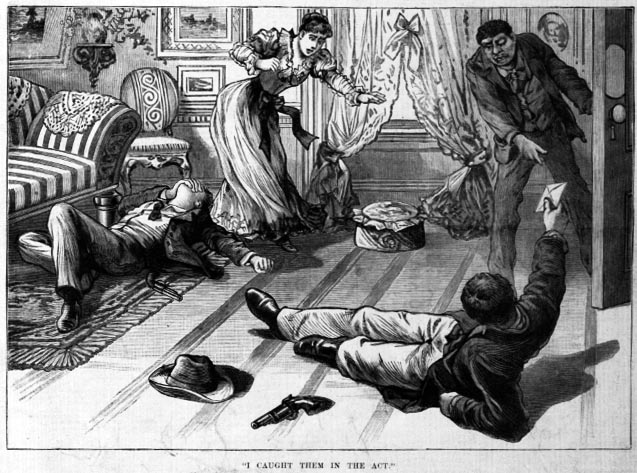
"I Caught Them in the Act."
C. F. Stephens owned a store in Livingston, Georgia about 12 miles from Rome. He employed Frank Wilkerson as a clerk in his store and provided him with room and board in his home.
Stephens was increasingly unhappy with this arrangement, and he sensed that things were not right in his house. He heard rumors that Wilkerson and his wife, Jessie, were intimate, and he found letters from Wilkinson to Jessie that appeared to confirm this.
Stephens wanted to find out for sure, so the morning of July 12, 1892, he told Jessie that he was going to Rome and would be back at 3:00 that afternoon. Instead, he returned home at 2:00. Stephens hitched his horse about half a mile from his house and walked home. He entered through the back door and took off his shoes so no one would hear his footsteps.
The bedroom door was closed. When Stephens opened the door, he found Wilkerson and his wife in a compromising position. He drew his revolver and shot twice, wounding Wilkerson. Stephens had only two bullets in his pistol, so he grabbed Wilkerson and pulled him to the floor. Wilkerson drew his pistol and shot twice; one of the bullets hit Stephens between the eyes, and he died a few minutes later.
Before he died, Stephens took the incriminating letters from his pocket and wrote on one, “I caught them in the act. C. F. Stephens.” He gave the letters to his manservant, saying, “Take these to my father. They tell a tale.”
Mrs. Stephens tried to grab the letters, but the servant left with them. She and Wilkerson were both arrested.
The trial of Frank Wilkerson the following October in Troy, Georgia, caused a sensation due to the prominence of the Stephens family. The courtroom was packed every day. More than sixty witnesses testified, but there was very little hard evidence beyond the obvious facts of the case. The debate centered on the incidents that led to the murder and the motives of those involved.
Several prosecution witnesses testified to having caught Wilkinson and Jessie Stephen in “a questionable attitude.” One testified that Stephens had not meant to kill Wilkerson, just to scare him. He had told Wilkerson to leave several times, but Wilkerson said that would be over Stephen’s dead body. Others testified that Wilkerson had intended to murder Stephens at the first opportunity and that Mrs. Stephens knew of his plans.
When Frank Wilkerson testified, his voice was so soft he could not be heard from 10 feet away and had to pause and weep several times. He said no one regretted the killing more than he did, but when Stephens started firing, he had nowhere to go and had to shoot back. He denied ever having intimate relations with Mrs. Stephens. When Stephens caught them, they were standing and talking about his leaving the house. The letters were just thanking Mrs. Stephens for some advice she had given him.
Jessie Stephens also denied any intimacy with Wilkerson, but she did say she loved him more than her husband. She said the handwriting on the letter was not her husband’s, but Deputy Sheriff McConnell, who had known Stephens from boyhood, said the signature was definitely his.
The jury convicted Frank Wilkerson of voluntary manslaughter.
Following the conviction, a grand jury indicted Jessie Stephens for adultery and accessory to murder. She fled the city before the police could take her into custody.
Sources:
“The Defendant Testifies,” Atlanta Journal, October 15, 1892.
“Didn't Desire His Blood,” Atlanta Journal, October 12, 1892.
“In the Southern States,” Dallas Morning News, July 19, 1892.
“Killed by His Wife's Lover,” Morning News, October 12, 1892.
“Killed by His Clerk,” Morning News, July 13, 1892.
“Mrs. Stephens Must Stand Trial,” Morning News, October 22, 1892.
“The Murderous Result,” Daily State Chronicle, July 14, 1892.
“She Loved Wilkinson,” Morning News, October 15, 1892.
“Wilkerson on Trial,” Atlanta Journal, October 11, 1892.
Wednesday, January 5, 2022
Alonzo Walling.
|
Alonzo Walling, Scott Jackson’s roommate, was arrested in February 1896 as Jackson’s accomplice in the murder of Pearl Bryan. Cincinnati phrenologist Dr. S. E. Hyndman analyzed Walling’s character by measuring his head and came to this conclusion:
“Alonzo Walling is easily led in the direction of friendship and in this, he would often do things which his better nature would revolt against. He would not go back on a friend until the very last, and then only to save his own life if he had promised to stand by him. He likes the society of the viscous better than that of the higher order. He would plunge into danger and calculate the chances afterward. His standard of morals is not of a higher order, his perceptive powers are small and if he were to be influenced, he would have to be managed through flattery.” |
Saturday, January 1, 2022
The Tragic Benham Mystery.
In 1892, Florence Tout, age 15, defied her parents and eloped with 23-year-old Howard Benham. Benham took control of Florence’s trust fund and five years later she died under suspicious circumstances.
Read the full story here: Married at 15, Dead at 20.
Wednesday, December 29, 2021
Scott Jackson.
|
Phrenologist, Dr. S. E. Hyndman, performed measurements on the
head of Scott Jackson, accused killer of Pearl Bryan, shortly after his arrest in February 1896. He came to this conclusion:
"My analysis of Scott Jackson reveals a bold, fearless, intense organization, with a perverted amativeness, and unwise gratification of this faculty has changed his physical, intellectual and moral condition and debased his higher mental qualities. He readily and quickly reasons from cause to effect; is intensely selfish in whatever he does; would mislead anyone to assist himself and has strong perceptive powers. He is a good planner and a fearless executer; once his mind is made up to do a thing, neither God, nor man, nor the devil, would prevent the attempt, every faculty would be perverted." |
Saturday, December 25, 2021
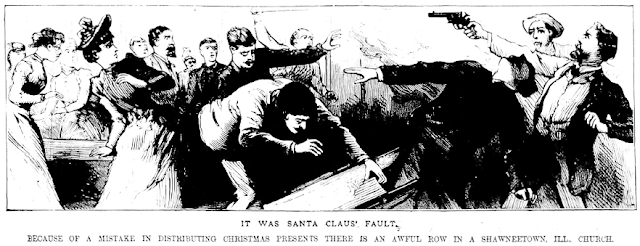
It was Santa Claus' Fault.
Sources:
“A Free Fight in a Church,” Boston Herald, December 26, 1889.
“It Was Santa Claus' Fault,” National Police Gazette, January 11, 1890.
“Wound Up om a Free Fight,” New York Herald, December 26, 1889.
Monday, December 20, 2021
So Far from Home.
New Book!
The Pearl Bryan Murder
Saturday, December 18, 2021
Murder of Col. Sharp.
Saturday, December 11, 2021
Michael M’Garvey.
The evening of November 21, 1828, Michael M’Garvey violently chastised his wife, Margaret, in the room, they occupied on the top floor of a house at the corner of Pine and Ball Alleys, between Third and Fourth Streets, and between South and Shippen Streets in Philadelphia. He tied her by the hair to a bedpost and began beating her, unmercifully with a whip, continuing at intervals for the next hour and a half. When she passed out, he attempted to throw her out the window but pulled her back in when someone outside saw him and cried out.
Saturday, December 4, 2021
The Wife's Lament.
The business was doing well, and the two men got along until O’Keefe moved in. That winter they frequently argued over the way Kenney was treating O’Keefe’s sister. Kenney was a quiet man when sober, but aggressive when drunk, which became increasingly frequent. The arguments sometimes turned violent with punches thrown and bottles broken. Kenney ordered O’Keefe out of the house. O’Keefe refused to leave, and his sister took his side. O’Keefe remained but the two men barely spoke to each other.
At dinner on May 2, 1872, O’Keefe asked Kenney about the store. Kenney had been drinking heavily for several days and O’Keefe worried that it would hurt their sales. Kenney told him to mind his own business, but since the store was O’Keefe’s business, the argument escalated. When the subject of Kenney’s cruel treatment of his wife arose again, Kenney jump up and said, “Come down to the green and we will settle this matter.” Mrs. Kenney interceded then and separated them.
Around 8:00 that night, as Kenney was waiting on a customer and O’Keefe came to the barroom door and looked in. When Kenney was through with the customer, he went outside, and the argument started up again on the sidewalk. A scuffle ensued, they clinched and fell to the ground. O’Keefe pulled a jackknife from his pocket and stabbed Kenney in the neck. Kenney exclaimed, “I am killed.” O’Keefe took off down the alley.
Kenney managed to raise himself from the sidewalk and staggered into the store with blood streaming from his neck. Medical aid was summoned, but O’Keefe had severed Kenney’s jugular vein and he died before the doctors arrived. His wife bent over him, frantically imploring him to speak to her. “Who did this?” she asked, “What did Peter do that they should kill him.” She continued to lament over her husband’s body until someone removed her to a neighboring house.
O’Keefe entered the house through the backdoor, ran upstairs, and changed his clothes. He went back out through the barroom door where officers Dudley and Johnson were waiting for him. At the police station, O’Keefe confessed to the stabbing. The police searched his room and found the knife in his pants pocket. It was just a small penknife with a 3-inch blade, but it was long enough to kill.
Richard O’Keefe was indicted for manslaughter.
Sources:
“Committed for Trial,” Fall River Daily Evening News, May 3, 1872.
“Murder of Peter Kenny by Richard O'Keefe,” Illustrated Police News, May 9, 1872.
“The South Boston Murder,” Boston Evening Transcript, May 6, 1872.
“Terrible Murder in South Boston,” Boston Herald, May 3, 1872.
Saturday, November 27, 2021
A Red Path of Jealousy.
Martha Place, driven by jealousy, strangled her stepdaughter.
Saturday, November 20, 2021
A Boy Murderer.
Wesley took the infant, splattered with blood, out of the room, and cleaned and dressed her. Then he hitched up the buggy and started for his grandfather’s house, stopping on the way to tell the neighbors that an assassin had murdered his parents; he took the baby and they fled for their lives.
The neighbor went to the Elkins’s house where they found the bodies of 45-year-old Mr. Elkins and his 25-year-old wife. Mr. Elkin’s head had been blown to pieces, and Mrs. Elkin’s head was beaten to a jelly. They sent for the police who were immediately skeptical of Wesley’s story.
![]() |
| Wesley Elkins, around the time of the murder |
John Wesley Elkins was indicted for first-degree murder. At his trial the following January,
![]() |
| Wesley Elkins, after his release. |
Wesley was believed to be the youngest person to date to be sent to prison in America, and his life sentenced prompted heated arguments. Some felt that no 11-year-old boy belonged in prison regardless of the crime, others felt that Wesley should be sent to the gallows.
Wesley Elkins used his time wisely while at Anamosa. He worked at the prison library and at the chapel and became proficient with the written and spoken word. In 1902, twelve years into Wesley’s sentence, after bitter debate Governor Cummins issued him parole papers. Wesley left the prison a free man.
Following his release, Wesley led a full life. He first settled in St. Paul, Minnesota where he worked on the railroad. Then in 1922, he married a Hawaiian woman in Honolulu. Eventually, he became a farmer in San Bernardino, California, where he resided until his death in 1961.
Sources:
"A Boy Murderer." Evening Star 27 Jul 1889.
"A Brilliant Beginning." National Police Gazette 9 Nov 1889.
"A Young Fiends' Confession.." New York Herald 20 Oct 1889.
"Double Murder by a Boy." New York Herald 27 Jul 1889.
"Murdered his Father and Mother." Daily Illinois State Register 27 Jul 1889.
Anamosa State Penitentiary: The Strange Case of Wesley Elkins.
"To Prison For Life." Kalamazoo Gazette 23 Jan 1890.
"Wesley Elkins." Wheeling Register 13 Jan 1890.
Saturday, November 13, 2021
Most Horrible Crime of the Age!
William Bachmann was last seen alive at a brewery owned by Charles Marlow and Marlow was quickly arrested for Bachmann’s murder. But prosecuting Marlow would prove difficult because there were no eyewitnesses to the crime, there was no identifiable body, and Marlow’s mother-in-law, under oath, had already confessed to the murder.
Read the full story here: The Marlow Murder.
Saturday, November 6, 2021
Hamilton Y. Jones, Detective.
At 8:00 the next morning, George Powers’s dead body was found lying under the table with a bullet wound in the side of his head. A hole in the window near the table indicates that the shot was fired from outside. The murderer then broke out a back window, sash and all, and entered the room. Powers was still alive, and a fearful struggle ensued. His hands were covered with mud as if he had caught hold of the killer’s boots. The killer then beat Powers’s brains out with a club.
The killer rifled through Powers’s trunk and turned his pockets inside out, but the only thing taken was his pocket watch. The description of the stolen watch was remarkably detailed: a silver open-face watch, No. 14,122, with case No. 15,399, Hoyt movement, key winder. That day, $1,000 was raised to prosecute the search for the killer.
The killer or killers were believed to have been among a group of tramps seen around Marshall that week. Their identity remained unknown until September 14, when someone from Marshall recognized them in St. Louis. William. Lyons, alias Kerr, John J. Schanner, William Staab, and William Gagon were arrested on suspicion but later released.
The early afternoon of October 26, Chief of Police Phillips of Springfield, Illinois, received the following dispatch:
Lincoln, Ill., October 26 – Arrest a man, smooth face, black overcoat, black stiff hat, low heavy set. Wanted for murder. On freight due at 2:30 this p.m.
Jones.
Though the police did not know who Jones was, they arrested the described man as he descended from a boxcar. The man said his name was Martin Cratty, and among his effects were letters and papers addressed to that name. One letter, signed Kittie O’Brien, was suspicious. It spoke of a scheme and said Cratty had been recommended as one who could do the work and keep it secret.
When the 3:50 passenger train arrived from the north, the police learned the identity of Mr. Jones, and they were none too happy. It was Hamilton Y. Jones, a self-styled detective that they knew well. “He is a notoriously hard character,” said the Daily Illinois State Journal, “and is as familiar with the walls of our county jails as he is with a drink of whiskey, and that is putting it pretty strong.”
Jones produced a warrant for the arrest of A.C. Kerr and stated that Martin Cratty was an alias. He was wanted for the murder of George Powers in Marshall. Jones claimed that Cratty had pawned Powers’s watch in Lincoln the previous day. Cratty claimed he had purchased the watch from a jeweler in Bloomington and had the dealer’s certificate at home. Jones said he had been working the case for over a month and had captured the killer. From the State Journal again, “Hamilton, however, is a liar of proportions that Baron Munchausen never dreamed of and is a man whom the police regard as a sneak thief and petty crook of the worst stripe.” The police tended to believe Cratty’s story, but to be on the safe side, they held him in jail.
Jones left but planned to return on October 30 to take charge of the prisoner and return to Marshall. In the meantime, the police recovered the pawned watch and found it was not Powers’s—it had a Millan movement, not a Hoyt movement, and neither of the numbers matched. Cratty’s stepfather arrived in Springfield with a statement from Cratty’s employer proving he was in Bloomington at the time of the murder.
Hamilton Jones returned to Springfield on October 30, and as soon as he entered the police station, he was arrested for the false imprisonment of Martin Cratty. Cratty was released, and Jones occupied his old cell.
When his investigations began, Hamilton Jones convinced authorities in Marshall that he was on the right track. They furnished him with $15 cash, a pair of handcuffs, and a good revolver. From time to time during his travels, Jones telegraphed for more money which Marshall provided. On November 12, Jones was arrested in Marshall for securing money under false pretense.
On December 15, Hamilton Y. Jones was arrested again in Springfield on an unrelated matter. He was charged with impersonating a United States Post Office Inspector and stealing mail. This time he would serve a term in the penitentiary.
The murder of George Powers remained unsolved.
Sources:
“Arrested for the Powers Murder,” Chicago Daily News, October 27, 1886.
“Deeds of Blood,” Juneau County Argus, September 23, 1886.
“A Foul Murder,” Daily Illinois State Journal, September 14, 1886.
“Hamilton Y Jones' Vagaries,” Daily Inter Ocean, December 16, 1886.
“Illinois,” Indianapolis Journal, November 11, 1886.
“Martin Cratty,” Daily Illinois State Register, October 29, 1886.
“Minor Mention,” Daily Illinois State Register, November 12, 1886.
“A Mysterious Murder,” National Police Gazette, October 2, 1886.
“News Article,” Daily Illinois State Journal, October 28, 1886.
“A Rough Experience,” Daily Illinois State Journal, October 27, 1886.
“See Saw, See Saw,” Daily Illinois State Journal, October 30, 1886.


.jpg)