
Read the full story here: The Sleepwalking Defense.

Read the full story here: The Sleepwalking Defense.

Around 8:00, the night of Sunday, June 11, 1871, neighbors heard gunshots from the drug store. They went inside and found Amelia Berry lying on the floor, mortally wounded. On the floor above, they found Edward, insensible, with a bullet through his brain. The room was in disarray, and some of the furniture was broken. Edward died soon after, and Amelia died around 11:00 the following night.

Read the full story here: James E. Eldredge
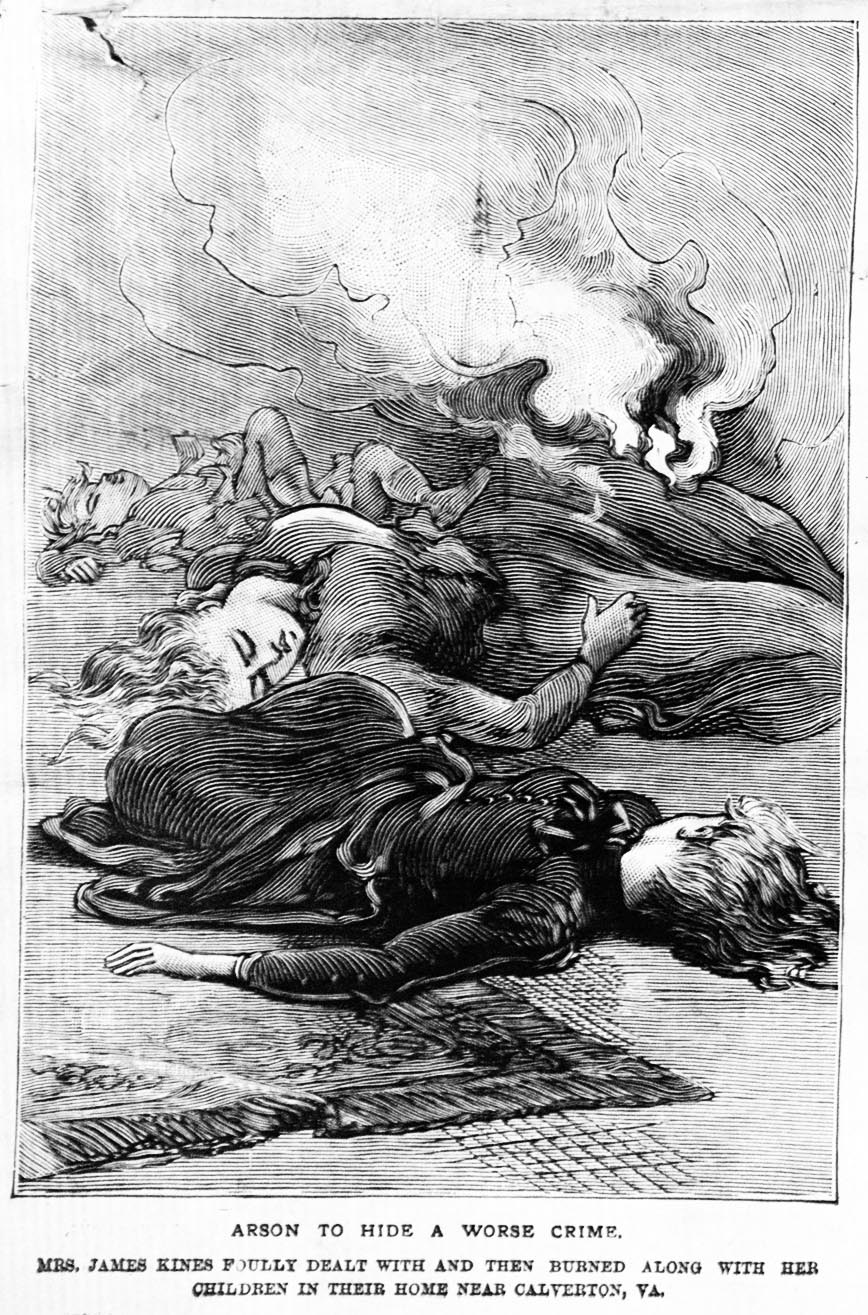
The house belonged to Mrs. J. W. Kines, a widow who lived there with three of her children. It appeared that all four were still inside. The Robinsons ventured in and were able to pull out three bodies. 8-year-old Lizzie Kines lay near the door and was only slightly burned. Annie Kines, ten years old, was so badly burned as to be unrecognizable. Mrs. Kines’s body was severely charred but not as bad as her daughter's. There was no trace of 4-year-old Gilbert Kines.

Read the full story: Murder at Bloomingdale.


A pair of attractive young ladies sat down at the table next to them. Nelly Dalton and Fanny Coburn were sisters, the daughters of John Gove, who owned a clothing store in Boston. Fanny recognized Mr. Porter and reminded him they had been introduced at a ball for the City Guards the previous February. The four struck up a conversation, and although both ladies were married, they became quite flirtatious. Before they left, they told the men that they often came to Vinton’s and hoped they would see them there again.

Mrs. Caldwell exclaimed, “Go up and take care of him; he threatened to kill me, and I hit him with an axe, and I don’t know, but I have killed him.”


Included in

Reuben Snyder’s 26-year-old brother Ephriam was also at the party. Annie and Ephriam had been going together, off and on, for several years but lately had been arguing. Annie left the party around 8:00 that night. Ephriam left a few minutes later.
The next morning, Annie Harman’s body was found by the side of the road, about a quarter mile from her home. Her skull was crushed, her jaw broken, and her face badly cut and bruised. Next to the body lay a bloodstained chestnut club. A few feet away was another bloodstained piece of wood.
Ephriam Snyder became the prime suspect. Rebecca Snyder, Ephriam’s sister-in-law and Annie’s cousin, reported that Annie told her she thought she was pregnant and did not know what she would do if Ephriam did not marry her. Ephriam refused to marry her; he was engaged to someone else. Annie threatened to take him to court.


The attorneys gave their closing arguments on May 2. W.H. Kain, for the defense, addressed the jury for an hour and twenty-five minutes. He was followed by E.D. Ziegler, for the defense, who spoke for an hour and fifteen minutes. After lunch H.L. Fischer, for the commonwealth, spoke for two hours. Before giving the case to the jury, the judge addressed them for an hour.
The jury deliberated from 4:30 to 6:00 before returning a verdict of not guilty. Ephriam Snyder heartily shook the hand of each juryman and each member of his defense team before leaving the courtroom.
It was not the legal oratory that swayed the jury, one of the jurymen noticed something that even the prosecution missed. The bullets in the cartridge box were a perfect plane, while the bullet found at the scene was concaved. This was enough to convince the jury that the cartridges were not the same as the bullet. Without that, there was not enough evidence to convict Ephriam Snyder of murder.
No one else was ever arrested for Annie Harman’s murder, but the scene of the crime became a center of local superstition. A large shirt was seen stretched at full length in the top limbs of a high hickory tree. The soiled garment was known throughout the region as the “Bloody Shirt.”
Sources:
“Ephraim Snyder's Trial for Murder,” The Philadelphia Times, April 28, 1879.


When tried for the 1840 murder of Catherine Merry, Charles Cook pled innocent by reason of insanity. Despite a history of medical treatment for extreme melancholy, and strange behavior such as running through the streets of Schenectady, wearing nothing but a blanket, proclaiming himself to be the Savior of the world, the jury rejected his plea and found him guilty.
Before his execution, Cook issued a formal written confession elaborating on his mental condition: “I labored upon the control of a single passion, it was that of sexual fondness; and whenever frustrated in my attempts to gratify it, the spirit of revenge came upon me.”
 |
| Museum of the City of New York |
William Howe and Abraham Hummel were the most successful
criminal lawyers in Gilded Age New York. With a combination of skill,
showmanship, and unethical practices, they defended most of the city’s significant
criminals and many of its murderers. Whether they won or lost, Howe and Hummel
made every trial sensational.
Here are a few of the many accused murderers defended by Howe and Hummel:
| Defendant | Victim | Year | Story |
| James Logan | Charles M Rogers | 1869 |

The Rogers Murder. |
| Jacob Rosenzweig | Alicd Bowlsby | 1871 |

The Great Trunk Mystery. |
| Billy Forester | Benjamin Nathan | 1871 |

Who Killed Benjamin Nathan? |
| Edward Reinhardt | Mary Reinhardt | 1879 |

The Silver Lake Mystery. |
| Thomas McCabe | Catherine McCabe | 1882 |

A Boy Murderer. |
| Dan Driscoll | Breezy Garrity | 1886 |

Murder Among the Whyos - Part 1. |
| Daniel Murphy | Dan Lyons | 1887 |

Murder Among the Whyos - Part 2. |
| Hannah Southworth | Stephen Pettus | 1889 |

Avenging Her Honor. |
| Mickey Sliney | Robert Lyons | 1891 |

The Confessions of Mickey Sliney. |


Nettie Brown (or Braun) kept a house of ill-fame in St. Louis with her partner and bartender George Hobbs (or Haubs). In 1877, Lizzie Fields was one of their girls. Lizzie and Nettie had been as close as sisters at first, but they were bitter enemies by April. Lizzie gave Nettie a ring of hers for safekeeping; the trouble began when Lizzie saw her ring on the finger of George Hobbs. After a heated argument, they threw Lizzie out of the house, keeping her clothes and the ring.
Lizzie Fields took up residence in a nearby brothel run by Gussie Freeman. On April 3, 1877, Hobbs was walking down the alley near Freeman’s house when Lizzie began shouting vile names at him through an open window. Hobbs paid no attention at the time, but later, he and Nettie went back to Freeman’s to see her. Lizzie taunted them again from the window, and Hobbs picked up a rock and threw it at her. He missed Lizzie but broke the window and tore the curtain.
They went to the door, but Gussie would not let them in. Hobbs explained that he wanted to pay for the window he had just broken, so Gussie opened the door. As they argued over how much the repairs would cost, Nettie rushed in and found Lizzie in the front room. Nettie pulled a butcher knife from her sleeve. Lizzie was holding a soda bottle and was ready to use it as a weapon. Accounts differ as to what Hobbs did next; he either tried to separate the women or held Lizzie’s wrist so Nettie could strike. In either case, Nettie plunged the butcher knife into Lizzie’s chest twice. Then, she and Hobbs ran from the house.
Gussie Freeman sent a messenger to fetch a doctor, and others ran from the house following Nettie and Hobbs. The police arrested the couple soon after. Lizzie held on to life until May 15. The cause of death was a secondary hemorrhage brought on by the ulceration of knife wounds. Nettie Brown was charged with first-degree murder and George Hobbs as an accessory.
The trial of Nettie Brown began on February 15, 1878. Her plea was self-defense, claiming that Lizzie threatened her with the soda bottle. Her attorney also asserted that the secondary hemorrhage was brought on by the large dose of morphine Lizzie had taken that day. He claimed she was nearly dead already when the stabbing occurred.
The jury deliberated for twenty-four hours before telling the judge they were hopelessly deadlocked—9 for acquittal, 3 for conviction. The problem was they were given only two choices, acquittal or first-degree murder and Missouri juries were reluctant to send a woman to the gallows.
In May, State’s Attorney Beach wanted to change the charge to second-degree murder. However, the defense insisted that she be tried on the original charge. Beach argued that such a trial would be useless as no jury would convict a woman of murder in the first degree. The judge agreed to the new charge and the defense requested a continuance.
The case was continued several more times before being tried in April 1879. Nettie Brown was found guilty of second-degree murder and sent to Jefferson City Penitentiary. George Hobbs case was continued generally, meaning the charges were effectively dismissed unless the state found new evidence.

“Oh my stars! Oh my Stars!” said Buel, apparently horrified.
They went to the farmhouse to notify the family. Both Mr. and Mrs. Richards were away that day, so they took Catherine’s sister Maggie and the housekeeper to the barn. Maggie asked Buel what had happened to Catherine, and he said the bull must have killed her.
Buel repeated this several times and it became the accepted story until the coroner got a look at the body. He concluded that Catherine had not been gored by the bull, someone had strangled her and hit her in the face with a blunt object. He also found evidence that she had been raped.
Myron Buel became the prime suspect in Catherine’s murder. Buel was called “The Boy Murderer” but he was 20 years old in 1878. He was madly in love with Catherine, though she was six years younger. He had asked her to marry him, and when she refused, Buel made improper suggestions, driving her to tears. Though he always recanted later, he continued making lewd comments until Catherine threatened to tell her parents.
On the day of the murder, when Buel and Bowen were working in the hops field, he told Bowen that the rubber boots he was wearing were too hot and he went back to the house to change them. He was gone for about 45 minutes. When Bowen asked what took him so long, he said he had to put away a horse that had gotten loose.
Buel was charged with murder and brought to trial on February 17, 1879. The trial lasted ten days and the courtroom was crowded with spectators each day. Following the closing arguments, the judge spoke for an hour and a half, giving instructions to the jury. The jury deliberated for four hours before returning a verdict of guilty.
Buel’s lawyers moved for a new trial on the grounds that the judge had instructed the jury to find him guilty of first-degree murder or acquit him. He should have instructed them on the several degrees of manslaughter as well. The motion was denied, and the judge sentenced Myron Buel to be hanged on April 18.
The execution date was changed to November 14 to allow Buel’s attorneys to argue before the Court of Appeals. The Court refused to grant a new trial and affirmed the judgement of the lower court. They petitioned the Governor for a reprieve, but he refused.

Throughout the process, Buel maintained his innocence but, three days before his execution, with no hope left, Buel confessed to his spiritual advisors and his counsel. In his confession, Buel said he was angry because Catherine had told her parents about his “passionate desire” for her. On the day of the murder, he knew Mr. and Mrs. Richards would not be home. When he told Bowen he was going to change his boots, he was going to kill Catherine.
“Oh! How I felt as I went down the path to the barn!” Buel confessed.
He found Catherine in the cheese house, playing with her kittens. He had let out the calf, knowing she would help him bring it back to the barn. When they were inside the barn, he shut the door and quickly threw a rope around her neck and pulled it tight.
“Her eyes looked terrible when she was struggling,” said Buel, “Then I struck her with a milking stool that stood by me. I then ravished her. She was dead but warm when I committed the crime.”
He carried her to the bull’s stall so it would appear that the bull killed her, then he let the bull out.
“I loved Catherine and was jealous. I intended to kill her and ravish her because I was mad.”
Myron Buel was hanged on November 14, 1879. The gallows in New York State at the time used a counterweight to jerk the condemned man upward. At 10:39 a.m. the body shot four feet up in the air and fell back with a sickening thud. Fourteen minutes later Drs. Westlake and Hills pronounced him dead.

Greed, jealousy, revenge, obsession – the motives of America’s gas-lit murders are universal and timeless. Yet their stories are tightly bound to a particular place and time; uniquely American, uniquely 19th Century.


.jpg)


