Showing posts with label Decapitation. Show all posts

Saturday, September 20, 2025

The Demon Druses.


 "The verdict of the coroner’s jury charges that Mrs. Druse shot her husband with a revolver, struck him with an axe upon the head, and severed his head from his body, causing instantaneous death. That Roxalana Druse afterward cut up and burned the body. Mary J. Druse, George W. S. Druse, and Frank Gates are charged with being feloniously present and abetting the said Roxalana Druse in committing the murder."
--"The Demon Druses", Illustrated Police News, February 14, 1885.

Read the full story here: The Druse Butchery.

Saturday, September 7, 2024

A Young Fiend.

Maggie Thompson, a pretty eight-year-old girl living on Merchant Avenue in Cleveland, Ohio, mysteriously disappeared on May 9, 1889. She was coming from school, just two blocks away, but she never reached her home. Detectives, police constables, and private citizens searched the neighborhood to no avail. They found no trace of Maggie.

Thursday, January 27, 2022

Her Struggle was Useless.

Artist's rendition of the Pearl Bryan murder from The Mysterious Murder of Pearl Bryan, Or, The Headless Horror. Cincinnati: Barclay & Co., 1896.

Read Pearl Bryan's story in the new book,


Now available at Amazon.


Thursday, January 13, 2022

Pearl Bryan.


Pearl Bryan.


Murder victim Pearl Bryan was the belle of Greencastle, Indiana. She was popular among her peers and admired by all who knew her. Pearl was a girl of the most amiable disposition. Too amiable in fact, said her friends, and inclined to yield to the requests or urgings of others.

Though friendly and outgoing, Pearl kept her personal life private. When Pearl learned she was pregnant, she told no one but her second cousin, Will Wood.

Will Wood was Pearl’s confidant, but he was not to be trusted. He was a rude braggart who boasted of his sexual relations with Pearl. The Cincinnati Enquirer summed up Will Wood’s Greencastle reputation saying, “The youth is generally recognized as a cigarette fiend of unbalanced mind and of a totally depraved nature.” Many in Greencastle believed that Will Wood was the father of Pearl’s unborn child and was ultimately responsible for her death.
Will Wood

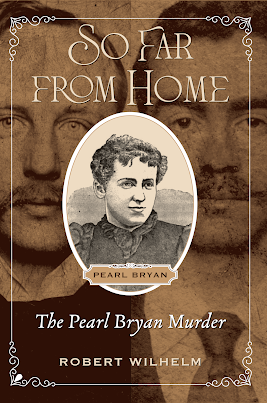
So Far from Home: 

The Pearl Bryan Murder

by Robert Wilhelm


Wednesday, January 5, 2022

Alonzo Walling.


Scott Jackson
Courtesy of The Cincinnati Enquirer

Alonzo Walling, Scott Jackson’s roommate, was arrested in February 1896 as Jackson’s accomplice in the murder of Pearl Bryan. Cincinnati phrenologist Dr. S. E. Hyndman analyzed Walling’s character by measuring his head and came to this conclusion:
“Alonzo Walling is easily led in the direction of friendship and in this, he would often do things which his better nature would revolt against. He would not go back on a friend until the very last, and then only to save his own life if he had promised to stand by him. He likes the society of the viscous better than that of the higher order. He would plunge into danger and calculate the chances afterward. His standard of morals is not of a higher order, his perceptive powers are small and if he were to be influenced, he would have to be managed through flattery.”


Walling’s involvement in the case was always somewhat shadowy, he was accused of actively participating in Pearl Bryan’s murder, but he may have been little more than a knowing but innocent bystander. The public saw Walling as dull, weak-willed, and subservient to Jackson against his own best interest. Whatever his connection was to the murder, he kept the secret to himself and stood by his roommate to the end.


Wednesday, December 29, 2021

Scott Jackson.


Scott Jackson
Courtesy of The Cincinnati Enquirer

Phrenologist, Dr. S. E. Hyndman, performed measurements on the head of Scott Jackson, accused killer of Pearl Bryan, shortly after his arrest in February 1896. He came to this conclusion:
"My analysis of Scott Jackson reveals a bold, fearless, intense organization, with a perverted amativeness, and unwise gratification of this faculty has changed his physical, intellectual and moral condition and debased his higher mental qualities. He readily and quickly reasons from cause to effect; is intensely selfish in whatever he does; would mislead anyone to assist himself and has strong perceptive powers. He is a good planner and a fearless executer; once his mind is made up to do a thing, neither God, nor man, nor the devil, would prevent the attempt, every faculty would be perverted."

Dr. Hyndman’s assessment was probably influenced as much by public opinion as it was by the bumps on his heads In Cincinnati, Scott Jackson was viewed as strong, self-centered, and fundamentally evil. Jackson was the master manipulator who seduced the farm girl, persuaded the preacher’s son to send her to Cincinnati, and enlisted the country boy to help kill her. Some believed that Jackson had hypnotic power to impose his will on others and attributed that power to a property that even phrenology could not measure: his evil eye. 

Every written description of Scott Jackson referred to the power of his eyes. They were steel blue, some said violet, and had a mesmerizing power that he used to beguile Pearl Bryan into an intimate affair that she kept secret from her friends and family. She was—referencing the most popular novel of the time—Trilby to his Svengali.

Monday, December 20, 2021

So Far from Home.


New Book!

So Far from Home 

The Pearl Bryan Murder


"Yes. they drove far from the city,
To a place so far from home,
There they left her body lying
Headless and all stained with blood"
 Pearl Bryan (Traditional Ballad)

Available at Amazon.

Saturday, March 24, 2018

Massachusetts Butchery.

Two young boys walking down a road in Lexington, Massachusetts, on January 4, 1887, found a bloody shirt atop a stone wall by the side of the road. They stopped to look around and saw a bundle of clothes lying on the crust of snow on the other side of the wall. The bundle consisted of an entire suit of men’s clothing, from undergarments to overcoat, all saturated with blood. The boys gathered the clothes and hurried back to town. The Lexington Police examined the clothing and believed that it was evidence that a murder had been committed within the previous 48 hours.

Their speculation was confirmed the following morning when L. I. Brooks, a farmer from Lincoln, Massachusetts saw what he thought was a large snowball in a patch of bloody snow. Looking closer he saw that it was a severed human head with two or three deep gashes in the left side. About four feet to the right of the head he found a severed arm. He left the body parts where he found them then drove his sleigh as fast as possible into Lexington to inform the Selectmen. A search party was sent out at once and by the end of the day, they had found the naked body of a man, half hidden by bushes in a gully about a mile from where the head was found. The head, left arm, and right leg of the body were missing. The search continued, but the missing leg was not found that day.

Saturday, October 1, 2016

Shocking Murder in Charlestown, Massachusetts.

Little Murders
(From Jackson Citizen, December 15, 1868)

Shocking Murder in Charlestown, Massachusetts.
Two Brothers-in-Law Engage in a Difficulty and One Cuts the Other’s Head Off with a Cleaver—Arrest of the Murderer

Boston, Mass. December 4, 1868.

This morning a shocking murder occurred in Furbush’s fat factory, Furbush’s Court, Charlestown. Two men, brothers-in-law, were there at work quietly together when one went out, and returning soon after with a cleaver  deliberately cut the head off his unsuspecting companion, who was still at work, and whose head at the time of the murder was over a chopping block whereon fat is cut. The murderer then escaped. The murdered man was to testify against the other in some petty civil suit, and this is supposed to have been the cause of the deed. The name of the man is Dennis Cronan, the murderer’s name is Reene.

The murdered man and Reene were at work in a room by themselves, and from the cut it would seem that Cronan was leaning over when the blow was struck so his head was severed from the body except for a few ligaments in front. Officer Brower was informed about nine o’clock that a suicide or murder had occurred at Faribush’s factory. Officer Brower hastened to the place, which is located at the neck, and found the man lying on his shovel and some bones and fat, his head being severed from his body, with the exception that a small piece of the skin on the throat was not cut. The men at work in the adjoining room did not know that the murder had occurred and the body may have lain therefore an hour before it was discovered. A coroner was summoned and immediately took charge of the body and summoned a jury of inquest.

The murder must have been occasioned by the petty civil suit referred to. The two men had a dispute about some money, and the case had been in court once. It occasioned considerable hard feeling between the two men, which culminated in the act of Reene to-day. Cronan must have expired instantly, or, in the words of the officer, “he never knew what killed him.”

The two me were ordinary Irish laborers and both resided in Charlestown, near the factory, where they were employed to cut up and shovel fat, bones, &c.

"Shocking Murder In Charlestown, Massachusetts." Jackson Citizen 15 Dec 1868.

Saturday, October 17, 2015

An Ancient Mystery Solved.

Little Murders
(From New York Tribune, November 29, 1883)


An Ancient Mystery Solved.
 The Perpetrator of One Murder, Which Led to Four Others, Discovered.

Seymour, Ind., Nov. 28. – An old murder mystery, resulting in four other tragedies, has just been cleared up. Moore Woodmansee, a wealthy merchant of Medora, nineteen miles from here, came to Seymour, January 3, 1866, on his way to Cincinnati. He had $2,000 with which to purchase goods. He was missed from his room at the Roder House, and the cause of his disappearance was a mystery until October, when his body was found in White River, with the head cut off. Gordon Kinney, an employee of the hotel, was suspected of the crime. When the excitement caused by the finding of the body was at its highest, an unknown man called Kinney from his door one night; as the latter opened the door he was shot and instantly killed.

In 1872 Reuben Wheeler was mortally wounded. When told he had to die, Wheeler made a confession, saying that on the night of Woodmansee’s murder two men had taken from the Roder stable the horse and spring-wagon. In the morning they returned. The bottom of the wagon was covered with blood. It was afterward taken out and new boards substituted. Roder was arrested for the murder, but acquitted; and again the affair was a dark mystery.

Saturday, October 19, 2013

Mabel Smith.

Little Murders:
From Defenders and Offenders:


Mabel Smith.

"This big mulatto is a wicked creature, who severed her grandmother’s head from her body with an axe, in order to effect her elopement with her white paramour, who called himself Thomas B. Hayward. After the deed, they skipped off together in a buggy. The old woman was opposed to the connection, and it was supposed the deed was done in a fit of anger while quarreling over the man. They were both captured a few hours after the deed."


Defenders and offenders. New York: D. Buchner & Co., 1888.


Saturday, April 28, 2012

Horror!


For several days there had been no activity on the Deering farm, just south of the city of Philadelphia, so on April 11, 1866, their neighbor, Mr. Ware, went over to see what was wrong. He found the house empty, but in the barn, he saw a human foot protruding from the hay. Ware ran for help, and together they uncovered the brutally mutilated bodies of Christopher Deering, his wife Julia, four of their children—ranging in age from eight years to fourteen months—and Elizabeth Dolan, a visiting cousin. Outside the barn they found the body of Cornelius Cary, seventeen-year-old hired hand, similarly mutilated.

The following day, the headline in the Philadelphia Inquirer bore the single word: “Horror!”.

Saturday, February 25, 2012

Decapitation and Dismemberment

Cutting the head and limbs off a corpse is hard and messy work. It is almost always an afterthought, an act of desperation by the murderer to avoid capture by hiding the identity of the body or to facilitate its disposal.
Of course, there were cases where decapitation was part of a deranged killer’s psychotic obsession.  Joseph Lapage raped and murdered 17-year-old Josie Langmaid, who was on her way to school in Pembroke, New Hampshire in 1875. Then, for no apparent reason, Lapage cut off her head and carried it half a mile before dropping it in the woods.


More often, the head was removed to obscure the identity of the corpse. The killers of Pearl Bryan in Newport, Kentucky, in 1896, were accused of severing her head while she was still alive. Whether she was alive at the time or not, Pearl Bryan’s head was removed to hide her identity. The killers might have succeeded in this if they had thought to remove her shoes as well.

Saturday, January 21, 2012

The Mysteries of Pearl Bryan

Someone with a knowledge of American murder ballads would likely notice a serious omission at Murder by Gaslight—the 1896 murder of Pearl Bryan that inspired three distinct ballads, each with several variations. The reason I haven’t yet posted on the death of Pearl Bryan is that I have written a book on that murder and was hoping to publish the book before the post.  But at the moment, I have no idea when that might happen.
In the meantime, an article I wrote some time ago on the death of Pearl Bryan was recently published by the magazine, Kentucky Explorer, and I have decided to reprint the article here. “Pearl Bryan: Headless Corpse Found on Northern Ky. Farm” –originally titled “The Mysteries of Pearl Bryan”—explores some of the unanswered questions in a case that today is usually presented as open-and-shut. It is longer than the average post, but it is a complicated story and still just the tip of the iceberg.
And here is a version of one of the ballads, “Pearl Bryan,” recorded in 1926 by Burnett & Rutherford:

"Pearl Bryan" -
Burnett & Rutherford

 The Mysteries of Pearl Bryan

When the headless corpse of a young pregnant woman was found on John Locke’s farm in the Highlands near Ft. Thomas, on February 1, 1896, the shock was felt far beyond the Ohio Valley.  For the rest of that winter and most of the spring the Ft. Thomas Tragedy unfolded in daily newspapers across America and, for a time, rivaled the murder of Lizzie Borden’s parents, four years earlier, for the dubious distinction of “Crime of the Century.”  The woman was Pearl Bryan, from the little town of Greencastle, Indiana and the mystery of how she had come to Kentucky, and there met such a gruesome fate, seemed as unfathomable as it was incomprehensible.

Saturday, September 3, 2011

The Boston Barrel Tragedy


1872 was an eventful year for Boston, Massachusetts. That year the city hosted the World’s Peace Jubilee and International Musical Festival, lasting 18 days and drawing thousands of visitors. The Boston Red Stockings won the National Association of Professional Base Ball Players Championship. The Great Boston Fire devastated 65 acres of downtown real estate. And the dismembered body of Abijah Ellis was found stuffed inside two barrels, floating in the Charles River.

Saturday, May 14, 2011

The Confession of Manuel P. Garcia

In January 2011, I posted a story on the 1821 murder of Peter Lagaordette by Manual Phillip Garcia from the Torch Light and Public Advertiser, Hagerstown, Maryland. At the time I doubted that I could find any additional information, but I have since found a picture and summary of a pamphlet on the murder printed and sold in 1821. Here is the summary from The Annals of Murder by Thomas M. McDade:
In an empty house in Portsmouth, Virginia, the police found the butchered body, the head, hands and feet partially burned in the fireplace. In an early use of laundry marks, the initials “P.L.” and “M.P.G” helped identify the people involved. Lagoardette had been courting a girl in Baltimore; Castillano was himself interested in her. The three men all were criminal characters.

Sunday, February 21, 2010

Josie Langmaid-"The Murdered Maiden Student"

On October 4, 1875, 17-year-old Josie Langmaid was absent from school – The Pembroke Academy in Pembroke, New Hampshire. When her parents learned that Josie never arrived at school, they organized a search party. At 9:00 that night they found the mutilated body of Josie Langmaid in the woods near the academy. The following morning they found her head, half a mile from where the body had been. The gruesome discovery tore the community of Pembroke apart.