Showing posts with label Massachusetts. Show all posts

Saturday, March 7, 2026

Medford's Murder Mystery.

(Boston Post, March 29, 1897,)

Walter R. Debbins was shot twice in the back, in broad daylight, on Highland Street in Medford, Massachusetts, on the afternoon of Saturday, March 27, 1897. Though no one saw the murder or heard the gunshots, there was enough traffic on Highland Street that afternoon for the police to precisely pinpoint the time of the shooting to between 1:00 and 1:05. But that was all they could pinpoint; everything else about the crime was shrouded in mystery that grew more dense with each new revelation.
 

Read the full story here: The Medford Mystery.

Saturday, February 28, 2026

Sororcide.

The Murder of Lizzie Anderson
Josie Fay was standing at the corner of Bowker and Sudbury Streets in Boston’s West End, on the evening of January 19, 1880. Stella Vannell approached her and asked if she had seen Ida King. Josie pointed down Bowker Street, where Ida stood talking with a young man named Michael Tolan. Stella walked up to the couple, called out to Ida, and began making disparaging remarks about Tolan. The women exchanged angry words, and the argument escalated until, in a flash, Stella drew a large clasp-knife and plunged it into Ida’s breast. Both women were drunk at the time of the incident, and both were using assumed names. In fact, they were sisters, Maggie and Lizzie Anderson.

Saturday, December 6, 2025

The Knife in Boston.

On the afternoon of November 27, 1874, Aaron P Barnes went, with his business assistant, John W. Ganie, to a lodging house Barnes owned on Gouch Street in Boston. One of the lodgers had left, and they wanted to ensure the room was ready for the next tenant. They went upstairs and found three young ruffians, somewhat intoxicated, lounging in the furnished but otherwise vacated room.

The men, Richard Nealon, James McCall, and George Watson (alias Jeremiah Cummings), appeared ready for a permanent stay. Barnes told them to leave, and they refused. An argument ensued.

McCall stepped up and said, “Shut your mouth; I’ll shoot you.”

Saturday, May 24, 2025

Was Abbott Innocent?

Illustrated Police News, February 28, 1885.

Joseph Crue returned from work to his home in Groton, Massachusetts, on January 18, 1880, and found his wife, Maria, lying dead in the bedroom.  She had been shot three times in the face, and the Medical Examiner determined that she had been raped.

A tramp was seen in the neighborhood that day looking for work. A neighbor of the Crues, Jennie Carr, identified the tramp as Stearns K. Abbott from a police photograph. Abbott had recently been released from New Hampshire State Prison, where he had served time for larceny. He had also served prison time in Massachusetts and Connecticut. Abbott had already left town, so the police circulated his photograph among New England police departments. Ten days later, Abbott was arrested in East Weare, New Hampshire.

Abbott was convicted of murder and sentenced to hang, but there was lingering doubt as to his guilt. In February 1885, Chief Wade of the State District Police said:

I never thought Abbot Killed that woman. Why, there was a whole hour of her husband’s time that was unaccounted for, and that length of time was sufficient for him to commit the deed in. It was the old story, though, of giving a dog a bad name and everybody will kick it. Abbott had a bad reputation and no friends to look out for his interests. That Jennie Carr that swore so strongly in the case knew a good deal more than she swore to. She didn’t care to tell all she knew. I have no doubt that the truth will come out in this case and that it will be at last cleared up. Stearns Kendall Abbott is an innocent man, so far as the murder of Mrs. Crue is concerned. 

The truth never did come out, but public pressure led the state governor to commute Abbott's sentence to life in prison. Abbott served thirty years of his sentence before being pardoned in 1911. He never wavered in his assertion of innocence. 

Read the full story here: The Groton Tragedy.

Saturday, April 19, 2025

Liquor and Free Love.

As Police Officers Henry Johnson and Eli Veazie were leaving the Chelsea, Massachusetts City Marshal’s office on the evening of February 17, 1872, they were approached by a man, intoxicated and in a state of agitation.

“I have had my revenge. I want you to go with me,” he said, “I suppose I have killed him and shall have to suffer for it.”

Saturday, September 28, 2024

A Mysterious Tragedy.

Dr. Henry Clark of Boston was summoned to 11 Hamilton Place at around 7:00 the morning of December 30, 1879. A woman had been shot and needed urgent care. When he got there, she was nearly gone, and there was nothing he could do. 

A policeman and a medical examiner arrived soon after and determined that the woman, Mrs. Helen J. Ward, had been shot twice in the head. One shot entered her temple and went through her head, the other fractured her skull without entering. 

Her 18-year-old daughter, also named Helen, did her best to explain what happened. Mother and daughter shared a bed. They worried about burglars, so they kept a revolver on a chair beside the bed. Miss Ward believed she had been in a somnambulant state and fired at a moving object that she thought was a burglar. Alternatively, she thought the gun may have discharged accidentally. This took place around 4:00 am, raising the question of why she didn’t contact someone sooner. Miss Ward was considered cold and unfeeling because she did not seem overly affected by her mother’s death.

Saturday, February 24, 2024

Alice and Lillie.


Alice Hoyle last saw her sister, Lillie, the night of September 1, 1887, in the room they shared in Webster, Massachusetts. Lillie left to use the outhouse, and Alice fell asleep. Lillie never returned. The next morning, Alice went out, thinking Lillie had already left for work. That is the story Alice told the police— as the investigation progressed, she would change it several times.

Read the full story here: The Webster Mystery.

Saturday, December 23, 2023

Shot on Christmas Eve.


“A dark, mean little bedroom, a woman, half-undressed, dirty and pale, and blear-eyed from long excesses, a male companion, leaning over her with a revolver at her head, two shots, a shriek, an ugly hole under the ear, and the vice and crime of Boston had added another murder to its long score.” 

- The Boston Herald’s vivid description of the murder of Josephine Brown on Christmas Eve, 1891.


Read the full story here: Two Shots, A Shriek.

Saturday, September 2, 2023

The Groton Tragedy.

Illustrated Police News, July 6, 1895.

Joseph Crue returned from work to his farm in Groton, near Ayer, Massachusetts, about 8:00 on the evening of January 18, 1880. He was surprised to find all the doors locked and curtains closed. His wife, Maria, should have been inside, but there was no response when he knocked on the door. The hatchway to the cellar partly opened, so he entered that way. He lit a lamp in the kitchen and searched the dark house for his wife. He found her lying dead in the bedroom, shot three times in the face and once in the chest.

Saturday, August 26, 2023

Morbid and Melancholy.

Cora Marston.

On September 1, 1865, Dr. Carlos Marston, his wife Susannah, and their adopted daughter Cora were found shot to death in their bedrooms. Susannah Marston was said to have a “morbid and melancholy disposition” and suffered for years with depression. Her behavior was increasingly erratic and on that morning she snapped. Susannah drugged her husband and Cora with chloroform then shot them both. She then lay down beside Carlos and shot herself.

Read the full story here: The Dedham Tragedy.
 

Saturday, March 25, 2023

The Cruel Axe.


17-year-old James E. Nowlin murdered George Codman in a Massachusetts stable in January 1887. Then he took an axe and chopped Codman’s body into pieces. As he traveled home in a sleigh, he threw the pieces into the snow along the road.

Read the full story here: Massachusetts Butchery.


Saturday, February 25, 2023

Maria Bickford.

Maria Bickford, a beautiful young prostitute, was found murdered in her room in Boston’s Beacon Hill. Her throat was slashed from ear to ear and her bed had been set on fire. 

Read the full story here: The Sleepwalking Defense.

Saturday, January 7, 2023

Murdered at Prayer.


A.E. Ambrose was working in his yard in South Byfield, Massachusetts, the morning of January 3, 1879, when he was surprised by two of his neighbors, Mrs. Caldwell and her sister Miss Brown, excitedly running toward him. Mrs. Lucy Caldwell was known for her erratic behavior and always seemed somewhat excited, but he had never seen Miss Brown looking so terrified.

Mrs. Caldwell exclaimed, “Go up and take care of him; he threatened to kill me, and I hit him with an axe, and I don’t know, but I have killed him.”

Saturday, May 7, 2022

The Codman Murder.


James Nowlen murdered George Codman by cutting his throat from behind. Then he chopped the body into pieces which he threw into the snow as traveled down the road in his sleigh.

Read the full story here: Massachusetts Butchery.

Saturday, February 12, 2022

A Double Tragedy.

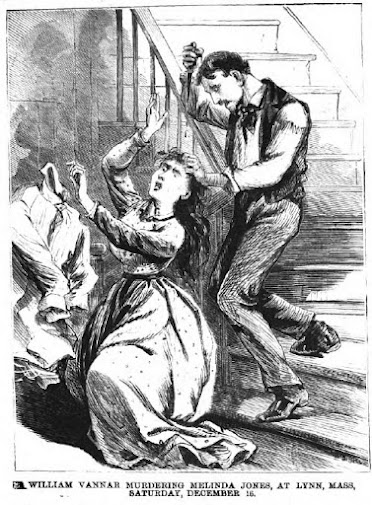
When William Vannar proposed to Melinda Jones in Washington, Maine,  in the late 1860s, relatives of both parties opposed the marriage. Vannar had returned from service in the 29th Regiment of Maine Volunteers with a bad drinking habit, and when Vannar was intoxicated, he became irrational and violent. The relatives feared the marriage would end in tragedy.

Melinda Jones (nee Luce) married Samuel Jones, a farmer, around 1859. The two had grown up together in Washington, Maine, and they had a happy marriage raising three children. But Samuel grew tired of farming and decided to go west and seek his fortune. In California, he had no luck prospecting and ended up working as a farmhand. At first, he would send Melinda small sums of money, but soon his letters stopped completely. Melinda made some inquiries and concluded that Samuel was dead. Not long after, she married William Vannar, another of her childhood friends.

As the relatives predicted, the marriage was a stormy one. There were periods of calm when the couple seemed happy, but Vannar could not stay sober, and when drunk, he would beat and abuse his wife. Four times she left Vannar and went home to her parents, but Melinda remained infatuated with Vannar, and each time she went back to him. 

In June 1871, Melinda had gone back to her parent’s home, and Vannar went to get her back. When she refused to go with him, he stabbed her in the breast. Her mother tried to intercede, and Vannar stabbed her as well. The wounds were not serious; Vannar was arrested for assault. He was released on $400 bond and fled the town. 

While on the run, Vannar would write and tell Melinda where he was. Four months after the incident, Vannar returned, and Melinda took him back as if nothing had happened. This time she abandoned her children and traveled with him to Lynn, Massachusetts, where Vannar’s sister lived.

Their time in Lynn followed the familiar pattern—periods of marital bliss punctuated by drunken abuse. The night of December 16, 1871, the couple attended a ball at Wyoma Square in Lynn. Allegedly, Vannar took jealous offense at the attention paid to Melinda by another man. The matter appeared to be forgotten the next morning. Vannar arose at 5:00, built a fire, and went out to buy some liquor. When he returned, they sat down to breakfast and were observed laughing and joking together about the previous night.

After breakfast, Vannar began drinking. His shirt had gotten dirty the night before, and Melinda said she would take it downstairs and wash it. He said he would hire someone to do it and save her the trouble. She took it downstairs anyway. Her disregard of his wishes infuriated Vannar, and he went down after her. A few minutes later, boarders in the house heard bloodcurdling screams coming from the basement. Mrs. Rodney, one of the boarders, saw Vannar come up the stair holding a knife, his clothing saturated with blood. He casually walked to the sink, washed his hands, cleaned his knife, and put it in his pocket. 

“Give my coat and gloves to my sister,” he said to Mrs. Rodney, “for she (meaning his wife) is dead now, and I have got to die.”

He went back downstairs, stepped over the corpse, and left through the back door. 

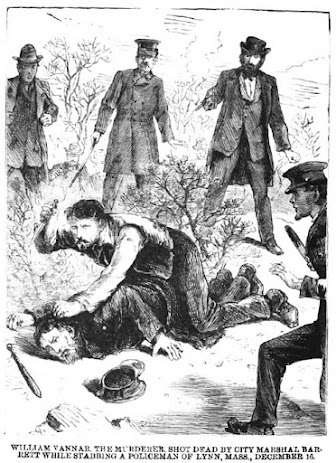
News of the murder traveled fast, and men turned out by hundreds to pursue Vannar. They had him cornered against a rock in the woods, but Vannar had his knife poised, ready to thrust, and no one would approach him. Officer John Thurston attempted to rush him with a club, but he slipped and fell. Vannar was on him instantly, dealing heavy blows with his knife. City Marshal, Daniel N. Barrett, drew his revolver and fired five shots, killing Vannar.

Officer Thurston suffered several stab wounds to the face and head and a bullet through his hand, but he survived the ordeal. A coroner’s inquest on December 21 ruled that Marshal Barrett’s action was justified.


Sources: 

“The Double Tragedy at Lynn Mass,” Illustrated Police News, December 28, 1871.
“The Lynn Tragedy,” National Aegis, December 23, 1871.
“News Article,” Gloucester Telegraph, December 20, 1871.
“News Article,” Evening Bulletin, December 26, 1871.
“The Recent Murder at Lynn Massachusetts,” Wheeling daily register, December 23, 1871.
“Tragedy in Lynn,” Republican journal, December 21, 1871.

Saturday, August 14, 2021

Piper and his Crimes.


Thomas Piper murdered three, including 5-year-old Mabel Young.  

Read the full story here: The Boston Belfrey Tragedy

Saturday, May 22, 2021

The Cannibal of Austerlitz.

Simon Vandercook was a 55-year-old “eccentric wanderer” from Lansingburgh, New York, a fortune seeker who relatives said was always filled with “utopian schemes.” In 1882, he claimed he had discovered gold outside of Alford, in Berkshire County, Massachusetts. Berkshire County had several small iron mines, with Marble and other minerals found there as well so a gold discovery was not considered impossible. Vandercook purchased the land for his gold strike from Oscar Beckwith in exchange for shares in the company he formed to mine the gold.

If Vandercook had actually discovered gold, the mine was not producing enough to sustain fulltime operation, and he earned money by cutting trees on the property and selling lumber. Beckwith believed he had been swindled and threatened to sue Vandercook.

Saturday, May 15, 2021

A Lovely Murderess.

The crack of gunfire startled the residents of 88 Merrimack Street, a boarding house in Lowell, Massachusetts, around 10:00, the night of  August 31, 1876. The boarders rushed to Lulu Martin’s room on the third floor, where the shot was fired. The door was locked; they heard a man inside shouting, “Go for the police! She has shot me! I will hold her! Break open the door!”

Saturday, January 16, 2021

Good News! Three Cheers!


The Hangman, a newspaper dedicated to the abolition of capital punishment, celebrated the commutation of Orrin DeWolf’s death sentence on September 9, 1845.

Did this young, drunken, diseased, conniving, duplicitous, murderous, libertine deserve mercy? You decide: Orrin DeWolf

Saturday, October 31, 2020

Two Shots, a Shriek.


“A dark, mean little bedroom, a woman, half-undressed, dirty and pale, and blear-eyed from long excesses, a male companion, leaning over her with a revolver at her head, two shots, a shriek, an ugly hole under the ear, and the vice and crime of Boston had added another murder to its long score.” The Boston Herald’s vivid description of the murder of Josephine Brown on Christmas Eve, 1891, served to underscore her sad and dismal life. Married and divorced by age twenty, Josephine’s family blamed her for the failed marriage and turned her away. Left to fend for herself, Josephine Brown spent the next twenty years as a prostitute.

Joe, as she was known on the street, had been working in a brothel run by Mrs. Mary Ann Fisher on Pitt Street, in Boston’s West End. The house had recently closed down with the arrest of Mrs. Fisher, and Joe was working as a street walker. The demise of Mrs. Fisher’s house meant more than the loss of shelter, it left Joe without protection from the potential violence of her profession, and without anyone to keep her away from whiskey, which, when she was left on her own, became Joe’s consuming passion.