Showing posts with label Nebraska. Show all posts

Saturday, May 18, 2024

The Boss Butcher.


On December 11, 1879, neighbors searching the Harelson farm in Kerney, Nebraska, found the bodies of Mrs. Harelson and her three children inside a haystack. There was little question as to the murderer's identity. Stephen D. Richards, who had been living with the Harelsons for the previous two weeks, told them that Mrs. Harelson and the children had gone to join her husband, a fugitive from justice. The neighbors were searching because they did not believe him.

By the time the bodies were found, Richards had sold the farm and fled the state. Sheriff S.L. Martin of Hastings, Nebraska, obtained some letters Richards had written to a woman there saying that he planned to meet her in Mt. Pleasant, Ohio. Richards took a circuitous route, and Martin tracked him to Omaha, Chicago, and other points. Martin nearly captured him in Chicago, but the press got wind of his arrival and published it in the newspaper, alerting Richards. He finally captured Richards as he was walking across a field in Mt. Pleasant in the company of two young women.

After his arrest, Richards confessed to murdering the Harelsons. He continued talking, and by his second day in jail, Richards, whom the Illustrated Police News dubbed “The Boss Butcher,” confessed to a total of nine murders. The Chicago Daily Tribune published his official confession:

I was born in Mt. Pleasant, Jefferson County, Ohio, and am a Quaker by birth and religion. I lived there with nothing eventful happening to me until three years ago when a desire to roam about took possession of me. I went West and have lived in Michigan, Iowa, Wisconsin, Kansas, Missouri, Colorado, and Nebraska. 

The first murder I committed was in Buffalo County, in the latter State, where I shot a man with whom I engaged in a quarrel. I afterward murdered another man in his own house, because he cursed me, beating his brains out with a hammer. I then went to Kearney. At that place there lived a Swede, a bachelor, on a farm by himself. He had plenty of money, and I went to live with him, and soon after which I poisoned him, but, as he did not die quick enough to suit me, I one night knocked his brains out with a club and took all his money.

This Mrs. Harelson, whom I murdered along with her three children, had a dissolute husband, and a short time ago, he went away and left her. I conceived the idea of murdering her and her children and then selling off everything she had and pocketing the proceeds. For this purpose, I told neighbors I was going to take Mrs. Harelson and her children to a neighboring town and for them to come over the next day and feed the stock. That night, I murdered them, hid their bodies under a haystack, and went away myself.

After two or three days, I returned and gave out that Mrs. Harelson had gone to join her husband and that I had bought everything she had. I accordingly sold out everything and, as I saw that I was suspected, left the place and came on Mt. Pleasant. It was on the 8th of December that I committed the murders.

Richards broke Mrs. Harelson’s jaw and smashed the back of her head with a smoothing iron. He dispatched the two oldest children the same way, then dashed the infant’s head against the floor.

Sheriffs Martin and Anderson of Kearney and Buffalo counties took him to Nebraska on December 24. They anticipated lynch mobs both in Ohio and Nebraska. As they waited for the train, Richards, in iron shackles and handcuffs, was heavily guarded. 

On the train, Richards maintained an attitude of cool indifference. When asked if he feared lynching, he said he would as soon die one way as another. He held his life of no account, and regarding those he killed, he said, “I placed others at about the same importance as hogs.”

As the train approached Kearney, the sheriffs heard that a large crowd had gathered at the depot. They feared a lynch mob but were also concerned about Richards's boast that the “secret society” he belonged to would be there to free him and take revenge on the lawmen.

They got off the train two miles east of Kearney and secured him in a wagon. Sheriff Anderson went to Kearney and addressed the crowd. He said that Sheriff Martin had taken him to Grand Island, and he would not be in Kearney until the following day. Martin had not taken him to Grand Island. After the crowd dispersed, he secretly took Richards to the Kearney jail.

The court issued three indictments against Richards for the murder of six people. He was tried on January 15, 1879, for the first-degree murder of Peter Anderson, the Swede he killed prior to the Harelsons. His plea was not guilty; he claimed he had killed Anderson in self-defense. The trial lasted two days, and after two hours of deliberation, the jury found him guilty. The judge immediately sentenced him to hang on April 26.

As execution day approached, Richards lost his cool attitude. The Reading Daily Eagle reported, “Lately, he has cried like a child and cannot sleep or eat, being so thoroughly unmanned through fear that it is thought he will have to be carried to the gallows.”

The hanging was to be held privately inside a high enclosure, but a mob quickly tore down the fence, and at least 2,500 people witnessed the execution. Richards regained his composure on the gallows and made a short address saying his soul was going to God and his body to the undertaker. Then, after a prayer by his spiritual advisor, he asked the crowd to join him in singing, “Come Thou Fount of Every Blessing.” 

The trap was sprung, and fifteen minutes later, Stephen D. Richards was dead.


Sources: 
“An Outlaw,” New Haven Evening Register, December 24, 1878.
“The Boss Murderer,” Illustrated Police News, January 4, 1879.
“By Mail and Telegraph,” READING DAILY EAGLE, December 23, 1878.
“Convicted and Sentenced for Murder,” Cincinnati Daily Gazette, January 17, 1879.
“A Cowardly Wretch,” READING DAILY EAGLE., April 26, 1879.
“Criminal News,” Chicago Daily Tribune., December 24, 1878.
“The Death Penalty,” Cincinnati Daily Gazette, April 28, 1879.
“A Desperado in Jail,” New York Herald., December 29, 1878.
“He Killed Children as He Would Rabbits,” New York Herald, January 7, 1879.
“The Nebraska Fiend,” Chicago Daily News, April 25, 1879.
“News Article,” Cincinnati Daily Star., December 23, 1878.
“Richards, The Murderer,” Canton Daily Repository., December 27, 1878.
“Richards, the Wholesale Murderer, Streteched Hemp Yesterday,” Cheyenne daily leader. [volume], April 27, 1879.

Saturday, September 9, 2023

Harry and Elizabeth.


Elizabeth Beecher married Henry King Jr. (known as Harry) in October 1886. Harry wanted to keep the marriage a secret from his father, a wealthy Chicago clothing wholesaler, so they lived under assumed names. The marriage was not a happy one, and the couple often fought. They separated for a while but could not stand to be apart. When Henry Sr. learned of the marriage, he offered Elizabeth $1,500 to give up all claims upon his son. Though her attorney advised her to take the money, Elizabeth stayed with Harry in Chicago.

In 1888, Harry moved to Omaha, promising to send Elizabeth money and bring her along when he was settled in business. The money stopped coming, so Elizabeth followed him to Omaha, only to learn he had married another woman. She and Henry spoke briefly in the parlor of the Paxton Hotel, then, as he turned to walk away, Elizabeth shot him four times in the back. Public sympathy was on Elizabeth’s side, and when the case went to trial, the jury deliberated for only thirty-five minutes before finding her not guilty.

Read the full story here: "I Have Shot my Husband."

Saturday, March 26, 2022

Salvation Army Tragedy.


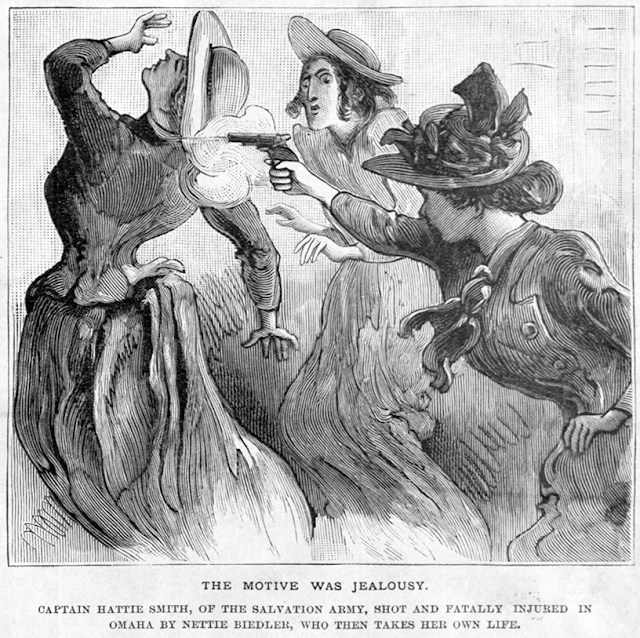
In November 1891, The Northwestern Division of the Salvation Army held a muster in Omaha, Nebraska, to honor "La Marechale" Catherine Booth-Clibborn, leader of the Salvation Army in France. When the afternoon session ended on November 14, Captain Hattie Smith from Oskaloosa, Iowa, walked down the sidewalk conversing with Captain Wallace of Marshalltown, Iowa. Nettie Biedler, a private in the Army, rushed up to them and, without speaking, drew a revolver from the folds of her dress and fired at Captain Smith. Smith let out a shriek and fled down the sidewalk with Wallace. Biedler followed and fired again. The first shot had wounded Smith and she fell to the ground after running less than a block. Biedler then put the revolver to her own head and fired. She died instantly.

Captain Smith had been stationed at Council Bluffs, Iowa before being transferred to Oskaloosa about a month before. Nettie Biedler was also from Council Bluffs and the press first believed jealousy was the motive for the shooting. Hattie Smith was engaged to Lieutenant Berry, of Boone, Iowa, and it was believed that Nettie Biedler was trying to steal him from her.

On her deathbed, Captain Smith explained that the motive was jealousy of another kind. Severely wounded, Smith was carried from the sidewalk to a drug store, then to her temporary boarding place. A physician examined her but pronounced the wound to be fatal. While still able to speak, Smith explained that she had known Nettie Biedler in Council Bluffs and induced her to join the Salvation Army. When they met again in Omaha, Biedler greeted her with a great show of affection and on several occasions sought to occupy the attention of Captain Smith to the exclusion of all others.

"It was a case of jealousy,” said Smith, “She was jealous because I didn’t talk to her more."

Lieutenant Mary Bannister said she carried a message from Biedler to Smith saying Biedler wanted to talk. Smith replied that she was too busy. After lunch, the two did meet for an extended talk but what was said is unknown. Lieutenant Bannister heard Smith say several times that she must go, and Biedler tried to stop her. Biedler said if Smith went out and left her there, she would be sorry for it.

A reporter went to Nettie Biedler’s home in Council Bluffs and spoke with her younger sister. She said that Nettie and Hattie had been fast friends and she knew of no trouble between the girls which might account for Nettie’s actions. She also had no idea that her sister owned a revolver.

Captain Hattie Smith died later that day. The motive for the murder was never fully explained. The Chicago Tribune summed it up as “…a queer combination of jealousy and semi-religious frenzy.”


Sources: 
“Bloody Deed at Omaha,” Chicago Tribune, November 16, 1891.
“The Motive Was Jealousy,” National Police Gazette, December 5, 1891.
“Salvation Army Tragedy,” Sioux City Journal, November 16, 1891.
“Shot by a Salvationist,” Saint Paul Globe, November 16, 1891.
“Was it Jealousy?,” Champaign Daily Gazette, November 16, 1891.

Saturday, April 3, 2021

"Yes, I Shot to Kill."


Commerce on the busy intersection  of Twenty-Fourth and J Streets, in Omaha, Nebraska, was interrupted, the evening of October 16, by the crack of three pistol shots. A young woman fired once in the air, trying to get the attention of the man who had just walked away from her. When he continued walking without turning around, she aimed at his back and fired again. Then she pointed the revolver at her own head and fired a third shot. Two bodies fell to the pavement.

Both were still alive and were quickly taken to Presbyterian Hospital. The man was Henry J. Reiser, a well-known, single, man-about-town, connected to the Armour meat packing company. The shot had severed his spinal cord, and he was not expected to live. The woman was Mrs. Eloise Rutiger, a prominent Omaha social leader, whose husband was also associated with Armour. The bullet had only grazed her head, and she was in no danger.

“Is he dead yet?” Mrs. Rudiger asked when she came to in the hospital, “Yes, I shot to kill. It was for my husband to do, but he would not, so I did it myself. The wretch has given me enough cause, and I hope I have accomplished what I undertook.”

Saturday, April 14, 2018

A Moment of Agony.

Albert E. Hauntstine had been a fugitive for nearly two weeks before being apprehended on November 22, 1888, in Columbus, Nebraska, by Platte County Sheriff Bloedorn. After his apprehension, Haunstine was described as “a harmless, innocent looking young man of about twenty-five.” But Haunstine’s mild appearance belied the brutal nature of his crime, he shot Hiram Roten and William Ashley in the head and tried to hide their bodies in a haystack on his farm in Broken Bow. A reward of $900 had been offered for his capture. When he was arrested Haunstine was armed with two Navy revolvers, a Winchester rifle, a derringer, and plenty of ammunition but was overpowered before he could make a move.

Haunstine admitted his guilt when captured and said that Roten had been one of his best friends but could offer no reason for the murders. The story came in from Broken Bow that Roten and Ashley were school officers in Custer County who went to see Haunstine on November 9, regarding their suspicion that he had stolen a clock and some furniture from the schoolhouse. Three days later Roten and Ashley had still not returned, and their friends began a search which ended in the haystack at Haunstine’s place. Both men had been shot through the head and Roten’s face had been badly eaten by hogs.

Saturday, April 7, 2018

“I Have Shot My Husband.”

An attractive young woman checked into the Paxton Hotel in Omaha, Nebraska, just before eight
o’clock the morning of November 17, 1888. Lewis Thomas, the elevator boy, took her to her room and as they rode in the elevator she asked him if Henry W. King was boarding at the hotel. When he answered yes she asked for his room number, and Thomas told her. Then she asked if a woman lived there with him. Thomas said yes and she responded angrily, “Well, the woman he is living with is not his wife.”

Saturday, December 30, 2017

Murder by Wholesale.

Little Murders
(From Portland Daily Press, December 25,1878)


Murder by Wholesale.

A Nebraska Man Confesses to Nine Murders.

Cincinnati, Dec. 21—A special from Steubenville says that Stephen D. Richards, who was placed in jail charged with the murder of the Harebon family at Kearney, Nebraska, has made a full confession acknowledging having committed nine murders within the last three years. The first murder was committed near Sand Hills, Nebraska. He had an altercation with a man unknown to him, and shot him through the head. The next was that of Mrs. Harebon and three children last October. He met Mrs. Harebon in jail, she having been arrested on a charge of aiding her husband to escape. When released, Richards visited her, staying two weeks when he concluded to murder her and take charge of her farm, which he had pre-empted. He broke her jaw and smashed the back of her head with a smoothing iron. He then killed the two oldest children with the same instrument, and seizing an infant dashed its head against the floor. He then gave out that Mrs. Harebon had gone to Texas to join her fugitive husband, but suspicion was aroused, search instituted, and the bodies found under a straw stack. Richards fled. Before the Herbon murder he was assisting a Swede named Peter Anderson in putting up a building. Anderson told some neighbors he believed Richards had poisoned him. The neighbors called next day but Anderson could not be found. Richards was in possession of Anderson’s horses and wagon. While the neighbors were searching the house for Anderson, Richards escaped. Richards admits he killed Anderson with a hammer. He states that he committed two other murders but refused to give the names of the victims. The sheriffs of Kearney and Buffalo counties will take Richards to Nebraska today. They think he is one of an organized gang of outlaws and cut-throats in that region.

Saturday, October 14, 2017

A Deliberate, Damnable Murder.

William B. Baldwin
Around 2:00 a.m., the morning of November 25, 1879, the citizens of Hastings, Nebraska, were awakened by frenzied cries of “fire!” The Burlington & Missouri Railroad Depot was burning. Firemen were dispatched to the blaze but, in the words of The Nebraska State Journal, Hastings had “as poor a Fire Department as could be well conceived.” The depot burned to the ground along with two freight cars, for a loss estimated at $20,000.

When the smoke cleared an even greater loss was revealed, the partially consumed body of Allen J. Yocum, a brakeman on the B&M line. Two other men at the scene Ralph M. Taylor, another brakeman, and William B. Baldwin, the telegraph operator at the depot said that an oil lamp had exploded and they managed to escape the fire. Baldwin expressed regret that he hadn’t tried harder to rescue Yocum.

But Baldwin and Taylor were clearly drunk when they were questioned and their stories were confused and contradictory. Witnesses stated that they had heard two or three gunshots prior to hearing the alarm. Rumors began to circulate that the fire was not accidental. Yocum’s body which was in the process of being transferred to his parents in Albia, Nebraska, was stopped in transit. A post-mortem examination revealed that Allen Yocum had two bullet wounds on his left side.

A coroner’s jury determined that Yocum had been murdered, shot by either Baldwin or Taylor. William Baldwin had a 22-caliber revolver which had recently been discharged. It was supposed that Baldwin had quarreled with Yocum and killed him, then set the fire attempting to hide the crime. He forced Taylor at gunpoint to keep quiet. “A Deliberate, Damnable Murder,” said The Nebraska State Journal.

But when the case went to trial the following June, the charge had been reduced, probably due to the circumstantial nature of the evidence. William B. Baldwin was found guilty of manslaughter and sentenced to ten years at hard labor in the Eastings Penitentiary.

Sources:
“Burned to Death,” The Nebraska State Journal, November 26, 1879.
“Caught By the Fire,” Chicago Tribune, November 26, 1879.
“A Hardened Villain,” National Police Gazette, November 27, 1880.
“The Hastings Affair,” The Nebraska State Journal, November 29, 1879.
“Murder and Arson,” Chicago Tribune, November 29, 1879.

Saturday, May 11, 2013

Guest Blogger: ExecutedToday.com

 
ExecutedToday.com recently celebrated its 2,000th consecutive day posting execution stories from all times and places—that’s every day since October 31, 2007. You’d think they would run out of material but there is no end in sight.
 
This is the second guest post from ExecutedToday.com and once again it is an honor to include one of their gallows tales on Murder by Gaslight. This one is a hanging in Nebraska for a murder that was never committed.

1887: William Jackson Marion, who’d be pardoned 100 years later

Originally posted on ExecutedToday.com March 25th, 2011 by Headsman
         
On this date in 1887, William Jackson Marion was executed in Nebraska for the murder of his best
friend, John Cameron.

Jackson had always upheld his innocence and his ignorance of Cameron’s fate; he was the picture of “utmost coolness” on the scaffold, declaring only “that I am a sinner, the same as other men. I have made no confession and have none to make. Go to the court dockets and see where men have been tried and acquitted and compare my case with them.”

And then, as given by the Gage County Democrat, the first, last, and only man hanged in Beatrice “stood erect upon the trap-door while his hands and feet were bound, the black cap drawn over his face, and the noose adjusted,” the trap sprung, and after a thousand-plus people had taken the opportunity to view this infamous corpse, it was buried in the potter’s field.

It was then 15 years since young “Jack” Marion and John Cameron had hauled out from Grasshopper Falls, Kansas, looking for work on a railroad.

Somewhere in the wilderness, John Cameron disappeared, and Marion returned to his mother-in-law’s saying his buddy had left. Marion’s whereabouts fade; he’s supposed to have drifted in Indian country: was it flight? It sure looked that way a year later, when a body turned up with clothes that matched Cameron’s … and bullet wounds in the head.

Saturday, July 24, 2010

The Great Sheedy Murder Case.

The evening of January 11, 1891, John Sheedy stepped out of the front door of his Lincoln, Nebraska home and was attacked by a man charging from the shadows. Sheedy was struck three times in the side of the head with a leather-covered steel cane. A powerful but controversial man, John Sheedy owned an illegal gambling casino and had enemies on both sides of the law. But when it was learned that the assailant may have been paid by Sheedy’s wife who delivered the death blow herself by poisoning his coffee, the unfolding tale of adultery, miscegenation, conspiracy, extortion, and murder threatened to undermine the social decorum and moral order of Lincoln.