Saturday, April 2, 2022

Who Killed Lottie Morgan?

Hurley, Wisconsin, a tough iron mining town, was the scene of many brutal crimes, but none more startling than the 1890 murder of Lottie Morgan. She was an actress who performed in variety theaters in Hurley and the surrounding area. Though she lived with Johnny Sullivan, a Hurley politician, she was known to have many lovers who kept her supplied with money and jewelry. Her arrangement with Sullivan may have been more about business than romance.

Lottie Morgan was well-known, well-liked, and reportedly one of the prettiest women on the range. Lottie was a prostitute, but newspapers used euphemisms to soften her notoriety—she was a courtesan, a sporting woman, one of the demimondes, of more than doubtful reputation. The Montreal River Mine and Iron County Republican said, “She carried herself with all the propriety possible for her class, was vivacious, sprightly, well informed, and was universally known here and at Ironwood and Bessemer.”

On the morning of April 12, 1890, the mutilated body of Lottie Morgan was found in the filthy alley between two low dives on Hurley’s main drag. She lay in a pool of coagulated blood with a deep gash in the side of her head, about 4 inches long, from the temple back. At her feet was her own 32 caliber revolver. A reporter found a bloodstained axe in a nearby shed, believed to be the murder weapon.

None could find a motive for the murder. Lottie was fully clothed when found and had not been molested. The police ruled out robbery because Lottie was still wearing her diamond earrings and other jewelry, valued at more than $5,000.

One of Lottie’s lovers was an ex-policeman, and some speculated that she was working as a police spy. The criminals who discovered her secret took their revenge.

The police and public favored another, more specific, theory. A recent nighttime robbery at the Hurley Iron Exchange Bank netted the thieves $39,000. Lottie had been subpoenaed to testify at the trial because the bank’s interior could be seen from the window of Lottie’s apartment. The court found Ed Baker and Phelps Perrin guilty of the robbery even without Lottie’s testimony, but they became the prime suspects in her murder.

Lottie Morgan’s elaborate funeral included a beautiful display of flowers and a procession featuring a brass band. The town raised nearly $200 to investigate the crime. A grand jury was convened to uncover the mysterious plot that led to Lottie’s murder.

But nothing was uncovered. In May, the County Board of Supervisors offered a $500 reward for the apprehension of the murders, but nothing came of this either. As time went on, the police and people of Hurley faced newer crimes and Lottie's case went cold. Lottie Morgan’s name disappeared from the newspapers and her unsolved murder was eventually forgotten.


Sources: 
“All over the State,” Vernon County Censor, April 13, 1892.
“Brained with an Ax,” St Paul daily globe, April 12, 1890.
“Brevities by Wire,” Aberdeen Daily News, April 12, 1890.
“Domestic,” Daily Inter Ocean, April 12, 1890.
“Found Murdered,” Erie Morning Dispatch, April 12, 1890.
“The Hurley Murder,” Bay City Times, April 12, 1890.
“A Hurley Murder,” Duluth News-Tribune, April 12, 1890.
“Lottie Morgan Murdered,” Montreal River Miner and Iron County Republican, April 10, 1890.
“Lottie Morgan's Murder,” Portage Daily Democrat, April 14, 1892.
“Murdering a Woman,” Milwaukee Journal, April 11, 1890.
“News of Wisconsin,” Boscobel Dial, May 26, 1892.
“To Cover a Crime,” Argus-Leader, May 17, 1890.
“Was She an Important Witness?,” Milwaukee Journal, May 14, 1890.
“Who Killed Lottie Morgan?,” Illustrated Police News, April 26, 1890.
“Who Killed Lottie Morgan?,” Detroit Free Press, April 12, 1890.
“Why Lottie was Murdered,” Wisconsin State Journal, May 14, 1890.

Saturday, March 26, 2022

Salvation Army Tragedy.


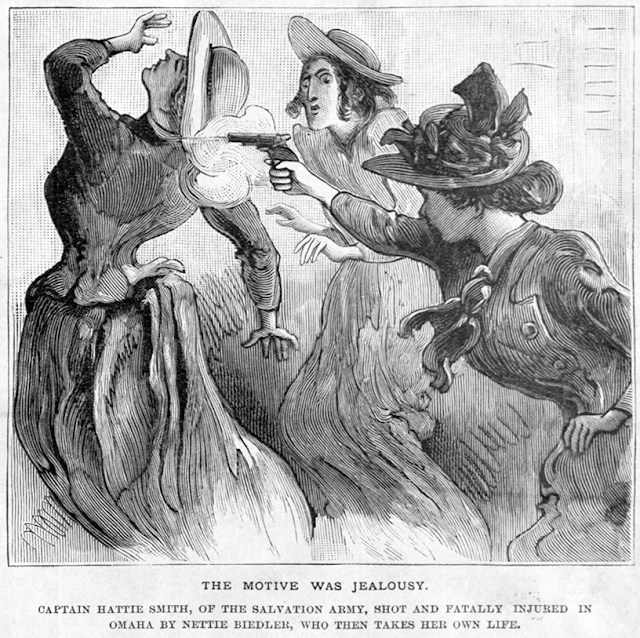
In November 1891, The Northwestern Division of the Salvation Army held a muster in Omaha, Nebraska, to honor "La Marechale" Catherine Booth-Clibborn, leader of the Salvation Army in France. When the afternoon session ended on November 14, Captain Hattie Smith from Oskaloosa, Iowa, walked down the sidewalk conversing with Captain Wallace of Marshalltown, Iowa. Nettie Biedler, a private in the Army, rushed up to them and, without speaking, drew a revolver from the folds of her dress and fired at Captain Smith. Smith let out a shriek and fled down the sidewalk with Wallace. Biedler followed and fired again. The first shot had wounded Smith and she fell to the ground after running less than a block. Biedler then put the revolver to her own head and fired. She died instantly.

Captain Smith had been stationed at Council Bluffs, Iowa before being transferred to Oskaloosa about a month before. Nettie Biedler was also from Council Bluffs and the press first believed jealousy was the motive for the shooting. Hattie Smith was engaged to Lieutenant Berry, of Boone, Iowa, and it was believed that Nettie Biedler was trying to steal him from her.

On her deathbed, Captain Smith explained that the motive was jealousy of another kind. Severely wounded, Smith was carried from the sidewalk to a drug store, then to her temporary boarding place. A physician examined her but pronounced the wound to be fatal. While still able to speak, Smith explained that she had known Nettie Biedler in Council Bluffs and induced her to join the Salvation Army. When they met again in Omaha, Biedler greeted her with a great show of affection and on several occasions sought to occupy the attention of Captain Smith to the exclusion of all others.

"It was a case of jealousy,” said Smith, “She was jealous because I didn’t talk to her more."

Lieutenant Mary Bannister said she carried a message from Biedler to Smith saying Biedler wanted to talk. Smith replied that she was too busy. After lunch, the two did meet for an extended talk but what was said is unknown. Lieutenant Bannister heard Smith say several times that she must go, and Biedler tried to stop her. Biedler said if Smith went out and left her there, she would be sorry for it.

A reporter went to Nettie Biedler’s home in Council Bluffs and spoke with her younger sister. She said that Nettie and Hattie had been fast friends and she knew of no trouble between the girls which might account for Nettie’s actions. She also had no idea that her sister owned a revolver.

Captain Hattie Smith died later that day. The motive for the murder was never fully explained. The Chicago Tribune summed it up as “…a queer combination of jealousy and semi-religious frenzy.”


Sources: 
“Bloody Deed at Omaha,” Chicago Tribune, November 16, 1891.
“The Motive Was Jealousy,” National Police Gazette, December 5, 1891.
“Salvation Army Tragedy,” Sioux City Journal, November 16, 1891.
“Shot by a Salvationist,” Saint Paul Globe, November 16, 1891.
“Was it Jealousy?,” Champaign Daily Gazette, November 16, 1891.

Saturday, March 19, 2022

Inhumanly Murdered.


The morning of October 27, 1845, the body of Maria Bickford, a beautiful young prostitute, was found murdered in her room in Boston’s Beacon Hill. Her throat had been cut from ear to ear and her bed had been set on fire. The prime suspect was Albert Tirrell who had been keeping Maria and who was seen arguing with her the day before. 

Tirrell was represented in court by prominent attorney and former US Senator, Rufus Choate, who won an acquittal with the first successful use of the sleepwalking defense.

Read the full story here:

Saturday, March 12, 2022

A Deathbed Marriage.


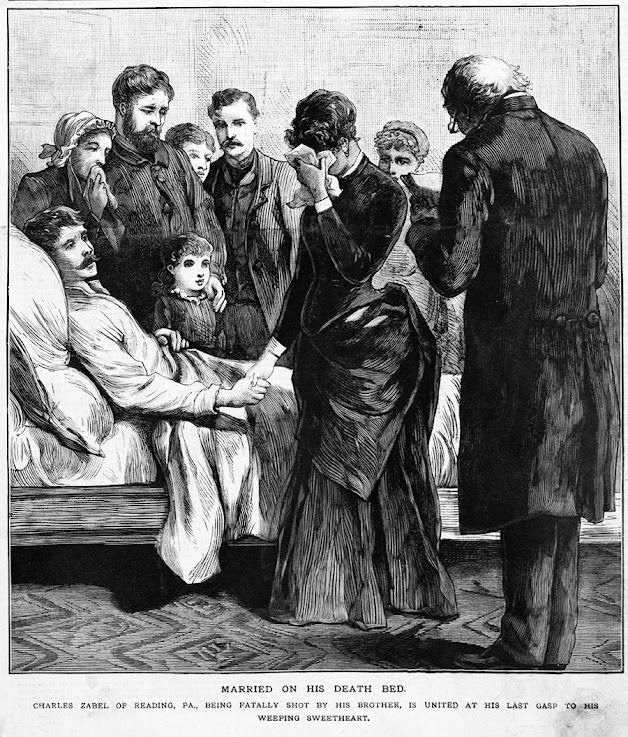
Frank and Charles Zabel lived with their widowed mother in Reading, Pennsylvania. Though in modest circumstances, the family lived happily together. Everything changed on June 5, 1886, when 18-year-old Frank Zabel, for reasons never made clear, fired three shots into his brother’s chest then attempted suicide by desperately wounding himself.

Both brothers were in critical condition, but it was soon apparent that Charles would not survive. Charles was engaged to Salome Reeser; the marriage was to occur a few weeks later. As Charles lay on his deathbed, the couple decided to marry immediately. Rev. Dr. J.J. Kuendig, pastor of St. John’s Lutheran Church, came to the house, and as Salome stood sobbing by the bed, he performed the service. Charles died the following afternoon, leaving both his mother and his bride prostrate with grief so severe that they both required the care of a physician.

The coroner’s inquest charged Frank Zabel with the murder of his brother Charles. Frank was still bedridden, so the police put the house under surveillance until he was well enough for prison. The only explanation the family could provide for Frank’s behavior was that, on the day of the murder, Frank had taken an overdose of a drug used for dyspepsia, which affected his mind, causing him to commit murder and attempt suicide.

The district attorney sent the drug to be analyzed by a chemist to see if the claim was justified. The result of the analysis was not strong enough for him to drop the murder charge against Frank Zabel, but when the case went before a jury the following March, Zabel was acquitted on the grounds of insanity.


Sources: 
“Berks County Murder Cases,” Patriot, December 11, 1886.
“Current Events,” Daily Gazette, June 7, 1886.
“In General,” Delaware gazette and state journal, March 31, 1887.
“Married and Died,” Plain Dealer, June 7, 1886.
“Married on his Death Bed,” National Police Gazette, June 26, 1886.
“News Summary,” Delaware Republican, June 8, 1886.
“The Zabel Tragedy,” Patriot, June 8, 1886.

Saturday, March 5, 2022

The Shooting of Albert Richardson.


On the afternoon of November 25, 1869, Daniel McFarland walked into the office of the New York Tribune and there shot and killed Albert Richardson, a Tribune editor. Richardson had planned to marry Daniel McFarland’s ex-wife, Abby Sage McFarland. The facts of the murder were irrefutable, but the trial that followed focused instead on the behavior of Abby McFarland. Was her adultery an attack on the sanctity of marriage that drove Daniel McFarland to murderous insanity? Or had she been justified in leaving a drunken, abusive husband, running to the safety of another man’s arms?

Read the full story here: The Richardson-McFarland Tragedy.

Thursday, March 3, 2022

Free Thrillers and Killers!


Download Free Mystery, Suspense, and Thriller Books:

Thrillers and Killers Giveaway 

Tuesday, March 1, 2022

Free Historical Mysteries!


Download free historical mysteries!

Historical Thriller and Mystery Giveaway

Saturday, February 26, 2022

Seduction and Murder.

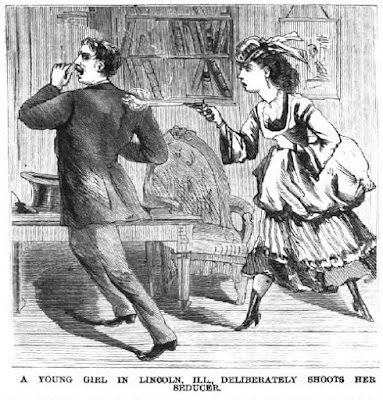
In November 1871, 18-year-old Mary Ann Sevindell filed a lawsuit against Henry H. Howell of Prairie Creek, Illinois, for seduction. They were both in the law office of Beason & Bilan in Lincoln, Illinois, on November 28, where attorneys were hammering out a settlement agreement. The lawyers came up with a compromise that pleased them, but apparently, it did not please Miss Sevindell. As Howell was leaving to have the agreement acknowledged, Mary Anne drew a pistol and without saying a word, shot him in the back. The bullet came out at the left breast.

Dazed, Howell walked a few steps then unbuttoned his vest and saw blood oozing from the wound. He saw the bullet on the floor, picked it up and handed it to one of the gentlemen in the room. He remarked that he was killed then sank to the floor.

It does not appear that Mary Ann Sevindell was ever charged with Howell’s murder.


Sources: 
“Seduction and Murder,” Plain Dealer, November 1, 1871.
“A Young Girl in Lincoln, Ill., Deliberately Shoots her Seducer,” Illustrated Police News, November 30, 1871.

Saturday, February 19, 2022

The Long Island Tragedy.

A series of violent home invasions in and around Brookville, Long Island in November 1883 and the months that followed left two people dead and four more seriously injured. The normally serene farming community was thrown into a state of confusion with at least a dozen false arrests, two perjured eye-witnesses, a false confession, lynch mobs, a jailbreak, and for a time, two independent and equally valid lines of inquiry that could not be reconciled.

Read the full story here: The Long Island Murders.

Saturday, February 12, 2022

A Double Tragedy.

When William Vannar proposed to Melinda Jones in Washington, Maine,  in the late 1860s, relatives of both parties opposed the marriage. Vannar had returned from service in the 29th Regiment of Maine Volunteers with a bad drinking habit, and when Vannar was intoxicated, he became irrational and violent. The relatives feared the marriage would end in tragedy.

Melinda Jones (nee Luce) married Samuel Jones, a farmer, around 1859. The two had grown up together in Washington, Maine, and they had a happy marriage raising three children. But Samuel grew tired of farming and decided to go west and seek his fortune. In California, he had no luck prospecting and ended up working as a farmhand. At first, he would send Melinda small sums of money, but soon his letters stopped completely. Melinda made some inquiries and concluded that Samuel was dead. Not long after, she married William Vannar, another of her childhood friends.

As the relatives predicted, the marriage was a stormy one. There were periods of calm when the couple seemed happy, but Vannar could not stay sober, and when drunk, he would beat and abuse his wife. Four times she left Vannar and went home to her parents, but Melinda remained infatuated with Vannar, and each time she went back to him. 

In June 1871, Melinda had gone back to her parent’s home, and Vannar went to get her back. When she refused to go with him, he stabbed her in the breast. Her mother tried to intercede, and Vannar stabbed her as well. The wounds were not serious; Vannar was arrested for assault. He was released on $400 bond and fled the town. 

While on the run, Vannar would write and tell Melinda where he was. Four months after the incident, Vannar returned, and Melinda took him back as if nothing had happened. This time she abandoned her children and traveled with him to Lynn, Massachusetts, where Vannar’s sister lived.

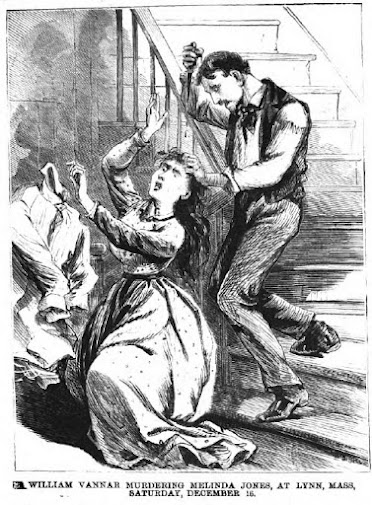
Their time in Lynn followed the familiar pattern—periods of marital bliss punctuated by drunken abuse. The night of December 16, 1871, the couple attended a ball at Wyoma Square in Lynn. Allegedly, Vannar took jealous offense at the attention paid to Melinda by another man. The matter appeared to be forgotten the next morning. Vannar arose at 5:00, built a fire, and went out to buy some liquor. When he returned, they sat down to breakfast and were observed laughing and joking together about the previous night.

After breakfast, Vannar began drinking. His shirt had gotten dirty the night before, and Melinda said she would take it downstairs and wash it. He said he would hire someone to do it and save her the trouble. She took it downstairs anyway. Her disregard of his wishes infuriated Vannar, and he went down after her. A few minutes later, boarders in the house heard bloodcurdling screams coming from the basement. Mrs. Rodney, one of the boarders, saw Vannar come up the stair holding a knife, his clothing saturated with blood. He casually walked to the sink, washed his hands, cleaned his knife, and put it in his pocket. 

“Give my coat and gloves to my sister,” he said to Mrs. Rodney, “for she (meaning his wife) is dead now, and I have got to die.”

He went back downstairs, stepped over the corpse, and left through the back door. 

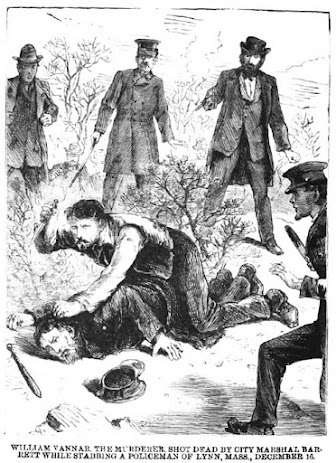
News of the murder traveled fast, and men turned out by hundreds to pursue Vannar. They had him cornered against a rock in the woods, but Vannar had his knife poised, ready to thrust, and no one would approach him. Officer John Thurston attempted to rush him with a club, but he slipped and fell. Vannar was on him instantly, dealing heavy blows with his knife. City Marshal, Daniel N. Barrett, drew his revolver and fired five shots, killing Vannar.

Officer Thurston suffered several stab wounds to the face and head and a bullet through his hand, but he survived the ordeal. A coroner’s inquest on December 21 ruled that Marshal Barrett’s action was justified.


Sources: 

“The Double Tragedy at Lynn Mass,” Illustrated Police News, December 28, 1871.
“The Lynn Tragedy,” National Aegis, December 23, 1871.
“News Article,” Gloucester Telegraph, December 20, 1871.
“News Article,” Evening Bulletin, December 26, 1871.
“The Recent Murder at Lynn Massachusetts,” Wheeling daily register, December 23, 1871.
“Tragedy in Lynn,” Republican journal, December 21, 1871.

Saturday, February 5, 2022

Obsession.


James M. Dougherty was an industrious young man in Brooklyn in the 1880s. He worked as a lineman for the Postal Telegraph Company and in his spare time he studied meteorology, electricity, astronomy and other sciences. He dabbled in a little of everything until after watching a play he became obsessed with the leading lady, Mary Anderson, and his love for her became his sole controlling passion.

Dougherty began to follow Mary Anderson wherever she performed. His obsession with the actress led him to believe that an organized conspiracy of his enemies worked to keep them apart. When Dougherty's stalking came to the attention of the police, he was declared insane and sent to an asylum.

He escaped from the asylum, but returned with a revolver and murdered the superintendent. 

“I am not crazy,” said Dougherty after his recapture, “but as sane as the sanest man that walks New York today.”

Read the full story here: Lunatic Dougherty.

Saturday, January 29, 2022

Concealing his Bloody Work.


In April 1866, Antoine Probst murdered eight men, women, and children with an axe and a hammer, on the Deering farm outside of Philadelphia. He arranged the bodies in straight rows and covered them with hay.

Read the full story here: Horror!

Thursday, January 27, 2022

Her Struggle was Useless.

Artist's rendition of the Pearl Bryan murder from The Mysterious Murder of Pearl Bryan, Or, The Headless Horror. Cincinnati: Barclay & Co., 1896.

Read Pearl Bryan's story in the new book,


Now available at Amazon.


Saturday, January 22, 2022

A Brutal and Cowardly Murder.


The Nicholsons of San Francisco owned some farmland near Watsonville in Monterey County, California. In 1873, Mrs. Sarah Nicholson spent all of her time there, working the farm while her husband traveled back and forth from San Francisco, where he had a carriage business.

Two years earlier, they bought the land from Matt Tarpey, a wealthy landowner and a big man in Monterey County politics. Tarpey was a well-known bully and desperado—“a brawling, profane, cowardly ruffian, with but few redeeming traits,”  said the San Francisco Chronicle. He was caught trying to rig an election by forging nationalization papers of immigrants. Twice Tarpey was accused of murder. In one case, he used his political influence to have the charges dropped; in the other, he was acquitted after allegedly bribing jurors.

Tarpey claimed the Nicholsons were behind in their payments for the land, and he wanted it back. In March 1873, Tarpey moved an old frame house from an adjacent property he owned onto the Nicholsons’ land and situated it about a quarter-mile from their farmhouse. He built a fence around the house and rented it to a man named Peterson.

Her husband was away when Mrs. Nicholson learned of the new house on her property, so she rode into town to consult with her lawyer. He told her that since she held the deed, she could not be driven out without legal process. If Tarpey moved a house onto her land, she had a right to take possession of it. The next day, she went to the house, accompanied by a young man named O’Neill and a boy who worked on the farm. 

When Peterson came by, he was surprised to find the house occupied. He demanded that they leave, but Mrs. Nicholson told him she was in possession of the house. If he had any grievance, he should talk to Tarpey.

That evening Tarpey buckled on a six-shooter, grabbed his Henry rifle, and started for the house. On the way, he stopped and borrowed a double-barreled shotgun. Behind a big oak tree on his property, he dug a hole where he could observe the house without being seen. After midnight that night, Tarpey fired six or seven shots in quick succession into the house. The occupants of the house were unarmed and, in a terrible fright, ran back to the Nicholson farmhouse. 

The next morning they went back to see what damage had been done. As they approached the house, Tarpey stepped into the roadway holding the shotgun. Mrs. Nicholson was startled but recovered herself and said, “Good morning, Mr. Tarpey.”

“Now, you d----d w----, I’ve got you.” Said Tarpey as he raised the shotgun and pulled the trigger. The gun clicked but did not go off.

“For God’s sake, Mr. Tarpey, take the whole thing, but do not murder me.” Said Mrs. Nicholson. 

Tarpey aimed the gun, and it clicked again. Terrified, she seized hold of O’Neill and said, “Come let us run; he’ll kill us both.”

As she turned to run, Tarpey fired again and this time the gun went off. Nine shots penetrated her back, and one went straight through her heart. Sarah Nicholson uttered a piercing scream and fell dead. O’Neill went to pick her up when the boy shouted, “Look out! He is going to shoot you.”

O’Neill ran; Tarpey fired again but missed. Tarpey turned to the boy and said, “Look out, I’m going to shoot you, too.”

The boy ran, and Tarpey did not fire.

As Tarpey walked toward Watsonville, he reflected on what he had done. He decided the best thing to do was turn himself in and claim the shot had been an accident. Constable Schade received Tarpey’s surrender but did not disarm him. Tarpey promised he would leave his weapons at his home in Watsonville, so they went there. When they got there, Tarpey changed his clothes and had breakfast, then buckling on his revolver, he went into the street, swaggering about and explaining the matter to friends he met. He stopped at the barbershop and had a shave, then told Schade he was ready to be taken to Salinas City.

As news of the shooting spread around the community, Schade was worried they might encounter some trouble on the road. They took a wagon back to Tarpey’s house to get his rifle before proceeding.

Someone telegraphed the news to Sheriff Wasson in Salinas, and he met the wagon a few miles outside of town. The sheriff took custody of Tarpey and disarmed him. He decided that the Salinas jail was not strong enough to prevent a mob from breaking in, so he planned to take the prisoner to Monterey.

As Schade had done, Sheriff Wasson first allowed Tarpey to march around town into barrooms telling his story. He even made a public speech describing the deed, trying to convince the crowd that the shooting had been accidental. 

When Tarpey was safely in jail in Monterey, an inquest was held on the murder. Two witnesses, O’Neill and the boy told what had happened that morning. That night the whole population of Watsonville turned out for a public meeting to express sorrow for the victim and denounce the murderer. They decided that they could not trust the legal system and decided to seek justice themselves. One old gray-haired gentleman named Slankard, who had known Mrs. Nicholson for many years, got up and said, “Gentlemen, if you permit this murderer to go unhanged twenty-four hours longer, you are all cowards.”

The people agreed, and in small groups, set off for Monterey. The crowds increased, coming from two counties, and by the time they reached Monterey jail, they were four hundred strong. A dozen or so men apologized to the sheriff then bound him hand and foot. With sledgehammers, they broke into Tarpey’s cell. They carried him to a wagon that contained a pine box and a long hemp rope. 

They took him about three miles outside of town and told him he had half an hour to arrange his worldly affairs and prepare himself for death. He dictated a brief will to a lawyer in the crowd then, on his knees, begged for his life. When the leader told him his time had come, Tarpey said, “Well, I’m ready, but you are committing murder.”

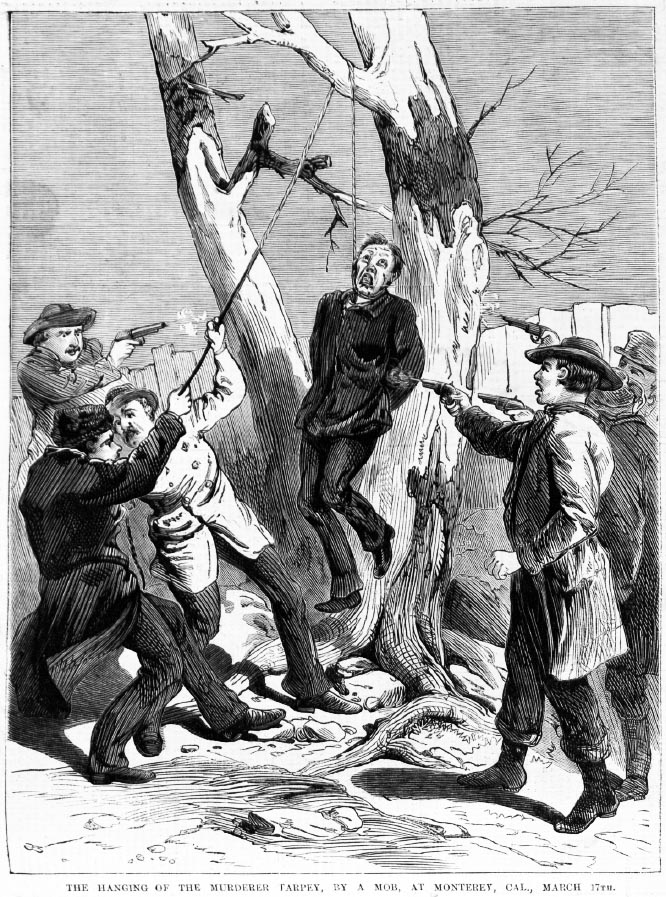
They threw the rope over the limb of a tree and tied a noose around Tarpey’s neck. They had him stand on his coffin as they drove the wagon forward. Tarpey fell, but the fall did not break his neck. The new rope stretched so much that his toes were touching the ground. Men from the mob grabbed the rope and pulled him up by force. Tarpey swung another ten minutes. Reportedly, some of the men shot at Tarpey as he slowly strangled to death.

In the days that followed, the authorities vowed to arrest those responsible for the lynching. Newspapers printed editorials half-heartedly denouncing vigilante justice, but the people of Monterey County were satisfied that Sarah Nicholson’s murder had been justly avenged. 


Sources: 
“Brutal and Cowardly Murder,” Gold Hill daily news, March 17, 1873.
“By State Telegraph,” Sacramento Daily Union, March 18, 1873.
“Cowardly Murder,” San Francisco Bulletin, March 14, 1873.
“The Hanging of the Murderer Tarpey,” Illustrated Police News, April 3, 1873.
“The Lane with a Turn in It,” San Francisco Bulletin, March 17, 1873.
“News Article,” Carson daily appeal, March 20, 1873.
“News of the Morning,” Sacramento Daily Union, March 17, 1873.
“The Tarpey Brothers in the Field,” Sacramento Daily Union, March 26, 1873.
“Tarpey Hanged,” San Francisco Chronicle, March 18, 1873.
“Telegraphic Dispatches,” Ely record, March 15, 1873.
“The Watsonville Tragedy,” San Francisco Bulletin, March 15, 1873.
“The Woman-Murderer,” San Francisco Chronicle, March 17, 1873.

Wednesday, January 19, 2022

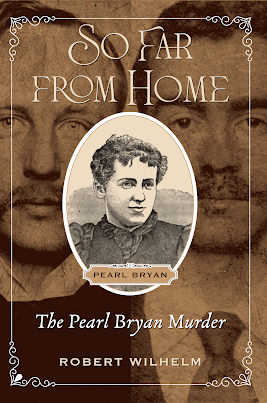
So Far from Home.


New Book!

So Far from Home 

The Pearl Bryan Murder


"Yes. they drove far from the city,
To a place so far from home,
There they left her body lying
Headless and all stained with blood"
 Pearl Bryan (Traditional Ballad)

Available at Amazon.

Saturday, January 15, 2022

The Ging Murder Case.


Harry Hayward, "The Plotter," was a handsome young playboy from a wealthy Minneapolis family. An inveterate gambler, he would finance his habit through theft, insurance fraud, and counterfeit currency.

Hayward was thought to have hypnotic powers. He persuaded Catherine Ging, "The Victim," to make him the beneficiary on a life insurance policy, then, on December 3, 1894, he lured her to a meeting with Claus Blixt, "The Assassin" – also acting under Hayward’s spell. As Catherine Ging was being murdered, Harry Hayward sat in a Minneapolis theatre watching a play with another woman. 

Read the full story here: The Minneapolis Svengali.

Thursday, January 13, 2022

Pearl Bryan.


Pearl Bryan.


Murder victim Pearl Bryan was the belle of Greencastle, Indiana. She was popular among her peers and admired by all who knew her. Pearl was a girl of the most amiable disposition. Too amiable in fact, said her friends, and inclined to yield to the requests or urgings of others.

Though friendly and outgoing, Pearl kept her personal life private. When Pearl learned she was pregnant, she told no one but her second cousin, Will Wood.

Will Wood was Pearl’s confidant, but he was not to be trusted. He was a rude braggart who boasted of his sexual relations with Pearl. The Cincinnati Enquirer summed up Will Wood’s Greencastle reputation saying, “The youth is generally recognized as a cigarette fiend of unbalanced mind and of a totally depraved nature.” Many in Greencastle believed that Will Wood was the father of Pearl’s unborn child and was ultimately responsible for her death.
Will Wood

So Far from Home: 

The Pearl Bryan Murder

by Robert Wilhelm


Saturday, January 8, 2022

"I Caught Them in the Act."

C. F. Stephens owned a store in Livingston, Georgia about 12 miles from Rome. He employed Frank Wilkerson as a clerk in his store and provided him with room and board in his home.

Stephens was increasingly unhappy with this arrangement, and he sensed that things were not right in his house. He heard rumors that Wilkerson and his wife, Jessie, were intimate, and he found letters from Wilkinson to Jessie that appeared to confirm this.

Stephens wanted to find out for sure, so the morning of July 12, 1892, he told Jessie that he was going to Rome and would be back at 3:00 that afternoon. Instead, he returned home at 2:00. Stephens hitched his horse about half a mile from his house and walked home. He entered through the back door and took off his shoes so no one would hear his footsteps. 

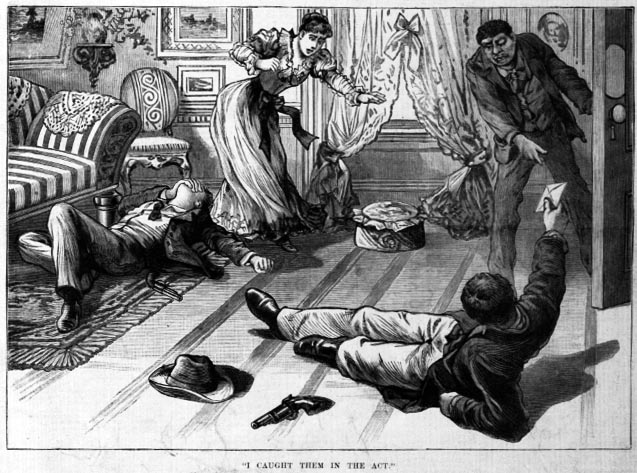
The bedroom door was closed. When Stephens opened the door, he found Wilkerson and his wife in a compromising position. He drew his revolver and shot twice, wounding Wilkerson. Stephens had only two bullets in his pistol, so he grabbed Wilkerson and pulled him to the floor. Wilkerson drew his pistol and shot twice; one of the bullets hit Stephens between the eyes, and he died a few minutes later.

Before he died, Stephens took the incriminating letters from his pocket and wrote on one, “I caught them in the act. C. F. Stephens.” He gave the letters to his manservant, saying, “Take these to my father. They tell a tale.”

Mrs. Stephens tried to grab the letters, but the servant left with them. She and Wilkerson were both arrested.

The trial of Frank Wilkerson the following October in Troy, Georgia, caused a sensation due to the prominence of the Stephens family. The courtroom was packed every day. More than sixty witnesses testified, but there was very little hard evidence beyond the obvious facts of the case. The debate centered on the incidents that led to the murder and the motives of those involved.

Several prosecution witnesses testified to having caught Wilkinson and Jessie Stephen in “a questionable attitude.” One testified that Stephens had not meant to kill Wilkerson, just to scare him. He had told Wilkerson to leave several times, but Wilkerson said that would be over Stephen’s dead body. Others testified that Wilkerson had intended to murder Stephens at the first opportunity and that Mrs. Stephens knew of his plans.

When Frank Wilkerson testified, his voice was so soft he could not be heard from 10 feet away and had to pause and weep several times. He said no one regretted the killing more than he did, but when Stephens started firing, he had nowhere to go and had to shoot back. He denied ever having intimate relations with Mrs. Stephens. When Stephens caught them, they were standing and talking about his leaving the house. The letters were just thanking Mrs. Stephens for some advice she had given him. 

Jessie Stephens also denied any intimacy with Wilkerson, but she did say she loved him more than her husband. She said the handwriting on the letter was not her husband’s, but Deputy Sheriff McConnell, who had known Stephens from boyhood, said the signature was definitely his.

The jury convicted Frank Wilkerson of voluntary manslaughter. 

Following the conviction, a grand jury indicted Jessie Stephens for adultery and accessory to murder. She fled the city before the police could take her into custody.


Sources: 
“Summary of the News,” Sun, October 21, 1892.
“'I Caught Them in the Act',” Illustrated Police News, July 30, 1892.
“The Defendant Testifies,” Atlanta Journal, October 15, 1892.
“Didn't Desire His Blood,” Atlanta Journal, October 12, 1892.
“In the Southern States,” Dallas Morning News, July 19, 1892.
“Killed by His Wife's Lover,” Morning News, October 12, 1892.
“Killed by His Clerk,” Morning News, July 13, 1892.
“Mrs. Stephens Must Stand Trial,” Morning News, October 22, 1892.
“The Murderous Result,” Daily State Chronicle, July 14, 1892.
“She Loved Wilkinson,” Morning News, October 15, 1892.
“Wilkerson on Trial,” Atlanta Journal, October 11, 1892.

Wednesday, January 5, 2022

Alonzo Walling.


Scott Jackson
Courtesy of The Cincinnati Enquirer

Alonzo Walling, Scott Jackson’s roommate, was arrested in February 1896 as Jackson’s accomplice in the murder of Pearl Bryan. Cincinnati phrenologist Dr. S. E. Hyndman analyzed Walling’s character by measuring his head and came to this conclusion:
“Alonzo Walling is easily led in the direction of friendship and in this, he would often do things which his better nature would revolt against. He would not go back on a friend until the very last, and then only to save his own life if he had promised to stand by him. He likes the society of the viscous better than that of the higher order. He would plunge into danger and calculate the chances afterward. His standard of morals is not of a higher order, his perceptive powers are small and if he were to be influenced, he would have to be managed through flattery.”


Walling’s involvement in the case was always somewhat shadowy, he was accused of actively participating in Pearl Bryan’s murder, but he may have been little more than a knowing but innocent bystander. The public saw Walling as dull, weak-willed, and subservient to Jackson against his own best interest. Whatever his connection was to the murder, he kept the secret to himself and stood by his roommate to the end.


Saturday, January 1, 2022

The Tragic Benham Mystery.


In 1892, Florence Tout, age 15, defied her parents and eloped with 23-year-old Howard Benham. Benham took control of Florence’s trust fund and five years later she died under suspicious circumstances.

Read the full story here: Married at 15, Dead at 20.